Viburnum opulus L.
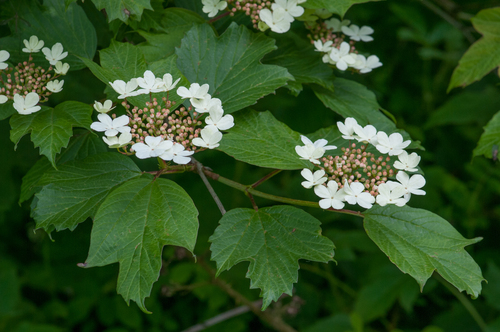
Source: Wikipedia
Synonyms 39
- 614,949 GBIF occurrences
- 94,727 iNaturalist observations
Records of the species are numerous (GBIF.org 2024) and there is currently no indication of widespread decline.
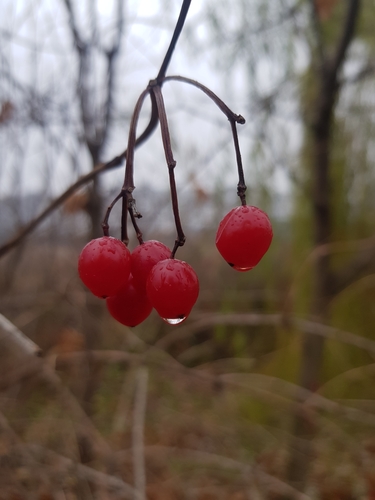
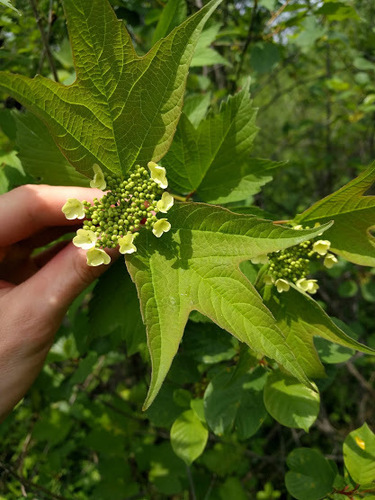
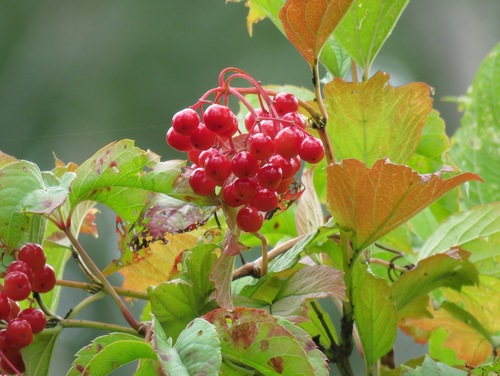
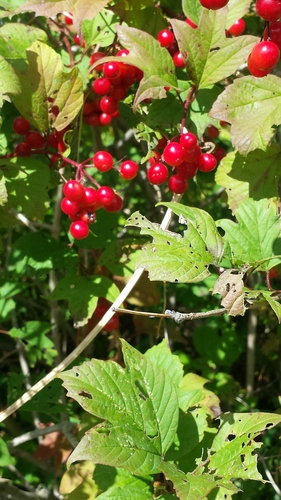
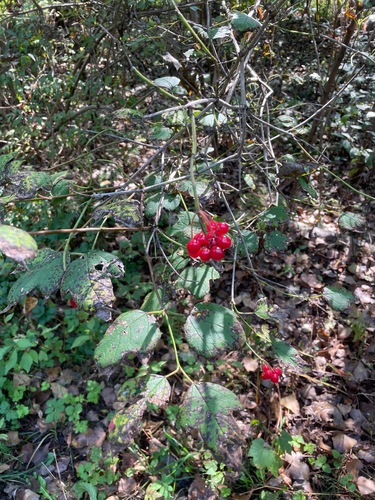
A deciduous shrub found in woodlands, humid forests, scrub, hedgerows, fens, stream banks and damp places growing on wet neutral or calcareous soils producing white flowers and red berries from June to July. It is also commonly planted in gardens and parks (Blamey and Grey-Wilson 2003, Botanical Society of Britain and Ireland 2024).
There are no significant threats to this species.
There are no conservation measures in place or needed. It is listed as Least Concern in Denmark (Aarhus Universitet 2019), Estonia (eElurikkus 2024), Germany (Ludwig and Schnittler 1996), Luxembourg (Colling 2005), Norway (Artsdatabanken 2024), Switzerland (Moser et al. 2002) and the United Kingdom (Cheffings and Farrell 2005).The species is represented by 103 germplasm accessions held at European institutions (EURISCO 2024) and is included in the living collection of at least 239 botanical gardens (BGCI 2024). It occurs in many protected areas, including Natura 2000 sites (UNEP-WCMC and IUCN 2024, GBIF.org 2024).
European regional assessment: Least Concern (LC) EU 27 regional assessment: Least Concern (LC)This species is classified as Least Concern due to its widespread distribution, stable populations and no major threats.
Gallery