Upupa epops Linnaeus, 1758
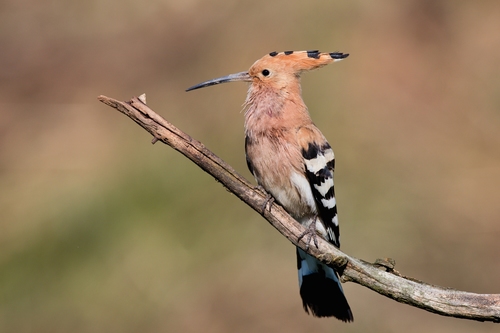
Source: Wikipedia
Synonyms 4
- 1,294,254 GBIF occurrences
- 52,020 iNaturalist observations
The European breeding population is estimated at 1,370,000–3,210,000 pairs (2,740,000–6,410,000 mature individuals). The breeding population in the EU28 is estimated at 1,070,000–2,500,000 pairs (2,140,000–4,990,000 mature individuals). For details of national estimates, see the Supplementary Information.
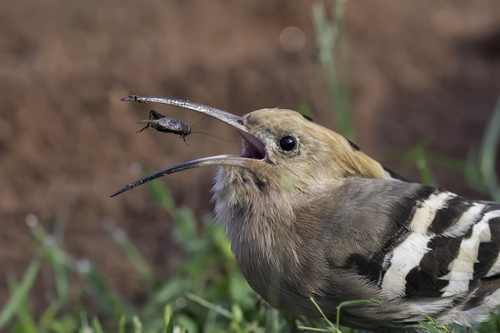
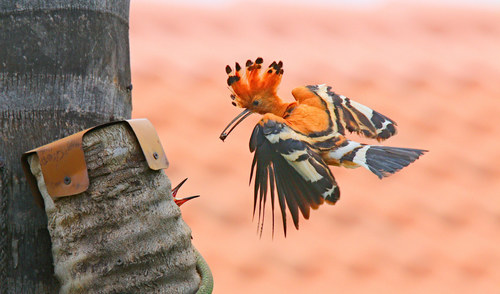
This species occupies open country such as pastures, parkland, orchards, sand-heathland, olive groves, and vineyards and requires the presence of features offering perches, shade, nest-sites and accessible food. It is frequently found around villages and in traditionally farmed areas. Breeding can occur up to 3,000 m in Turkey (Krištín and Kirwan 2015).In Central and Southern Europe, egg-laying occurs from late April or early May, although begins in January in the Canaries (Snow and Perrins 1998). The species is monogamous, solitary and a territorial breeder, although extra-pair paternity has been found in southeast Spain. It nests in natural holes in stumps, trees, walls, old buildings, cliffs, among boulders, in abandoned vehicles, drainpipes, wells, roof spaces and nest boxes and may use the same site for several seasons (Krištín and Kirwan 2015). The nest may unlined or lined with moss, grass, leaves or pine needles (Snow and Perrins 1998) and is normally relatively close to the ground but occasionally found over 40 m. (Krištín and Kirwan 2015). Typically, the species lays seven to eight eggs.It feeds almost entirely on animal matter, primarily large insects and their larvae and pupae (Snow and Perrins 1998).Northern populations are fully migratory while others our only partially migratory. European populations winter in northwest Africa, the Canary Isles, Israel and Arabia (Krištín and Kirwan 2015).Although the generation length for both EU and Europe regional assessments were calculated using the same methodology, new information arriving after the EU assessments were undertaken gave rise to an update in the generation lengths. This new information was then used for the Europe level assessments giving rise to a difference between the generation lengths used for the EU and Europe regions.
The species is hunted in Mediterranean region (Krištín and Kirwan 2015). Food quality and accessibility has been shown to affect reproductive success (Martin-Vivaldi et al. 1999, Fournier and Arlettaz 2001) as has the availability of suitable nesting cavities (Arlettaz et al. 2000) as a result of habitat changes after agricultural intensification (Bauer and Berthold 1997).
Conservation Actions UnderwayBern Convention Appendix II. There are currently no known conservation measures for this species.Conservation Actions ProposedResearch suggests that large areas of suitable breeding habitat should be maintained to allow functional and sustainable populations (Bötsch et al. 2012) therefore landscape scale management needs to be employed to maintain suitable foraging and breeding habitats for the species. Controls on hunting need to be introduced and enforced.
European regional assessment: Least Concern (LC)EU28 regional assessment: Least Concern (LC)In both Europe and the EU28, this species has an extremely large range (its extent of occurrence (EOO) is much larger than 20,000 km² and its area of occupancy (AOO) is much larger than 2,000 km²), and hence it does not approach the thresholds for Vulnerable under the range size criteria (criteria B and D2). The population size is extremely large (much larger than 10,000 mature individuals), and hence it does not approach the thresholds for Vulnerable under the population size criteria (criteria C and D). The population trend is estimated to be stable, and hence the species does not approach the thresholds for Vulnerable under the population size reduction criterion (criterion A). The probability of extinction has not been calculated for this species, therefore criterion E cannot be applied.For these reasons the species is evaluated as Least Concern in both Europe and the EU28.
Gallery