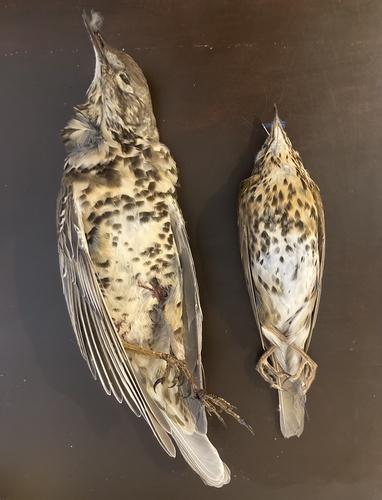
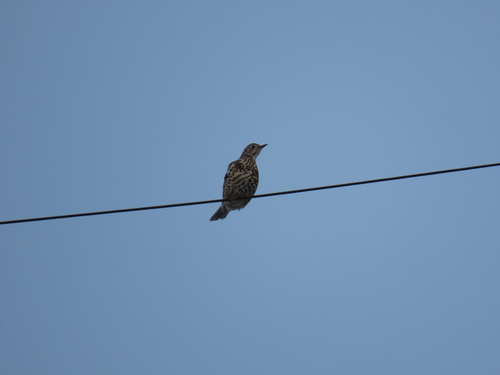
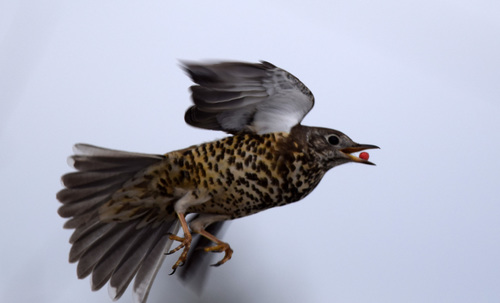
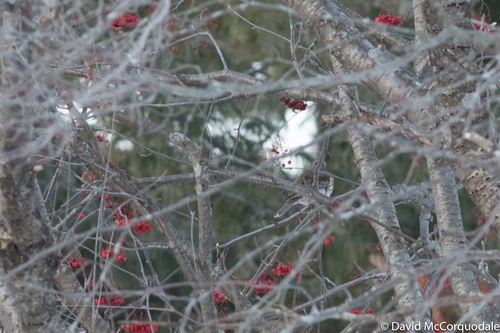
Turdus viscivorus Linnaeus, 1758
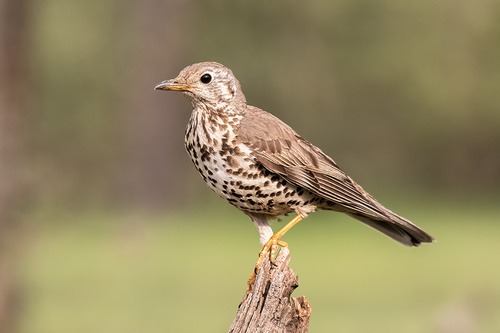
Source: Wikipedia
Synonyms 1
- 1,720,213 GBIF occurrences
- 27,066 iNaturalist observations
In Europe, the total population size is estimated at 7,300,000-13,600,000 mature individuals, with 3,650,000-6,760,000 breeding pairs (BirdLife International 2021), and comprises approximately 60% of the species' global range, so a very preliminary estimate of the global population size is between 12,200,000-22,700,000 mature individuals, although further validation of this estimate is desirable. The species' population in Europe is considered to have remained relatively stable over three generations (13.62 years) (BirdLife International 2021). As this region holds the majority of the species' global range, the global population size is considered to be stable over three generations.
The species requires a mosaic of wooded and open country, and thus inhabits open mature forest, woodland glades, orchards, riverside forest, open grassland with scrub and mountain steppe with shrubs; often penetrating grassy-bracken moorland areas on low craggy hills and mountains at some distance from trees. It is most typically found, in rolling, open landscapes with scattered trees or copses, including parkland and park-like farmland. In western and central Europe, it breeds from late March to late June and from late April in the north. It breeds from late March to July in Afghanistan east to the western Himalayas, In north-west Africa it breeds from March to June. The nest is a large cup of dry grass, plant stems, roots and moss, bound together with mud and lined with fine grasses and sometimes pine needles. Typically it is found two to ten metres up in the fork of a tree and normally lays three to five eggs. It feeds on invertebrates as well as seeds and fruit in the autumn and winter. In the west of its range the species is sedentary or a partial migrant and in the north and east of its range it is more fully migratory (Collar 2015).
In Spain the species suffers pressure from hunting. Finnish populations have suffered from the felling of old growth forest (Hagemeijer and Blair 1997, Collar 2015) as a result of modern forestry practices. Studies in the Netherlands have shown fluctuations in population numbers due to severe winter weather (Hagemeijer and Blair 1997).
Conservation Actions UnderwayEU Birds Directive Annex II. There are currently no known conservation measures for this species within its European range.Conservation Actions ProposedThe species would benefit locally from the restoration and maintenance of low-intensity forestry management.
This species has an extremely large range and the population size is extremely large, hence does not approach threatened thresholds for the range or population size criteria. The population trend appears to be stable, and hence the species does not approach the thresholds for Vulnerable under the population trend criterion. For these reasons the species is evaluated as Least Concern.
Gallery