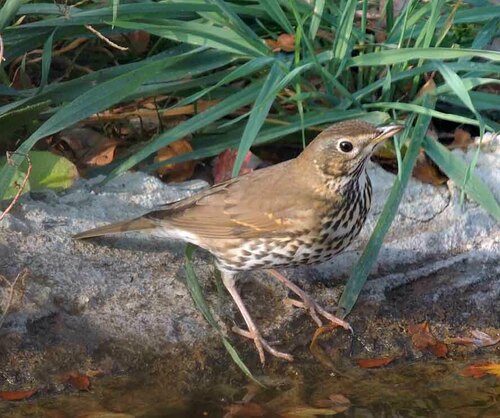
Turdus philomelos C. L. Brehm, 1831

Source: Wikipedia
Synonyms 1
- 4,596,478 GBIF occurrences
- 80,066 iNaturalist observations
The European breeding population is estimated at 23,600,000–39,000,000 pairs (47,300,000–77,900,000 mature individuals). The breeding population in the EU28 is estimated at 13,700,000–22,200,000 pairs (27,400,000–44,400,000 mature individuals). For details of national estimates, see the Supplementary Information.
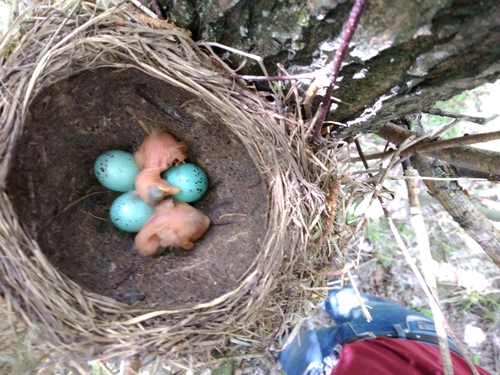
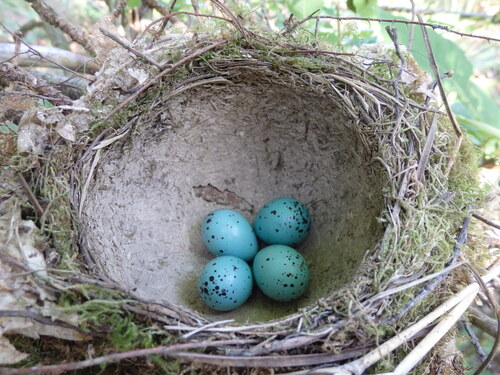
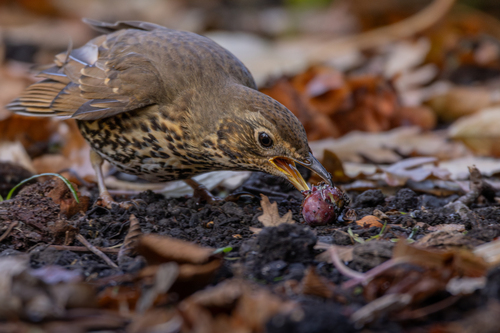
This species breeds in almost all types of temperate forest and woodland, generally in lowlands and valleys but reaching the tree-line in Switzerland and Russia. It requires patches of trees and bushes with small areas of open moist ground supporting abundant invertebrate fauna. It has also adapted well to modern lowland agricultural and urban landscapes, breeding in small woodlots, parkland, orchards, mature hedgerows, overgrown railway embankments, roadsides, cemeteries, and suburban gardens with some tall trees. In non-breeding areas in the south of its range habitats are somewhat drier.In Western Europe breeding occurs mainly from mid-March to mid-August but can start a month later in central and Northern Europe. The nest is a neat cup of grass, twigs and moss with a thick hard lining of clay, mud, dung or rotten wood, often mixed with leaves. It is usually placed in a bush, shrub or tree, often against the trunk, but can also be in a creeper on a wall, in a bank or on a ledge. Clutches are three to five eggs (Collar 2015).It feeds on a wide range of invertebrates, especially earth worms, as well as fruit as it is available through the year (Snow and Perrins 1998).The species is migratory, although southern and western populations are mostly sedentary (Collar 2015).Although the generation length for both EU and Europe regional assessments were calculated using the same methodology, new information arriving after the EU assessments were undertaken gave rise to an update in the generation lengths. This new information was then used for the Europe level assessments giving rise to a difference between the generation lengths used for the EU and Europe regions.
Local declines are thought to be due to changes in agricultural practices which may have caused a major reduction in availability of key summer food resources on lowland farmland, as well as the loss of hedgerows, scrub and permanent grassland with livestock, and the wide-scale installation of under-field drainage systems, which causes early soil drying and thus a loss of topsoil earthworms. Pesticides and predators may also be a threat (Collar 2015). The species has been subject to hunting for many decades in the Mediterranean, but there is no clear evidence this has caused a decline (Hagemeijer and Blair 1997, Collar 2015). Adverse weather is also known to negatively affect this species (Robinson et al. 2004).
Conservation Actions UnderwayEU Birds Directive Annex II. The species is listed as red in the national U.K. red list (Eaton et al. 2009). Research is being undertaken examining the ecology of this species and the causes of its decline. Conservation Actions ProposedIn the U.K., where the species is declining, management for this species should include the planting and restoration of hedgerows to provide nesting and feeding sites and this should be implemented along with sympathetic field margin management. Incentives are needed to encourage mixed farming, damper soil conditions and small, uncropped features, In addition it would likely benefiti from the creation and maintenance of ditches, which remain damper for longer during summer, preferably with hedge cover or close to scrub and raised water levels on grass fields (Peach et al. 2004). Future studies should focus on the relationships between species’s survival and environmental variables (Robinson et al. 2004).
European regional assessment: Least Concern (LC)EU28 regional assessment: Least Concern (LC)In Europe, this species has an extremely large range (its extent of occurrence (EOO) is much larger than 20,000 km² and its area of occupancy (AOO) is much larger than 2,000 km²), and hence it does not approach the thresholds for Vulnerable under the range size criteria (criteria B and D2). The population size is extremely large (much larger than 10,000 mature individuals), and hence it does not approach the thresholds for Vulnerable under the population size criteria (criteria C and D). The population trend appears to be stable, and hence the species does not approach the thresholds for Vulnerable under the population size reduction criterion (criterion A). The probability of extinction has not been calculated for this species, therefore criterion E cannot be applied. For these reasons the species is evaluated as Least Concern in Europe.In the EU28, this species has an extremely large range (its extent of occurrence (EOO) is much larger than 20,000 km² and its area of occupancy (AOO) is much larger than 2,000 km²), and hence it does not approach the thresholds for Vulnerable under the range size criteria (criteria B and D2). The population size is extremely large (much larger than 10,000 mature individuals), and hence it does not approach the thresholds for Vulnerable under the population size criteria (criteria C and D). The population trend appears to be increasing, and hence the species does not approach the thresholds for Vulnerable under the population size reduction criterion (criterion A). The probability of extinction has not been calculated for this species, therefore criterion E cannot be applied. For these reasons the species is evaluated as Least Concern in the EU28.
Gallery