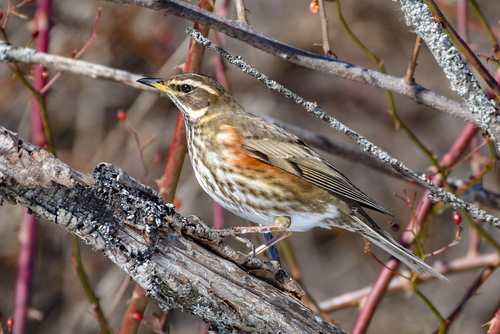
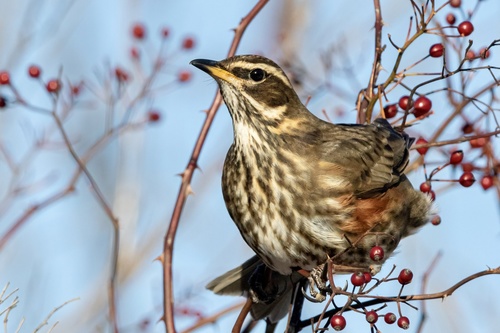
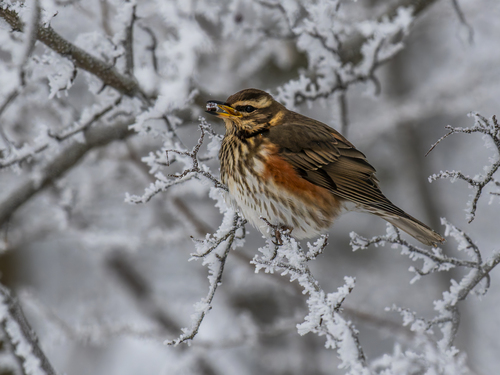
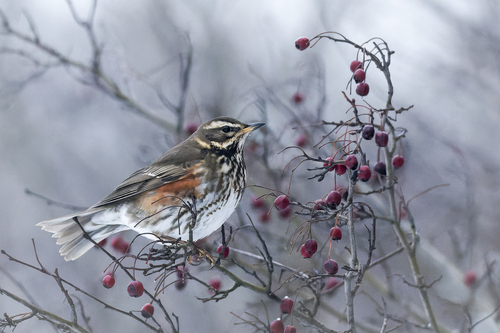
Turdus iliacus Linnaeus, 1758
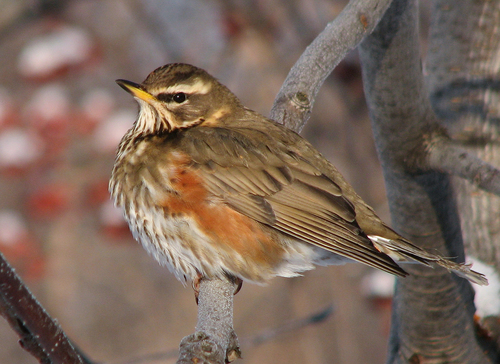
Source: Wikipedia
Synonyms 4
- 2,198,773 GBIF occurrences
- 28,756 iNaturalist observations
The European population is estimated at 8,000,000–14,000,000 pairs, which equates to 16,000,000–28,000,000 mature individuals (BirdLife International 2021). Europe holds c. 40% of the global range, so a very preliminary estimate of the global population size is 40,000,000-70,000,000 mature individuals, although further validation is needed.
During the breeding season, the species occurs in forest such as birch, pine, spruce and juniper, as well as open country in the lowlands, especially in river basins and on floodplains, and open deciduous or mixed forest, clearings in primary forest, regenerating forest, and scrub (Knaus and Lehikoinen 2020, Nagy and Pyle 2024). The species may also be found in semi-open cultivation, parks and gardens, and thinned woodlands near buildings (Nagy and Pyle 2024). In Iceland, and other boreal montane regions, it breeds in rocky areas with sparse birch scrub (Bent 1949). In Scotland, also found in swampy Alnus woodland (Nagy and Pyle 2024). It is found most commonly from sea level to 700 m (Quintero and Jetz 2018) but occasionally up to 2,100 m (Nagy and Pyle 2024).During the non-breeding season, the species is found in open woodlands, orchards, scrub thickets, generally wherever berry-bearing bushes and grassy areas can be found (Nagy and Pyle 2024). In Britain, it is generally found near parks and playing fields, often close to cover (Cramp 1988). It is also found in urban gardens and city centres (Nagy and Pyle 2024). Generally found below 800 m, but can be found near or above 1,000 m in areas such as Morocco where it occupies orchards, olive groves and cedars in the High Atlas Mountains (Cramp 1988, Thévenot 2003).
Population numbers can fluctuate owing to the effects of harsh and mild winters, and of unfavourably cold summers (Nagy and Pyle 2024). Climate change may be having an effect on this species given its northerly breeding distribution, with the latitudinal mean centre of weighted density having moved northwards in Finland from the 1970s to the 2010s (see Lehikoinen and Virkkala 2016, Virkkala 2016). Loss of thicket-scrub vegetation from over-grazing can also impact the presence of this species in an area (Ims and Henden 2012). The species is also illegally trapped in the Mediterranean (Murgui 2014).
Conservation and Research Actions UnderwayEU Birds Directive Annex II (huntable). Bern Convention on the Conservation of European Wildlife and Natural Habitats Annex III (protected). Across the EU, 486 Natura 2000 sites have been designated partly for this species, predominantly in Mediterranean countries where it occurs on passage and in winter (EEA 2024 ). Conservation and Research Actions ProposedImplement tighter controls on hunting around the Mediterranean. Encourage land management practices that could result in increased winter berry availability and hence aid survival during harsh winters (e.g. Staley et al. 2012).
This species has a large geographic range size and a very large, estimated population size (>40 million mature individuals). Its population has fluctuated in the past, including a notable decline between 2008-2014. However, over the past ten years (three generations), the well-monitored European breeding population has increased by 12%. As Europe holds around 40% of the species’ global breeding range, and there is no compelling evidence for declines elsewhere, it is unlikely that the global population is declining, or at least not declining at a rate that approaches the thresholds for consideration as threatened. As such, the species is listed as Least Concern.
Gallery