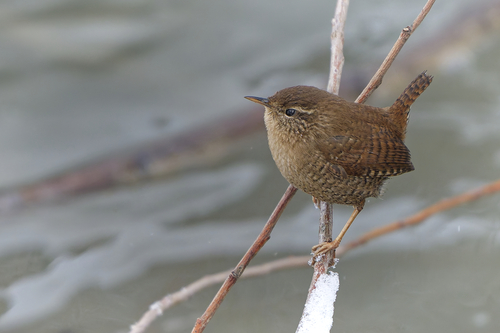
Troglodytes troglodytes (Linnaeus, 1758)

Source: Wikipedia
Synonyms 41
- 5,894,956 GBIF occurrences
- 59,718 iNaturalist observations
The European breeding population is estimated at 33,200,000–56,500,000 pairs (66,500,000–113,000,000 mature individuals). The breeding population in the EU28 is estimated at 30,000,000–49,000,000 pairs (60,000,000–97,900,000 mature individuals). For details of national estimates, see the Supplementary Information.
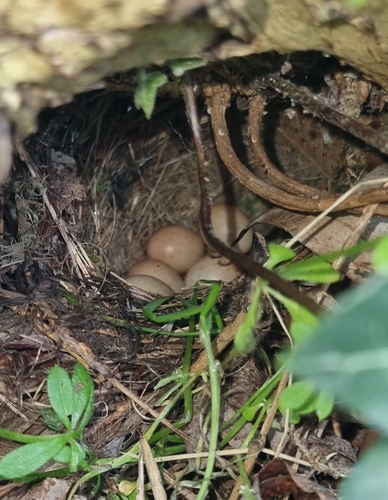
This species inhabits a wide variety of habitats. In Western Europe, it is most commonly found in deciduous and mixed woodland, well-vegetated suburbs, urban parks and gardens, moorland scrub, and offshore islands with very scanty cover.In European Russia, egg-laying occurs from the second half of May; however in Western Europe it begins late March or early April and a week or more later in Central Europe. The nest is a domed structure with a side entrance hole (Kroodsma et al. 2013) and is made of grass, leaves, moss and other vegetation, lined with feathers and hair (Snow and Perrins 1998). It is sited in a wide range of locations, often in dense vegetation but also in a cavity or crevice and will use artificial sites. Clutches can be three to nine eggs but most often five to eight.The diet is mostly invertebrates such as spiders (Araneae), beetles (Coleoptera), earwigs (Dermaptera) and orthopterans, but it will also take small vertebrates, such as small fish, tadpoles and young frogs.The species is resident, migratory and partially migratory (Kroodsma et al. 2013).Although the generation length for both EU and Europe regional assessments were calculated using the same methodology, new information arriving after the EU assessments were undertaken gave rise to an update in the generation lengths. This new information was then used for the Europe level assessments giving rise to a difference between the generation lengths used for the EU and Europe regions.
Some island populations, which represent whole subspecies are very small and thus vulnerable; the designation of race hirtensis, on St Kilda (Scotland) in 1884 led to an increase in collecting activity, although there is no evidence this caused a significant decline. In non-migratory populations, severe winters with prolonged snow cover can decimate numbers but this is normally temporary and recovery is quick (Kroodsma et al. 2013).
Conservation Actions UnderwayThe race fridariensis is listed on Annex I of the EU Birds Directive. Bern Convention Appendix II. There are currently no known conservation measures for this species.Conservation Actions ProposedNo conservation measures are currently needed for this species.
European regional assessment: Least Concern (LC)EU28 regional assessment: Least Concern (LC)In both Europe and the EU28, this species has an extremely large range (its extent of occurrence (EOO) is much larger than 20,000 km² and its area of occupancy (AOO) is much larger than 2,000 km²), and hence it does not approach the thresholds for Vulnerable under the range size criteria (criteria B and D2). The population size is extremely large (much larger than 10,000 mature individuals), and hence it does not approach the thresholds for Vulnerable under the population size criteria (criteria C and D). The population trend is estimated to be increasing, and hence the species does not approach the thresholds for Vulnerable under the population size reduction criterion (criterion A). The probability of extinction has not been calculated for this species, therefore criterion E cannot be applied.For these reasons the species is evaluated as Least Concern in both Europe and the EU28.
Gallery