Tringa erythropus (Pallas, 1764)
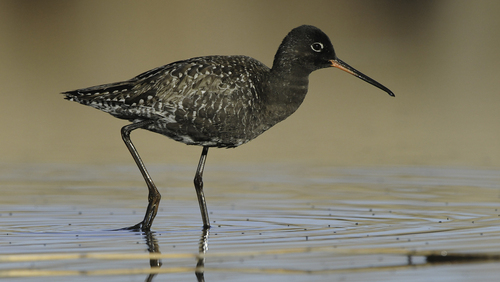
Source: Wikipedia
Synonyms 1
- 654,635 GBIF occurrences
- 10,023 iNaturalist observations
In Europe, the total population size is estimated at 37,900-81,300 mature individuals, with 18,900-40,700 breeding pairs (BirdLife International 2021), and comprises under a quarter (c.20%) of the species' global range. The global population size is estimated at 182,000-350,000 individuals (Wetlands International 2023), which equates to 121,000-233,000 mature individuals. The global population size has therefore been estimated at 121,000-233,000 mature individuals.
Behaviour This species is a full migrant (Hayman et al. 1986, Smit and Piersma 1989, del Hoyo et al. 1996), breeding in the subarctic and arctic zone of Fennoscandia and Siberia (Smit and Piersma 1989). On passage to its wintering grounds the majority of the species travels overland on a broad front, although there is also an important route down the west coast of Europe (Smit and Piersma 1989, del Hoyo et al. 1996). Females begin to moving south in early-June, the males following during July, and juveniles migrating from August to September (del Hoyo et al. 1996). The movements of this species are characterised by long flights between staging areas (such as the Wadden Sea, Dutch delta region, southern Hungary, south-east Greece, central Türkiye, the Black and Caspian Seas, central Kazakhstan, Lake Baikal, Chang Lake (Ussuriland), central Yakutia, Sakhalin, Japan and Korea) (del Hoyo et al. 1996), those birds wintering in Sahel and northern savanna zones (e.g. Mali, Nigeria and Chad (Smit and Piersma 1989)) also cross the Sahara (del Hoyo et al. 1996). Arrival in Africa begins in August and peaks in October (Hayman et al. 1986), the species being present throughout the tropics mainly between October and April (del Hoyo et al. 1996), and returning to arctic breeding grounds between late-April and mid-May (del Hoyo et al. 1996). Few birds remain in the tropics during the breeding season, but non-breeders may spend the summer just south of the breeding grounds (del Hoyo et al. 1996). The species breeds in dispersed pairs and is often seen singly, although it is also common in parties of up to 20 and exceptionally over 100 (Urban et al. 1986, del Hoyo et al. 1996). Adults typically moult in large flocks (Hayman et al. 1986) in staging areas in their arctic breeding range before moving to wintering grounds (del Hoyo et al. 1996). This species is both a diurnal and nocturnal feeder (del Hoyo et al. 1996). Habitat Breeding During the breeding season this species inhabits lowland and upland (but not montane) regions, in wooded and open tundra (Snow and Perrins 1998), marshes, swampy pine or birch forest near the arctic tree-line, and also more open areas such as heathland and shrub tundra (Johnsgard 1981, del Hoyo et al. 1996). Non-breeding During migration and on its wintering grounds (Flint et al. 1984) this species frequents a variety of freshwater and brackish wetlands such as sewage farms, irrigated rice fields, brackish lagoons, salt-marshes, salt-pans, sheltered muddy coastal shores (del Hoyo et al. 1996) and mudflats (Johnsgard 1981), marshes and marshy lake edges (Johnsgard 1981, Urban et al. 1986), small reservoirs, pools and flooded grasslands (Urban et al. 1986). Diet The species is carnivorous, its diet consisting chiefly of aquatic insects and their larvae (especially swimming beetles and hemipterans), terrestrial flying insects (such as craneflies), small crustaceans, molluscs, polycheate worms, and small fish and amphibians up to 6-7 cm long (Johnsgard 1981, del Hoyo et al. 1996). Breeding site The nest of this species is a shallow depression (Snow and Perrins 1998) positioned in grass tussocks (del Hoyo et al. 1996), on sphagnum moss (Flint et al. 1984), or in fairly dry areas of forest amongst low vegetation such as dwarf willows (Johnsgard 1981). Nest sites are often selected near dead trees or other suitable look-out perches (Johnsgard 1981).
This species is threatened by habitat loss in its wintering range and on migration: wetland sites in Ghana are being degraded through coastal erosion and developments involving drainage and land reclamation (Ntiamboa-Baidu 1991); and in China and South Korea important migrational staging areas around the coast of the Yellow Sea are being lost through land reclamation and degraded as a result of declining river flows (from water abstraction), increased pollution, unsustainable harvesting of benthic fauna and a reduction in the amount of sediment being carried into the area by the Yellow and Yangtze Rivers (Barter 2002, Barter 2006, Kelin and Qiang 2006).
Conservation Actions UnderwayThe following information refers to the species's European range only: The species is listed on Annex II (B) of the EU Birds Directive and Annex II of the Bern Convention.Conservation Actions ProposedThe following information refers to the species's European range only: Intensive grazing of grassland (>1 cow per hectare) was found to attract a higher abundance of this species in Hungary (Baldi et al. 2005).
This species has an extremely large range, and hence does not approach the thresholds for Vulnerable under the range size criterion (extent of occurrence under 20,000 km² combined with a declining or fluctuating range size, habitat extent/quality, or population size and a small number of locations or severe fragmentation). The population size is very large, and hence does not approach the thresholds for Vulnerable under the population size criterion (under 10,000 mature individuals with a continuing decline estimated to be over 10% in ten years or three generations, or with a specified population structure). Despite the fact that the population trend appears to be decreasing, the decline is not believed to be sufficiently rapid to approach the thresholds for Vulnerable under the population trend criterion (over 30% decline over ten years or three generations). For these reasons the species is evaluated as Least Concern.
Gallery