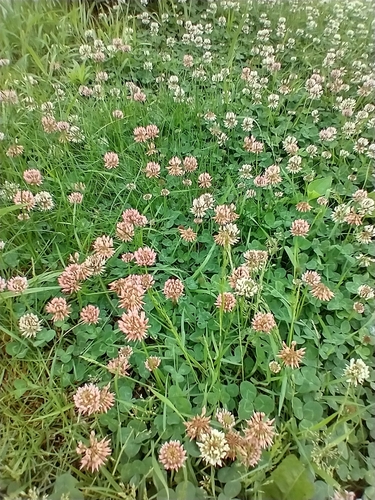
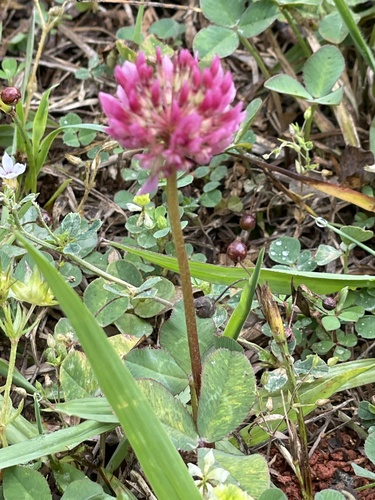
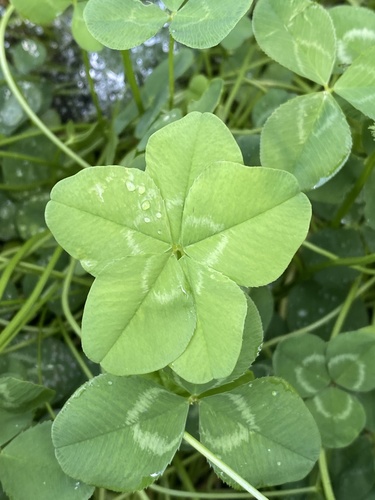
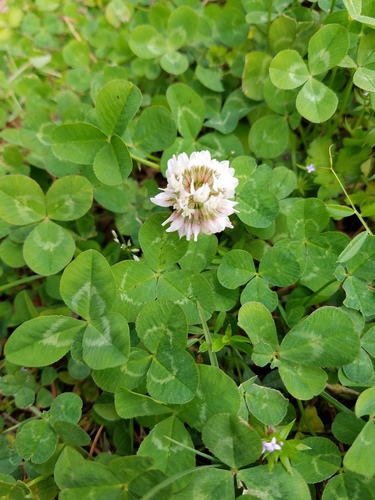
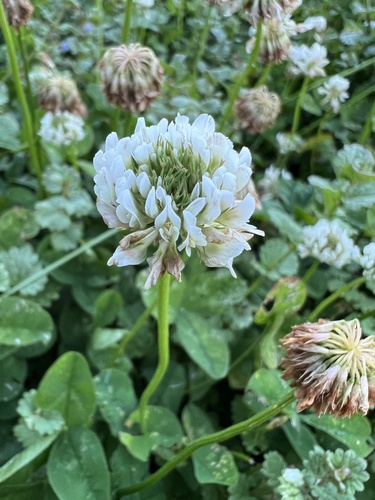
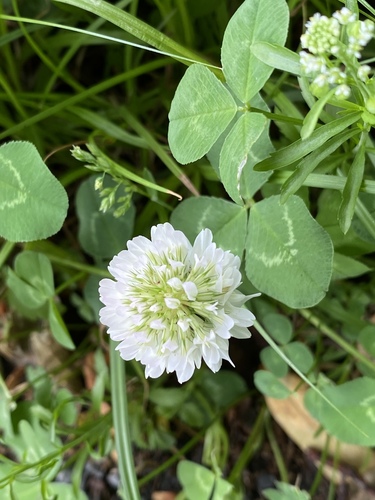
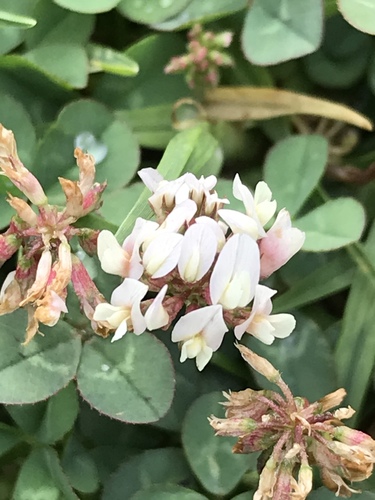
Trifolium repens L.
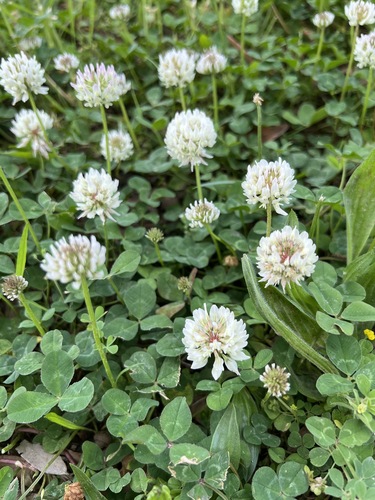
Source: Wikipedia
Synonyms 48
- 1,816,715 GBIF occurrences
- 255,733 iNaturalist observations
The exact population size is unknown, but the species is very common throughout Europe. It is found in a variety of habitats and populations are stable.In the UK, Preston et al. (2002) note the species is widespread throughout the whole of England, Wales, Scotland and Northern Ireland and that there has been no change in this species’ range in recorded floristic history.
T. repens, as well as other perennial Trifolium species, generally occur in mountain meadows and areas with high rainfall. It is widely sown and naturalised in temperate regions across the world, but outside of its natural range it can be found in grasslands (Lamont et al. 2001). It grows primarily on damp and swampy soils, and flowers between March and September (Zohary and Heller 1984).T. repens is a perennial legume, flowering between spring and autumn in northern areas, and often all year round in other regions. It grows in dry meadows and mud flats, and less commonly in saline meadows, wood margins, open woods, river banks, plains, semi-desert regions, roadsides, subalpine meadows and lower mountain areas. It favours moist clay and loam soils, and is tolerant to temperatures between 4.3ºC and 21.8ºC, annual precipitation between 310 mm and 1,910 mm, and soil pH from 4.5 to 8.2 (Duke 1981). In the UK this species is usually found below 400 m but has been recorded up to 880 m (Preston et al. 2002). It avoids particularly wet and acidic soils and grows in grasslands, waste ground and in other ruderal habitats but it is less common in taller grassland (Preston et al. 2002).
The biggest threat in Europe to T. repens (and all wild species of Trifolium) is overgrazing, generally during the seed production months in the summer (Lamont et al. 2001). An assessment by Moser et al. (2002) found the species to be Vulnerable (BGCI 2009). However, the fact that the species is extremely common and found in many different habitats throughout Europe means it is not currently threatened at the species level. However, recent studies have shown wild forms of the species is prone to introgression and genetic pollution from cultivated forms (Hargreaves et al. 2010).
T. repens is specifically listed in Annex I of the International Treaty on Plant Genetic Resources for Food and Agriculture as part of the forage legume gene pool so warrants specific conservation attention.Ex situ seed samples are available in numerous gene banks with the largest collections being held by the Margot Forde Forage Germplasm Centre in New Zealand (13,000 accessions), Vavilov Research Institute of Plant Industry, Russia, the National Plant Germplasm System in Washington, USA, ICARDA (Aleppo, Syria) and University of Aberystwyth (Aberystwyth , UK) (553 accessions) gene banks (Lamont et al. 2001). EURISCO reports 3,544 germplasm accessions held in European genebanks, 1,267 of which are reported to be of wild or weedy origin. Of the wild accessions, 1,125 originate from within Europe (EURISCO Catalogue 2010).In situ the species is likely to be passively conserved in many existing protected areas in throughout its range but as its conservation in these sites is not actively monitored it may be subject to population loss over time from factors such as climate change.Classified as Least Concern (LC) in Denmark (P. Wind pers. comm. 2010).
European regional assessment: Least Concern (LC) EU 27 regional assessment: Least Concern (LC)Trifolium repens due to its extremely widespread habitat and geographic distribution, and no known threats, it is classified as Least Concern.
Gallery