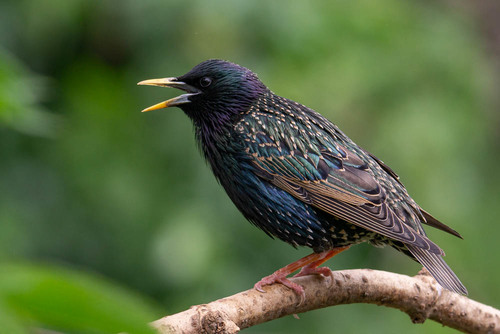
Sturnus vulgaris Linnaeus, 1758
Source: Wikipedia
Synonyms 9
- 28,300,536 GBIF occurrences
- 339,799 iNaturalist observations
The European breeding population is estimated at 26,600,000–47,200,000 pairs (53,300,000–94,400,000 mature individuals). The breeding population in the EU28 is estimated at 19,500,000–32,500,000 pairs (39,000,000–64,900,000 mature individuals). For details of national estimates, see the Supplementary Information.
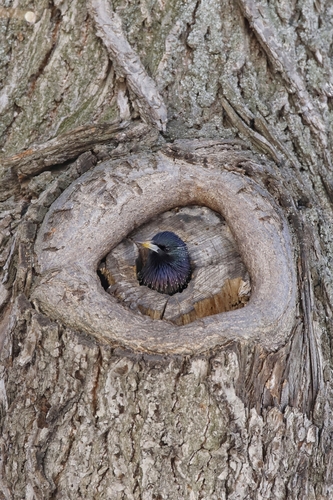
During the breeding season this species occupies open country, including modified habitats, with access to suitable nesting and roosting sites. It requires cavity nest-sites, typically in woodland or on man-made structures, close to open areas of short grassland for foraging. At other times it exploits a wide range of habitats, including moorland, saltmarshes, seashore and tidal flats, stubble fields, orchards, refuse dumps and sewage-treatment works. It roosts in reedbeds, scrub and trees, as well as bridges and buildings and even in town centres.Breeding occurs mostly between March and July. The nest is a bulky structure of dry grass, conifer needles, twigs, string and other materials and the cup is lined with softer materials such as grass, feathers, moss, wool, hair and paper, fresh green leaves and flowers. It is typically built in a hole in a tree, cliff, building or other structure and nest boxes are also readily used. Clutches are normally four to six eggs (Craig and Feare 2015).It is an omnivorous species, taking animal and plant material all year round but during the spring animal food predominates and is fed almost exclusively to nestlings (Snow and Perrins 1998).The northern and eastern populations are migratory, whereas southern and western populations, as well as those in urban areas, tend to be resident (Craig and Feare 2015).Although the generation length for both EU and Europe regional assessments were calculated using the same methodology, new information arriving after the EU assessments were undertaken gave rise to an update in the generation lengths. This new information was then used for the Europe level assessments giving rise to a difference between the generation lengths used for the EU and Europe regions.
The species is thought to be declining in some areas owing to the intensification and specialization of agriculture and consequent changes in rural habitats (Craig and Feare 2015), such as decreases in fallow and grassland and increases in autumn-sown arable crops (Hagemeijer and Blair 1997). Declines have coincided with a reduction in cattle farming. In some European countries it was formerly a regular food source and was also kept as a cagebird (Craig and Feare 2015).
Conservation Actions UnderwayEU Birds Directive Annex II. In parts of its natural Eurasian range, this species is encouraged through provision of nestboxes, as claimed to reduce some insect pests (Craig and Feare 2015).Conservation Actions ProposedThe promotion and expansion of low-intensity agriculture would benefit this species.
European regional assessment: Least Concern (LC)EU28 regional assessment: Least Concern (LC)In Europe, this species has an extremely large range (its extent of occurrence (EOO) is much larger than 20,000 km² and its area of occupancy (AOO) is much larger than 2,000 km²), and hence it does not approach the thresholds for Vulnerable under the range size criteria (criteria B and D2). The population size is extremely large (much larger than 10,000 mature individuals), and hence it does not approach the thresholds for Vulnerable under the population size criteria (criteria C and D). The population trend is estimated to be increasing, and hence the species does not approach the thresholds for Vulnerable under the population size reduction criterion (criterion A). The probability of extinction has not been calculated for this species, therefore criterion E cannot be applied. For these reasons the species is evaluated as Least Concern in Europe.In the EU28, this species has an extremely large range (its extent of occurrence (EOO) is much larger than 20,000 km² and its area of occupancy (AOO) is much larger than 2,000 km²), and hence it does not approach the thresholds for Vulnerable under the range size criteria (criteria B and D2). The population size is extremely large (much larger than 10,000 mature individuals), and hence it does not approach the thresholds for Vulnerable under the population size criteria (criteria C and D). The population trend is estimated to be decreasing by ca 6% over 16 years (three generations), and hence the species does not approach the thresholds for Vulnerable under the population size reduction criterion (criterion A). The probability of extinction has not been calculated for this species, therefore criterion E cannot be applied. For these reasons the species is evaluated as Least Concern in the EU28.
Gallery