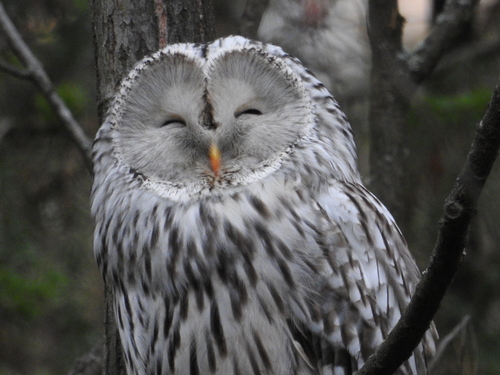
Strix uralensis Pallas, 1771
Source: Wikipedia
Synonyms 7
- 160,303 GBIF occurrences
- 8,180 iNaturalist observations
The population size within the Mediterranean was calculated using population size estimated from BirdLife International (2021) and the proportion of its range for each range state that falls within the hotspot boundary. Country-by-country, the percentage of the European range, and so number of breeding pairs, that falls within the Mediterranean hotspot is; North Macedonia (100%; 1-50 pairs), Italy (c. 5.8%; giving 1-3 pairs), Slovenia (c. 5.7%; giving 40-68 pairs) and Croatia (c. 1.5%; 10-15 pairs). This gives a total population size of 104-272 mature individuals.The population size is increasing in Slovenia and Italy, stable in North Macedonia and unknown in Croatia. Therefore, the population trend is considered to be increasing within the Mediterranean hotspot region.
The species occupies boreal forest and mixed woodland, with some open areas such as bogs, clearings or small fields, however, in Central Europe, it is confined to deciduous woods, particularly of beech (Fagus sylvatica), in mountain areas. It is often found near human dwellings and also in pastureland (Holt et al. 1999).It is monogamous (König and Weick 2008) and breeds from February to July. The species nests in tree holes or hollow stumps and will often use nest boxes. Also, they sometimes nest in cliff cavities or buildings, old raptor nests, crow nests (Corvus) or squirrel dreys (Sciurus) and rarely on ground (Holt et al. 1999). Clutches are usually three to four eggs.Its diet is made up of a large variety of mammals, birds, frogs, and insects, with voles, shrews, mice and rats as the main prey (König and Weick 2008).This species is extremely sedentary (Mikkola 1983).
In areas dominated by open areas, such as fields and clearfells, the Eagle Owl (Bubo bubo) outcompetes this species (Hagemeijer and Blair 1997). It also suffers from forestry management, which has resulted in the loss of hollow and broken trees which provide nesting sites (König and Weick 2008).
Conservation Actions UnderwayCITES Appendix II. Bern Convention Appendix II. EU Birds Directive Annex I.Conservation Actions ProposedNest boxes are important for the conservation of this species (Hagemeijer and Blair 1997) and thus should continue to be provided to prevent future declines (Holt et al. 1999).
Mediterranean regional assessment: Endangered (EN)Within the Mediterranean hotspot region, this species has an extent of occurrence (EOO) larger than 20,000 km² and its area of occupancy (AOO) is suspected to be larger than 2,000 km² too, and hence it does not meet the thresholds for Vulnerable under the range size criteria (criteria B and D2). The population trend appears to be increasing, and hence the species does not approach the thresholds for Vulnerable under the population size reduction criterion (criterion A). However, the population size is estimated to be very small within the Mediterranean hotspot region; only 104-272 mature individuals. While the population size in the wider European region is increasing, it is unsure whether there would be significant immigration as the species is not a migrant and so no regional adjustment has been made. Therefore, Strix uralensis is assessed as Endangered under criterion D.
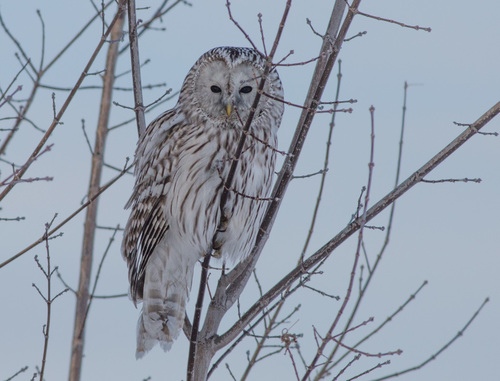
Gallery