Sorbus aucuparia L.
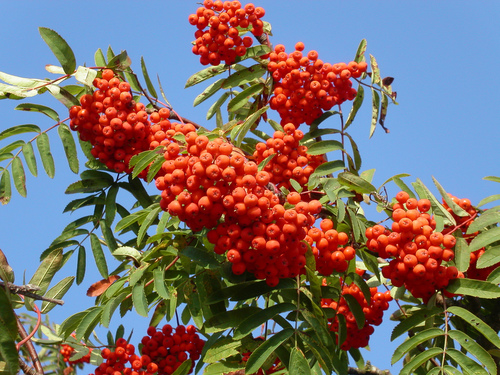
Source: Wikipedia
Synonyms 46
- 1,275,184 GBIF occurrences
- 99,257 iNaturalist observations
It is the most frequent European Sorbus species. It will have a population size far exceeding the threshold for a threatened conservation rating (10,000 mature individuals).
Rarely a shrub, Sorbus aucuparia is found as a tree to 15 m (-28 m). It is a very variable sexual diploid (2n = 34). It is limited by high summer temperatures (Raspé et al. 2000). This species tends to be scattered in woodland, often in clearings and above the treeline. It is a poor competitor and although it grows quickly in favourable conditions when young it often struggles to grow as large as other trees of the same habitat. It is often considered a weed tree of forestry as it is quick to colonise suitable habitats, such as disturbed woodland. In woodland these trees are found as single stems, whereas in more exposed situations it is found as multi-trunked trees. It is particularly characteristic of light, acid, sandy and peaty soils but is also found on shallow soils over limestone and on limestone cliffs (McAllister 2005).
Browsing by ungulates often causes multi-stemmed trees or complete loss of Sorbus aucuparia from the tree layer. The range of this species has been expanding north due to climate change and it is expected that the southern edge of this species range will move to higher altitudes (Räty et al. 2016) where possible.
This species is listed as Least Concern in Switzerland (Moser et al. 2002) and is considered Near Threatened in Red list of the vascular flora of Hungary (Király 2007). The species certainly occurs within protected areas within its European range. No conservation actions are required, although research into the impact of climate change on southern European populations is suggested. Sorbus aucuparia is reported as held in 182 ex situ collections (BGCI 2016).
Sorbus aucuparia is a tree or shrub found across Europe, North Africa, central and northern Asia into northern China. It is here assessed as Least Concern as it has an extensive distribution and a large population size. It is impacted by browsing by ungulates, and southern populations may be a risk from climate change.
Gallery