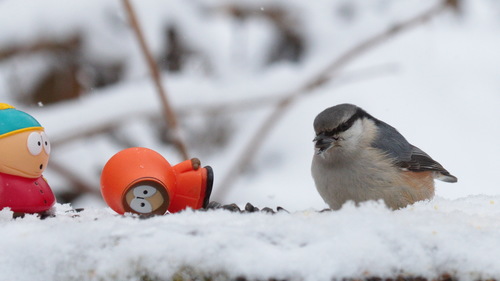
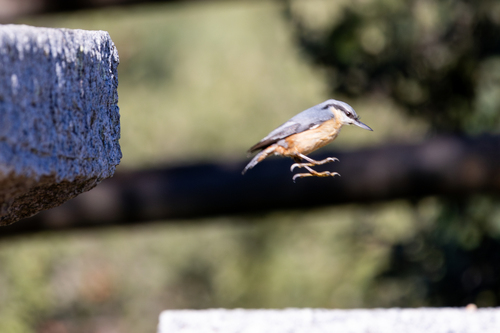
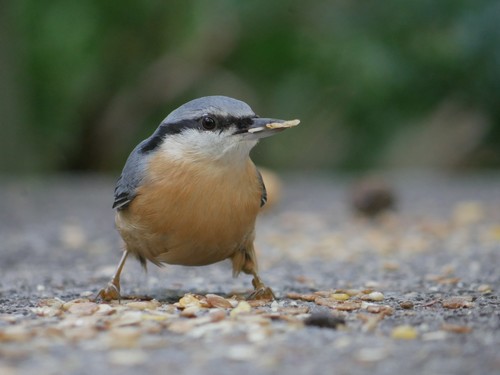
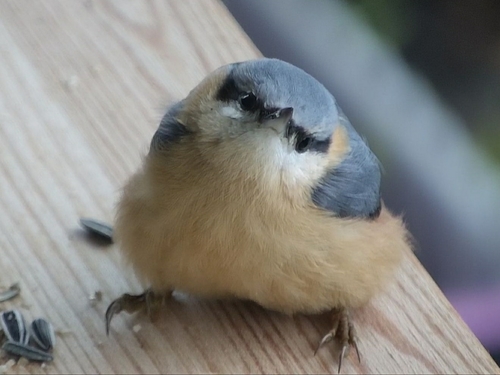
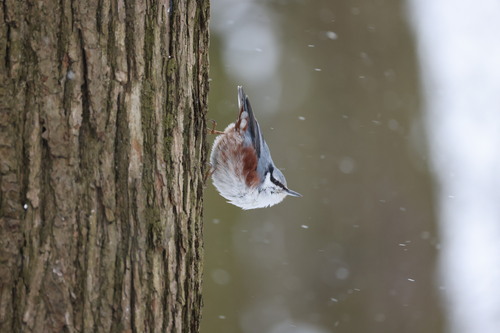
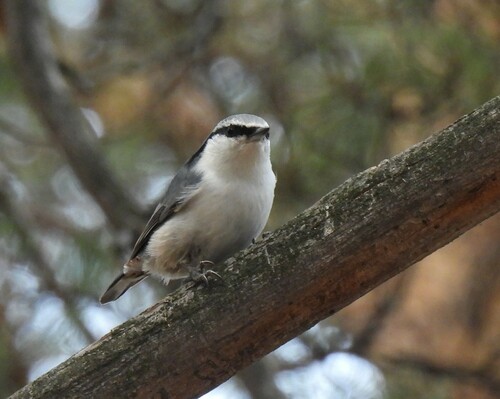
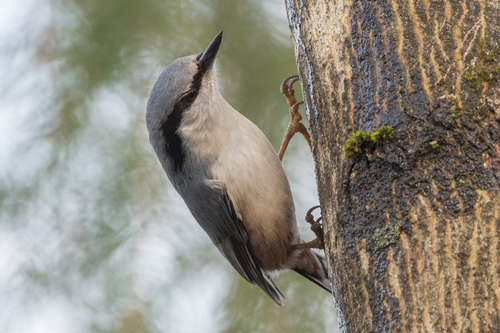
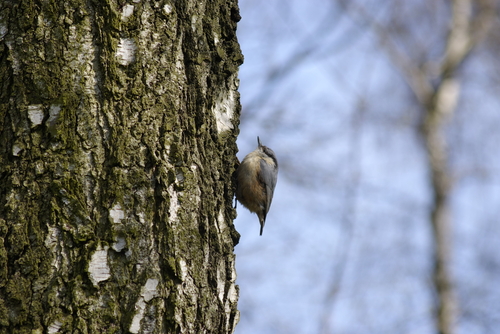
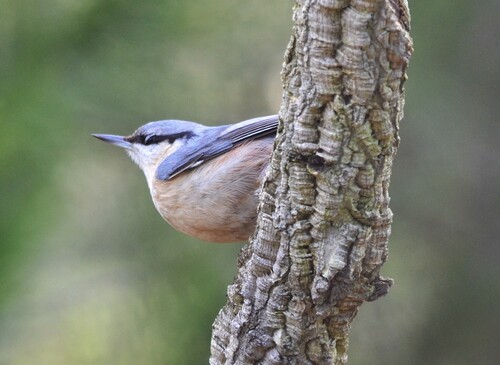
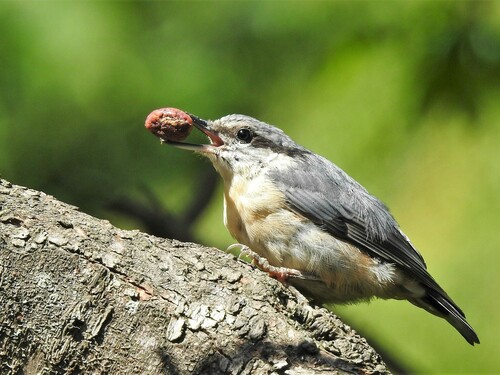
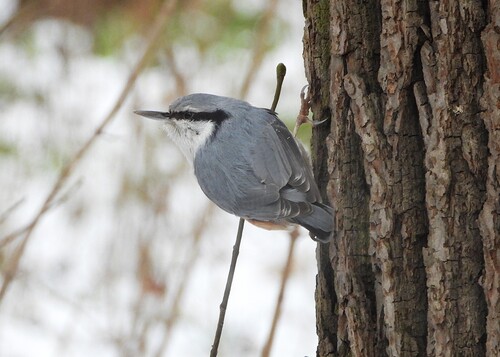
Sitta europaea
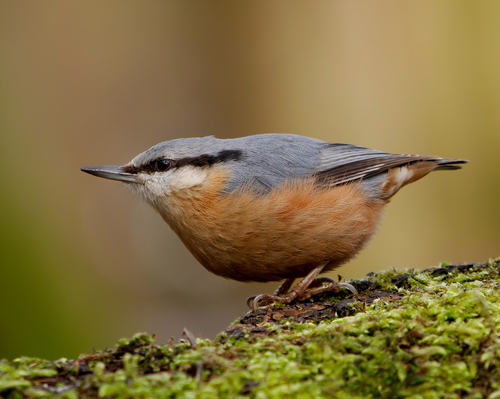
Source: Wikipedia
Synonyms 12
- 3,728,016 GBIF occurrences
- 89,259 iNaturalist observations
The European breeding population is estimated at 9,510,000–1,7400,000 pairs (19,000,000–34,700,000 mature individuals). The breeding population in the EU28 is estimated at 6,760,000–11,800,000 pairs (13,500,000–23,500,000 mature individuals). For details of national estimates, see the Supplementary Information.
This species inhabits mature forest with large old trees and a well-developed canopy providing extensive foraging areas, as well as nesting cavities. In much of Europe it prefers deciduous and mixed forest, especially oak (Quercus), but is also found in riverine woodland, parkland, old orchards, cemeteries, and sometimes large gardens and locally occupies in old spruce (Picea) and pine (Pinus) forests, especially in the mountains.Egg-laying occurs mainly from late-April to May but varies with latitude and altitude. The nest is a foundation of wood chips surmounted by bark flakes and rarely incorporating dry leaves, lichen, conifer needles and the like. It is sited in the hole in a tree, which is either natural or, more often an abandoned woodpecker hole. On occasion, it will use a nest box or a wall cavity, hole in a rock face or building or crevice between tree roots. Clutches are typically five to nine eggs.The species feeds on insects but in the autumn and winter it takes seeds, nuts and sometimes flower buds and sap. It will readily visit birdtables in the winter. This species is generally sedentary, but juveniles may disperse over short distances in late summer and autumn; occasionally these movements become irruptive (Harrap 2015).Although the generation length for both EU and Europe regional assessments were calculated using the same methodology, new information arriving after the EU assessments were undertaken gave rise to an update in the generation lengths. This new information was then used for the Europe level assessments giving rise to a difference between the generation lengths used for the EU and Europe regions.
The main threat to this species is forest destruction and fragmentation, which has lead to local declines and extinctions throughout its range. It is generally rare or absent from small forest fragments and the species does not inhabit areas without mature trees (Hagemeijer and Blair 1997, Harrap 2015).
Conservation Actions UnderwayBern convention Appendix II. There are currently no known conservation measures for this species.Conservation Actions ProposedLocally, this species would benefit from protection of its forest habitat and management should ensure that large, mature trees remain.
European regional assessment: Least Concern (LC)EU28 regional assessment: Least Concern (LC)In Europe, this species has an extremely large range (its extent of occurrence (EOO) is much larger than 20,000 km² and its area of occupancy (AOO) is much larger than 2,000 km²), and hence it does not approach the thresholds for Vulnerable under the range size criteria (criteria B and D2). The population size is extremely large (much larger than 10,000 mature individuals), and hence it does not approach the thresholds for Vulnerable under the population size criteria (criteria C and D). The population trend appears to be stable, and hence the species does not approach the thresholds for Vulnerable under the population size reduction criterion (criterion A). The probability of extinction has not been calculated for this species, therefore criterion E cannot be applied. For these reasons the species is evaluated as Least Concern in Europe.In the EU28, this species has an extremely large range (its extent of occurrence (EOO) is much larger than 20,000 km² and its area of occupancy (AOO) is much larger than 2,000 km²), and hence it does not approach the thresholds for Vulnerable under the range size criteria (criteria B and D2). The population size is extremely large (much larger than 10,000 mature individuals), and hence it does not approach the thresholds for Vulnerable under the population size criteria (criteria C and D). The population trend appears to be increasing, and hence the species does not approach the thresholds for Vulnerable under the population size reduction criterion (criterion A). The probability of extinction has not been calculated for this species, therefore criterion E cannot be applied. For these reasons the species is evaluated as Least Concern in the EU28.
Gallery