Sanicula europaea L.
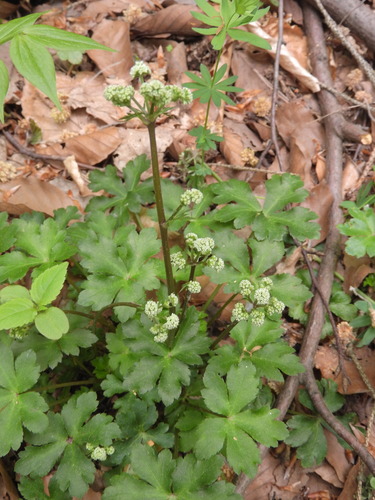
Source: Wikipedia
Synonyms 9
- 281,046 GBIF occurrences
- 12,933 iNaturalist observations
The species' population is presumed to be large given its widespread distribution and numerous records. No information on population trends is available across the species European range, however populations have declined in parts of Great Britain (Botanical Society of the British Isles and the Biological Records Centre 2012). In European parts of Russia the species is considered 'rare' or 'rare but increasing' (IAS PAs Russia 2014).
The species grows individually in shaded, moist to moderately dry, usually calcareous, basic soils, mostly on clay, rarely also on silt soils. The plant prefers to grow in hilly to mountainous beech and hornbeam forests (Düll and Kutzelnigg 2011). In Britain, the species is generally found in moist soil in deciduous woodland, but also locally in substantial hedge banks and shaded roadsides, and in the north and west of its British range it is sometimes found in relict woodland in gorges and in sheltered stream ravines (Botanical Society of the British Isles and the Biological Records Centre 2012).
No widespread threats for this species are known. The species is likely to have been impacted locally by habitat conversion (e.g., through urban or agricultural development).
The species is widespread across all Europe and in most cases is listed as Least Concern or Not Evaluated (Moser et al. 2002). No conservation actions are currently needed for this species.Reported in sixteen Red Books in European Russia (IAS PAs Russia 2014); for example, Moscow (category 5: Rare species whose status is improving; Samoilov and Morozov 2011) and Yaroslavl Oblast (category 3: Rare Voronin 2004). also reported in Red Books for Leningrad, Altai, and the following Oblasts: Pskov, Kemerovo, Bryansk, Vladimir, Ivanovo, Kaluga, Orel, Ryazan, smolensk, Tver, and Tula IAS PAs Russia 2014).The species occurs in several protected areas, including numerous Natura 2000 sites (UNEP-WCMC and IUCN 2023).
European regional assessment: Least Concern (LC)EU 27 regional assessment: Least Concern (LC)This species can be frequently encountered throughout much of the European region and does not appear to be in decline from any threatening processes at present. It is considered Least Concern.
Gallery