Rubus caesius L.
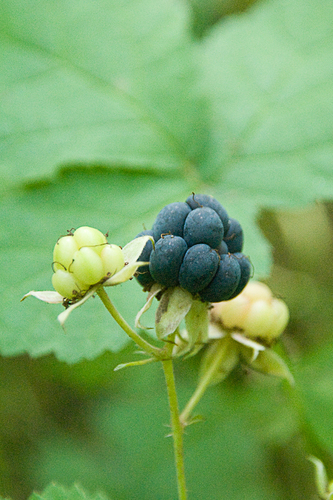
Source: Wikipedia
Synonyms 46
- 444,770 GBIF occurrences
- 33,188 iNaturalist observations
In the United Kingdom, this species has declined in the north and west of its range and in Ireland, it is rare (BSBI/BRC 2024). However, it is common throughout its native and non-native range and is sometimes thought of as a weed.
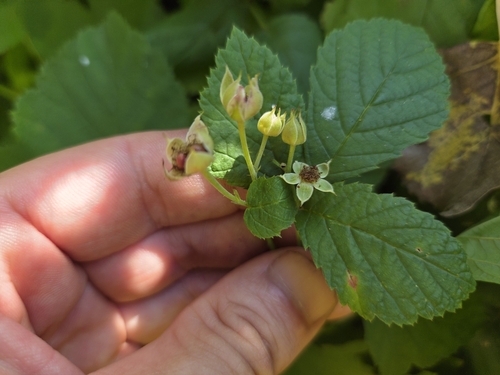
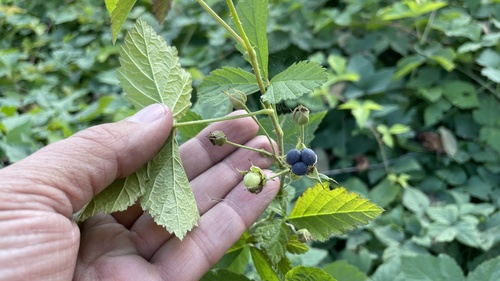
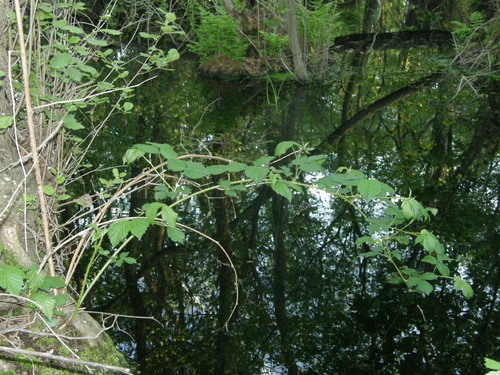
Dewberry is a dioecious perennial deciduous shrub with prickly stems found in damp habitats such as hedges, woodland borders, scrub and grassland and frequently on sea dunes. It prefers dry to moist basic soil, preferably calcareous and usually over limestone. It hybridises with Rubus fruticosus aggregate, which in some places is more frequent (Blamey and Grey-Wilson 2003, Heukels 2000, BSBI/BRC 2024).
The threats to this species are not known. It has suffered declines in the UK, perhaps due to changes in land use management and habitat alteration (BSBI/BRC 2024).
There are no conservation measures in place or needed. It is listed as Near Threatened in Norway (Artsdatabanken 2024) and Least Concern in Denmark (NERI 2007), Estonia (eBiodiversity 2012), Germany (Ludwig and Schnittler 1996), Switzerland (Moser et al. 2002), and the United Kingdom.The species is represented by 30 germplasm accessions held at European institutions (EURISCO 2024) and is included in the living collection of at least 58 botanical gardens (BGCI 2024). It occurs in many protected areas, including Natura 2000 sites (UNEP-WCMC and IUCN 2024).
European regional assessment: Least Concern (LC)EU 27 regional assessment: Least Concern (LC)This species is classified as Least Concern for both Europe and for the EU27 Member States due to its widespread distribution, stable populations and no major threats.
Gallery