Regulus regulus (Linnaeus, 1758)
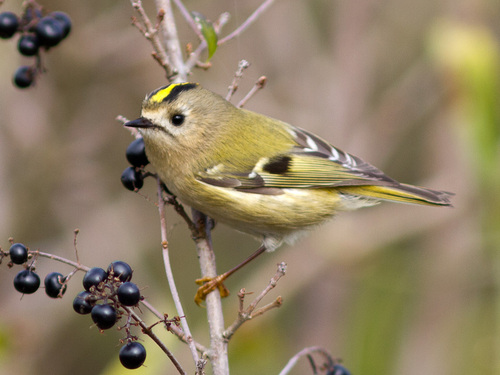
Source: Wikipedia
Synonyms 8
- 3,993,255 GBIF occurrences
- 33,677 iNaturalist observations
The European breeding population is estimated at 14,500,000–25,200,000 pairs (29,100,000–50,400,000 mature individuals). The breeding population in the EU28 is estimated at 10,400,000–16,600,000 pairs (20,800,000–33,200,000 mature individuals). For details of national estimates, see the Supplementary Information.
This species is found in boreal forests dominated by Norway Spruce (Picea abies) and fir (Abies). On Atlantic islands it uses laurel (Laurus) forest or pine (Pinus) stands with well-developed undergrowth of tree-heath (Erica), but also conifer stands of indigenous short-leaved juniper (Juniperus brevifolia) or introduced Japanese cedar (Cryptomeria japonica). Outside breeding season, and especially during migration, it will use mixed and deciduous forests, shrub vegetation and gardens and parks.Nesting begins the end of March and both sexes build the nest (Martens and Päckert 2015), which is an almost spherical cup of moss, lichens, cobwebs, feathers, and hair, in three distinct layers and with a small entrance at the top. Clutches are typically nine to eleven eggs (Snow and Perrins 1998).It feeds mainly on arthropods and is generally adapted to small-sized prey.The species is mostly migratory (Martens and Päckert 2015).Although the generation length for both EU and Europe regional assessments were calculated using the same methodology, new information arriving after the EU assessments were undertaken gave rise to an update in the generation lengths. This new information was then used for the Europe level assessments giving rise to a difference between the generation lengths used for the EU and Europe regions.
Severe winter conditions, particularly if they persist for lengthy periods over wide areas of the non-breeding range, can significantly reduce population levels, however it is capable of rapid recovery (Martens and Päckert 2015).
Conservation Actions UnderwayBern Convention Appendix II. There are currently no known conservation measures for this species.Conservation Actions ProposedAs this species is thought to be declining in Europe (Birdlife International 2015), research may be needed to determine it causes and potential conservation measures.
European regional assessment: Least Concern (LC)EU28 regional assessment: Least Concern (LC)In Europe, this species has an extremely large range (its extent of occurrence (EOO) is much larger than 20,000 km² and its area of occupancy (AOO) is much larger than 2,000 km²), and hence it does not approach the thresholds for Vulnerable under the range size criteria (criteria B and D2). The population size is extremely large (much larger than 10,000 mature individuals), and hence it does not approach the thresholds for Vulnerable under the population size criteria (criteria C and D). The population trend is estimated to be decreasing by ca 7% over 10 years, and hence the species does not approach the thresholds for Vulnerable under the population size reduction criterion (criterion A). The probability of extinction has not been calculated for this species, therefore criterion E cannot be applied. For these reasons the species is evaluated as Least Concern in Europe.In the EU28, this species has a very large range (its extent of occurrence (EOO) is larger than 20,000 km² and its area of occupancy (AOO) is much larger than 2,000 km²), and hence it does not approach the thresholds for Vulnerable under the range size criteria (criteria B and D2). The population size is extremely large (much larger than 10,000 mature individuals), and hence it does not approach the thresholds for Vulnerable under the population size criteria (criteria C and D). The population trend appears to be stable, and hence the species does not approach the thresholds for Vulnerable under the population size reduction criterion (criterion A). The probability of extinction has not been calculated for this species, therefore criterion E cannot be applied. For these reasons the species is evaluated as Least Concern in the EU28.
Gallery