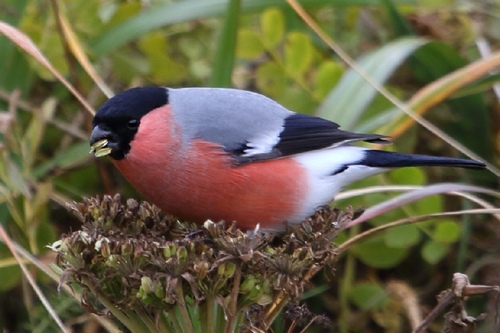
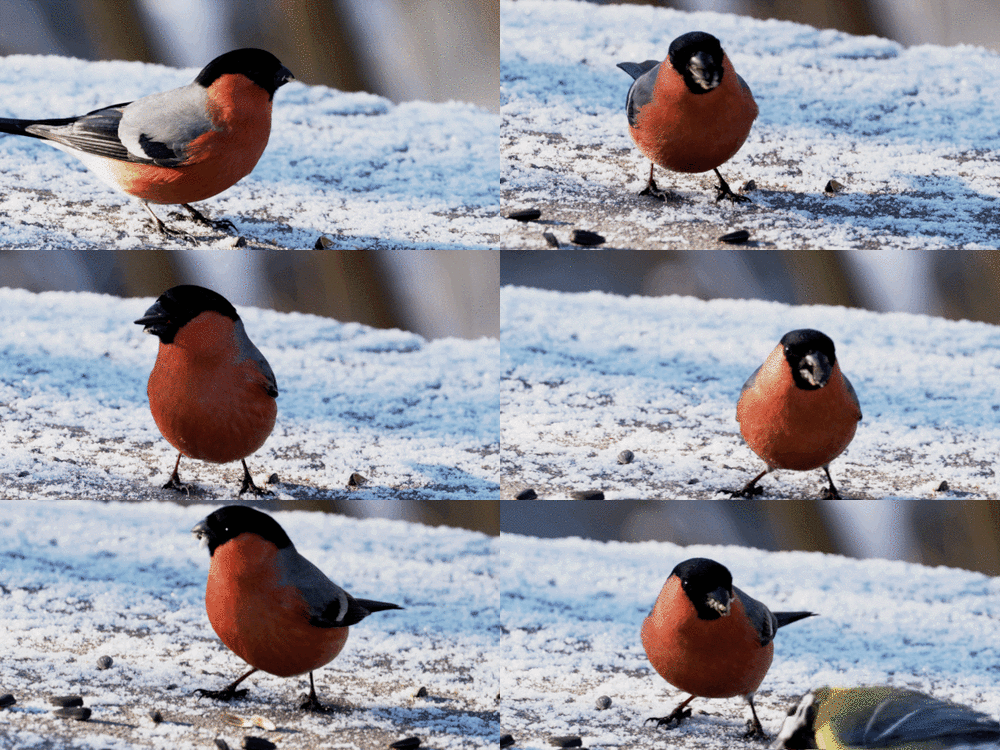
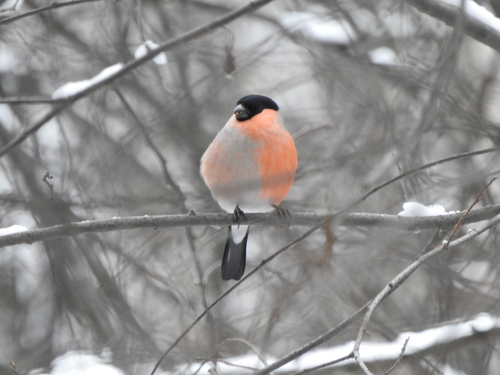
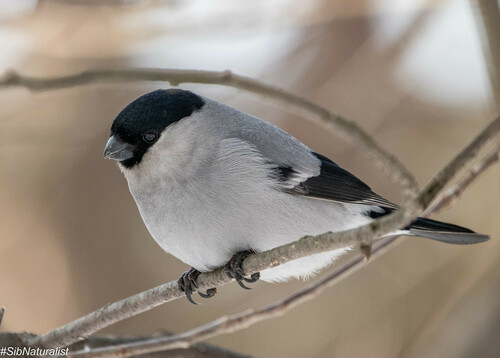
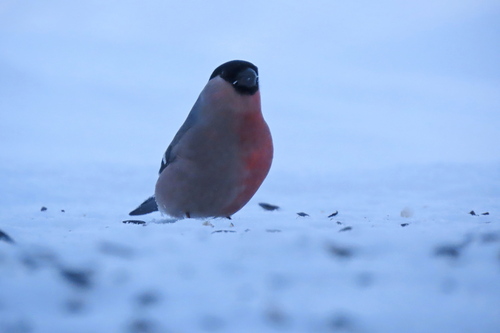
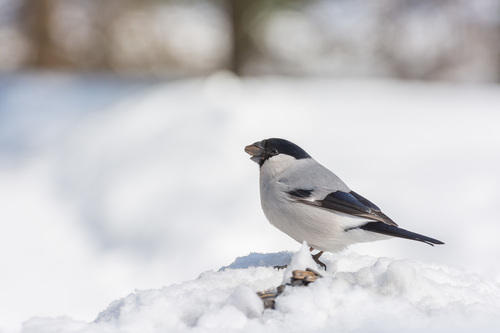
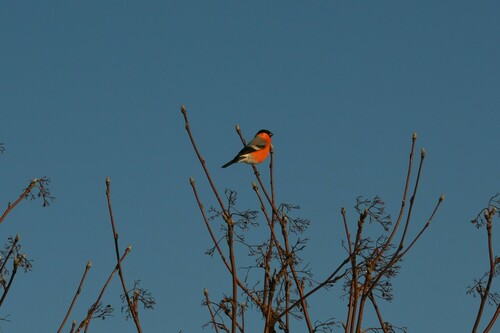
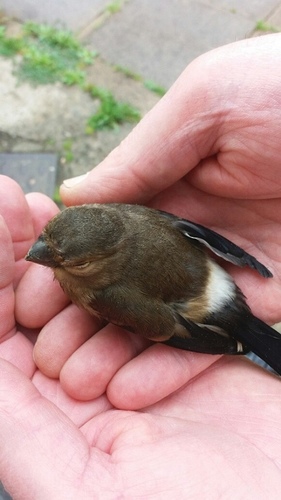
Pyrrhula pyrrhula (Linnaeus, 1758)
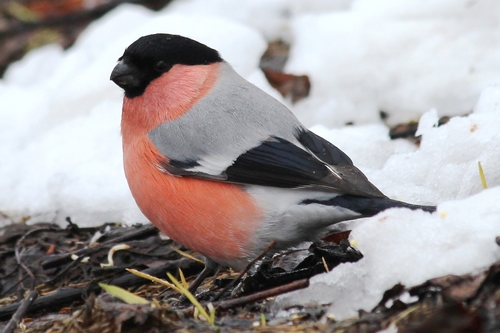
Source: Wikipedia
Synonyms 1
- 2,965,053 GBIF occurrences
- 84,988 iNaturalist observations
The European breeding population is estimated at 4,890,000–8,640,000 pairs (9,790,000–17,300,000 mature individuals). The breeding population in the EU28 is estimated at 2,390,000–4,310,000 pairs (4,780,000–8,620,000 mature individuals). For details of national estimates, see the Supplementary Information.
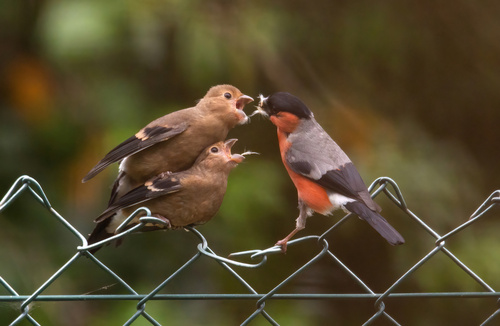
This species inhabits lowland and lower montane deciduous forest and woodlands, thickets and copses, as well as heaths, hedgerows and scrubby areas, parks and the edges of cultivation, including orchards and gardens in towns and cities. It occurs mostly in conifers and mixed and broadleaf forest in Siberia and other parts of Russia. In the Caucasus it favours in pine (Pinus) and tall beech (Fagus) forest, while in Northern Europe it prefers conifer forests with well-developed undergrowth of spruce (Picea), cedar (Cedrus), larch (Larix), also birch (Betula) and yew (Taxus).The breeding season is typically from late April to mid-September. The nest is generally constructed of dry grass, plant fibres, roots, moss, lichen and leaves set on a loose base of dry twigs and placed up to five metres from the ground in thick bush, brambles and honeysuckle or on a flat low branch of a conifer. Clutches are four to six eggs.It feeds on a range of seeds, buds and shoots of various plants, as well as some invertebrates (Clement and Christie 2013).The species is sedentary to migratory, with most populations likely being partially migratory (Snow and Perrins 1998).Although the generation length for both EU and Europe regional assessments were calculated using the same methodology, new information arriving after the EU assessments were undertaken gave rise to an update in the generation lengths. This new information was then used for the Europe level assessments giving rise to a difference between the generation lengths used for the EU and Europe regions.
Since the late 1970s numbers have declined in Britain owing to changes in agricultural practice, which is thought to adversely affected supply of weed seeds (Clement and Christie 2013). The exact mechanisms, which link land-use change and declines of the species, are poorly understood however (Siriwardena et al. 2001).
Conservation Actions UnderwayIn the U.K. it is a priority species under the U.K. Biodiversity Action Plan.Conservation Actions ProposedFurther research is needed on the importance of hedgerow structure and woodland understorey vegetation on this species (Siriwardena et al. 2001).
European regional assessment: Least Concern (LC)EU28 regional assessment: Least Concern (LC)In Europe, this species has an extremely large range (its extent of occurrence (EOO) is much larger than 20,000 km² and its area of occupancy (AOO) is much larger than 2,000 km²), and hence it does not approach the thresholds for Vulnerable under the range size criteria (criteria B and D2). The population size is extremely large (much larger than 10,000 mature individuals), and hence it does not approach the thresholds for Vulnerable under the population size criteria (criteria C and D). The population trend appears to be increasing, and hence the species does not approach the thresholds for Vulnerable under the population size reduction criterion (criterion A). The probability of extinction has not been calculated for this species, therefore criterion E cannot be applied. For these reasons the species is evaluated as Least Concern in Europe.In the EU28, this species has a very large range (its extent of occurrence (EOO) is larger than 20,000 km² and its area of occupancy (AOO) is much larger than 2,000 km²), and hence it does not approach the thresholds for Vulnerable under the range size criteria (criteria B and D2). The population size is extremely large (much larger than 10,000 mature individuals), and hence it does not approach the thresholds for Vulnerable under the population size criteria (criteria C and D). The population trend appears to be increasing, and hence the species does not approach the thresholds for Vulnerable under the population size reduction criterion (criterion A). The probability of extinction has not been calculated for this species, therefore criterion E cannot be applied. For these reasons the species is evaluated as Least Concern in the EU28.
Gallery