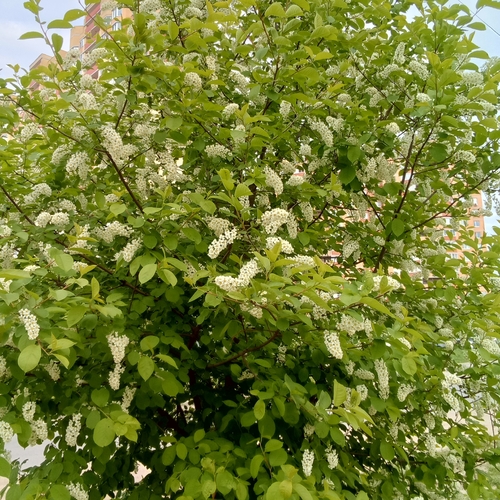
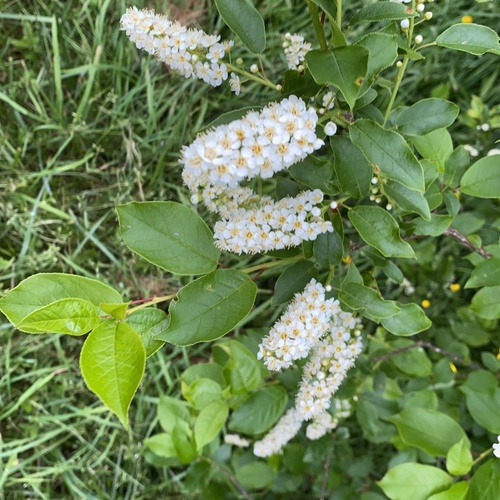
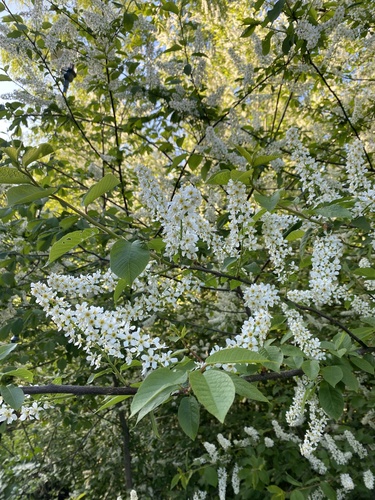
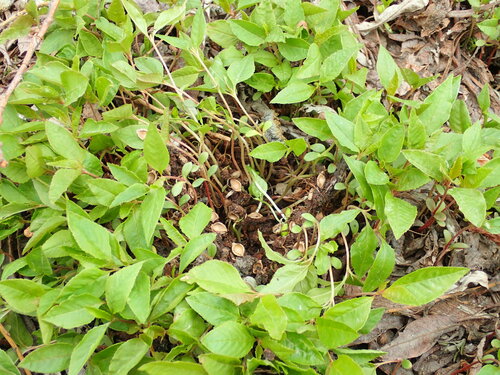
Prunus padus L.
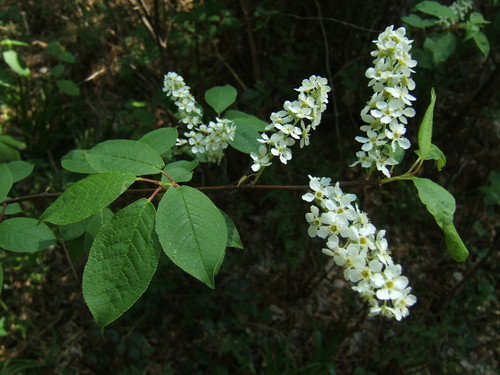
Source: Wikipedia
Synonyms 45
- 490,768 GBIF occurrences
- 60,987 iNaturalist observations
As detailed in the European Red List assessment for this species (Duarte et al. 2011), its distribution has remained unchanged in the last 40–50 years (Preston et al. 2002) and in the Netherlands was recorded in 1,001–3,000 1x1 km grid squares in 1902–1949 whereas in the periods 1975–1987 and 1988–1999 it was recorded in over 10,000 km2 (Tamis et al. 2003).Further research is needed to gather information about the population size and trend of this species throughout the rest of its range, although global population is presumed to be stable.
This species is often found in forest and scrub in Europe, most frequently on calcareous or base-rich substrates, avoiding very dry or very acidic conditions (Duarte et al. 2011).It can be found in moist woodland and scrub, along streams and shaded rocky areas in the UK (Preston et al. 2002). In Finland it occurs in herb-rich forests, waterfront thickets and forest edges, and is mostly found in open lowland forest in Hungary and the Czech Republic (Duarte et al. 2011).It is able to grow in various soil types, preferring damp calcareous or base rich soils in the UK (Preston et al. 2002) and is recorded as occurring on humid, poor, slightly acid soils and also on humid, moderately fertile soils in the Netherlands (Tamis et al. 2003).
There are currently no major threats to Prunus padus in Europe (Duarte et al. 2011). However, the subspecies borealis is threatened by forest fires, among other threats.
In Slovakia and Czech Republic, Prunus padus subsp. borealis is listed as Critically Endangered (CR) (Holub and Procházka 2000, Feráková et al. 2001, Procházka 2001). It is protected in the central/eastern region of Bourgogne (Association Tela Botanica 2000–2010) but is classified as Least Concern (LC) in Denmark (Wind and Pihl 2010) and Switzerland (Moser et al. 2002). It also does not feature on the Global Red List of Japanese Plants (National Museum of Nature and Science 2008). EURISCO reports seven germplasm accessions of P. padus held in European genebanks, none of which are reported to be of wild or weedy origin (EURISCO Catalogue 2010). Four germplasm accessions are held in the National Plant Germplasm System (NPGS), in the USA, two of which are of wild origin, neither of which are duplicated at a second site (USDA, ARS, National Genetic Resources Program 2013). Germplasm collection and duplicated ex situ storage is a priority for this species.As it is a widespread species some populations occur in protected areas (Information Center for the Environment (ICE) 2013) and while passive conservation is presumed, incorporation of targeted monitoring and management of this species into existing management plans of these sites is recommended:
- Bayerischer Wald National Park and Pflaelzerwald (Germany)
- Beinn Eighe National Nature Reserve and Isle of Rhum National Nature Reserve (United Kingdom)
- Bialowieza National Park (Poland, present with reproducing population)
- Palava Protected Landscape Area and Trebon Basin Protected Landscape Area (Czech Republic)
- Jiuzhaigou Nature Reserve (China, common with reproducing population present)
Prunus padus is globally assessed as Least Concern as it is a widely distributed species across Eurasia that has no known major threats and is also assessed as Least Concern in Europe. As identified in the European Red List assessment for this species, national level monitoring is required for the subspecies borealis as it is rare and locally threatened in some countries (Duarte et al. 2011). Germplasm collection and duplicated ex situ storage is a priority for this species, alongside incorporation of targeted monitoring and management of this species into existing management plans of protected areas where this species is present.
Gallery