Poecile palustris (Linnaeus, 1758)
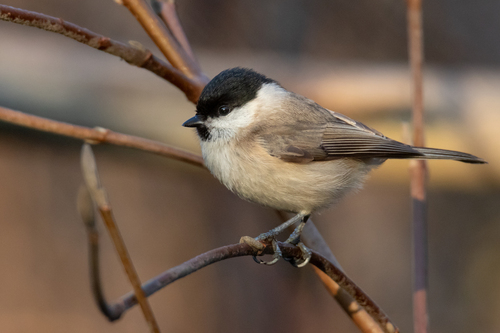
Source: Wikipedia
Synonyms 16
- 1,525,215 GBIF occurrences
- 26,872 iNaturalist observations
In Europe, the total population size is estimated at 7,480,000-13,300,000 mature individuals (BirdLife International 2021). Europe comprises c. 55% of the species' global range, so a very preliminary estimate of the global population size is 14,000,000-24,000,000 mature individuals, although further validation of this estimate is needed.
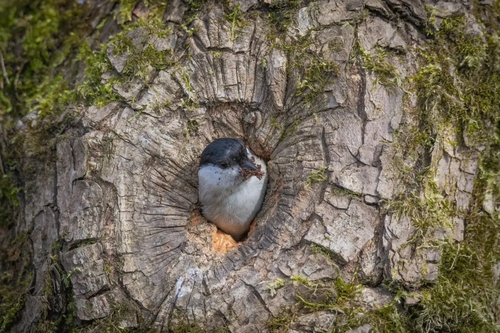
The species inhabits lowland to submontane and montane mature deciduous woodland and forest with a relatively high proportion of dead or rotting trees and open undergrowth. It is often found in large areas of oak (Quercus) and beech (Fagus), also mixed forest, riverine alder (Alnus) carr, and forests of poplar (Populus), birch (Betula), willow (Salix) and bird cherry (Prunus padus) and is also occasionally seen in wooded edges of cultivation, orchards, parks and large gardens. It uses the edge of reedbeds and in western China it uses riverine willows and scrub in deep valleys in the non-breeding season, otherwise it has no preference for marshes, damp areas or urban areas. Outside the breeding season it may use conifers and rural gardens (Gosler et al. 2013). It breeds from late March to June and is monogamous, pairing for life. The nest is a cup or pad of moss, plant material, animal hair and feathers, in a hole in a tree or stump or among upturned tree roots. It also less frequently uses a cavity in a wall or a hole in the the ground. Clutches are generally five to ten eggs. It feeds chiefly on small invertebrates as well as vegetable matter, including fruits and seeds. The species is mostly resident, although juveniles undertake short-distance post-breeding dispersal (Gosler et al. 2013).
The species suffers from habitat loss and fragmentation through urbanisation, agricultural intensification and the replacement of deciduous forest with coniferous. Severe winters cause mortality and are a particular threat to small isolated populations. The species’s extremely low colonization rate means although suitable habitat areas may exist, they may not be colonized for a long time (Hagemeijer and Blair 1997). Increased predator pressure (Siriwardena 2006) and competition from other parids may affect the species (Perrins 2003).
Conservation Actions UnderwayBern Convention Appendix II. Research has focused on the causes of declines despite high breeding success and apparent improvements in habitat quality (Broughton and Hinsley 2015).Conservation Actions ProposedConservation measures should aim to expand woodland cover to secure and link existing populations and where possible woods should be allowed to reach a natural climax stage. Hedgerows should be conserved and more planted to facilitate dispersal; it is suggested that local measures should ensure gaps of 100 m or more be closed up with new hedgerows or ‘stepping stone’ patches of hedge. Large numbers of nestboxes in a wood may do more to encourage populations of other parids to the detriment of this species. Translocations may be a potential future tool to enable colonisation (Broughton and Hinsley 2015).
This species has an extremely large range, and hence does not approach the thresholds for Vulnerable under the range size criterion (extent of occurrence under 20,000 km² combined with a declining or fluctuating range size, habitat extent/quality, or population size and a small number of locations or severe fragmentation). The population size is extremely large, and hence does not approach the thresholds for Vulnerable under the population size criterion (under 10,000 mature individuals with a continuing decline estimated to be over 10% in ten years or three generations, or with a specified population structure). Despite the fact that the population trend appears to be decreasing, the decline is not believed to be sufficiently rapid to approach the thresholds for Vulnerable under the population trend criterion (over 30% decline over ten years or three generations). For these reasons the species is evaluated as Least Concern.
Gallery