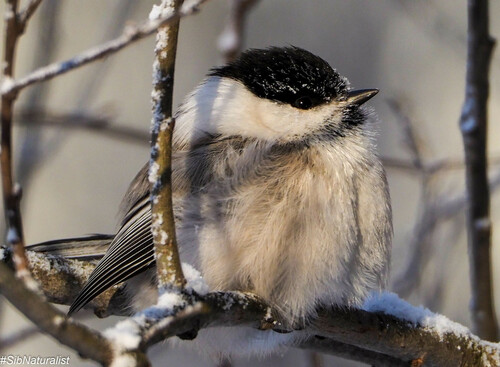
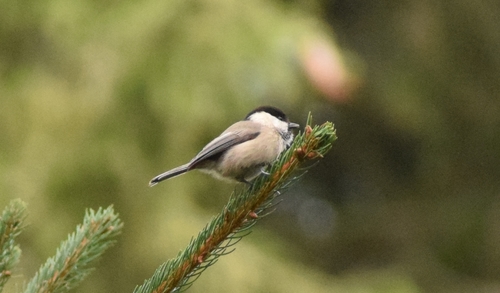
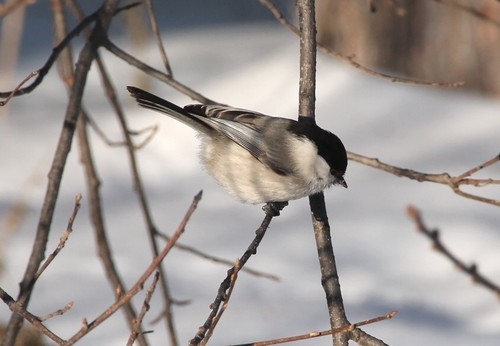
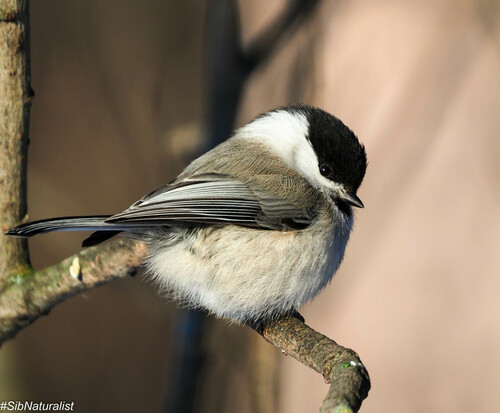
Poecile montanus (Conrad von Baldenstein, 1827)
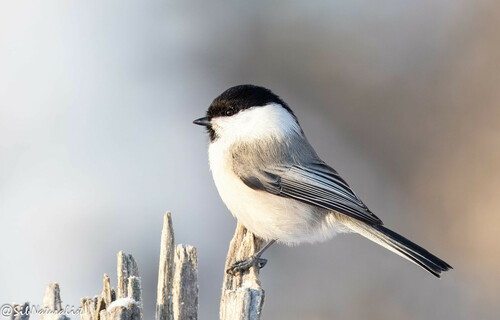
Source: Wikipedia
Synonyms 23
- 1,339,214 GBIF occurrences
- 33,915 iNaturalist observations
The European breeding population is estimated at 7,000,000–12,700,000 pairs, which equates to 14,000,000–25,400,000 mature individuals. The breeding population in the EU28 is estimated at 2,030,000–3,270,000 pairs, which equates to 4,070,000–6,540,000 mature individuals. For details of national estimates, see the Supplementary Information.
This species inhabits lowland, submontane and montane forests and woodlands, principally coniferous forests of pine (Pinus), larch (Larix) and spruce (Picea), and in Siberian taiga it is most frequently in steppe-forest of Siberian stone pine (Pinus sibirica). It is often found in dense and damp areas, especially Sphagnum bogs and areas of willows (Salix) or alders (Alnus) and on tundra edge. In Europe, it also occurs in willows, alders and more shrubby vegetation, including elder (Sambucus) patches, edges of woods, copses, and hedges, especially along rivers and beside lakes. In Tien Shan, it occurs in montane conifer forest, also mixed broadleaf woodland with well-developed undergrowth and willow thickets, and lowland to submontane birch (Betula) forest. It is also found in riverine and swamp thickets, and occasionally in osier (Salix) beds.It breeds from April to July and is monogamous, forming a pair-bond for life. The female builds the nest, which is constructed mostly of bark or wood strips, grass, plant fibres, animal hair and feathers (rarely, moss included). It is placed in a hole or crevice up to 3 m (often less than 1 m, exceptionally to 10 m) from the ground in a rotting tree trunk or old stump. The hole is excavated by both sexes or may be adapted from an existing one. Clutch size is five to nine eggs.The species feeds mostly on invertebrates and larvae, but also on vegetable matter. It may store food behind loose bark, under branches, in bud capsules or in lichen and rarely in the ground in a steep bank.The species is mainly resident (Gosler et al. 2013).Although the generation length for both EU and Europe regional assessments were calculated using the same methodology, new information arriving after the EU assessments were undertaken gave rise to an update in the generation lengths. This new information was then used for the Europe level assessments giving rise to a difference between the generation lengths used for the EU and Europe regions.
Habitat loss and degradation are implicated in the decline in the U.K. and there is also recent evidence that increased competition from other parids, which evict this species from nest-holes, and increased nest predation by Great Spotted Woodpeckers (Dendrocopos major) are also important factors, exacerbated by the low dispersal ability of the species that makes recolonisation difficult after local extinction (Gosler et al. 2013). The species may also be threatened by future climate change (Harrison et al. 2003, Siriwardena 2004).
Conservation Actions UnderwayBern Convention Appendix II. In the U.K. the species is Red listed and is a U.K. Biodiversity Action Plan (BAP) priority bird species and several local BAPs have been developed. Conservation Actions ProposedInvestigate rates of habitat loss and pressures from other species to determine their impact on this species. Ensure existing populations are adequately protected.
European regional assessment: Least Concern (LC)EU28 regional assessment: Near Threatened (NT)In Europe, this species has an extremely large range (its extent of occurrence (EOO) is much larger than 20,000 km² and its area of occupancy (AOO) is much larger than 2,000 km²), and hence it does not approach the thresholds for Vulnerable under the range size criteria (criteria B and D2). The population size is extremely large, (much larger than 10,000 mature individuals), and hence it does not approach the thresholds for Vulnerable under the population size criteria (criteria C and D). Despite the fact that the population trend appears to be decreasing, the decline is not believed to be sufficiently rapid to approach the thresholds for Vulnerable under the population size reduction criterion (criterion A). The probability of extinction has not been calculated for this species, therefore criterion E cannot be applied. For these reasons the species is evaluated as Least Concern in Europe.Within the EU28, this species has an extremely large range (its extent of occurrence (EOO) is much larger than 20,000 km² and its area of occupancy (AOO) is much larger than 2,000 km²), and hence it does not approach the thresholds for Vulnerable under the range size criteria (criteria B and D2). The population size is extremely large, (much larger than 10,000 mature individuals), and hence it does not approach the thresholds for Vulnerable under the population size criteria (criteria C and D). The probability of extinction has not been calculated for this species, therefore criterion E cannot be applied. The population trend appears to be decreasing at a moderately rapid rate which approaches the thresholds for Vulnerable under the population size reduction criterion (criterion A) and is therefore assessed as Near Threatened (NT). There is not considered to be significant potential for rescue from outside the region, and therefore the final category remains unchanged.
Gallery