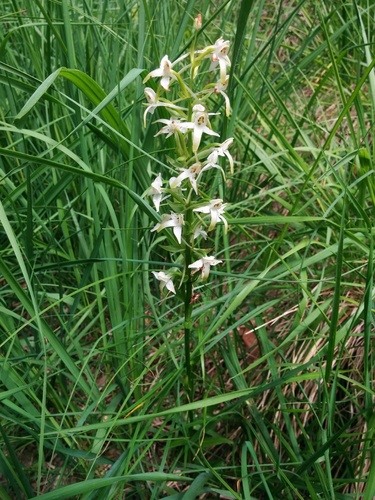
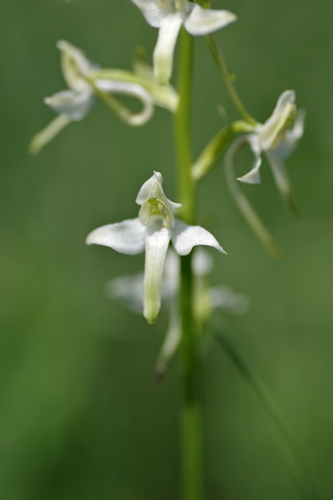
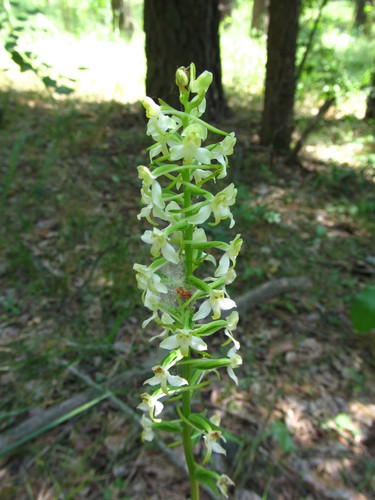
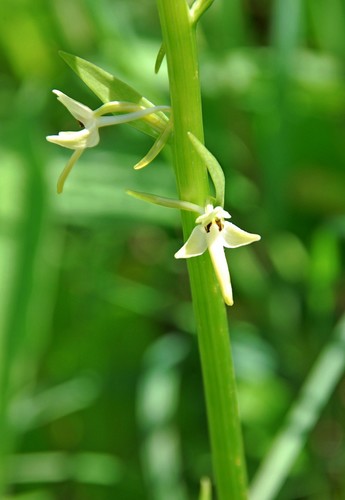
Platanthera chlorantha (Custer) Rchb.
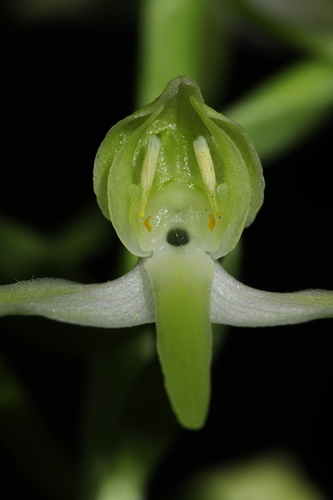
Source: Wikipedia
Synonyms 20
- 162,826 GBIF occurrences
- 13,999 iNaturalist observations
The Greater Butterfly Orchid is widespread, but populations are declining, and many subpopulations have been lost or appear to have only a handful of individuals. The species has declined greatly in the United Kingdom, with a loss since the 1930s of 46% of the historical range and 53.5% in Ireland. Declines are largely related to alteration of land management strategy and the proliferation of woodland habitats (Botanical Society of Britain and Ireland 2024). Population decline is noted for subpopulations in northeastern Ukraine, but the rate of population decline is quite low (Широков et al. 2020).
The species is found in a variety of habitats such as short grassland, damp meadows, fens, deciduous woodland, woodland edges, and open woodland. It prefers dry to damp, often calcareous (chalk, limestone and bas-rich clays), alkaline soils. This species grows in shade to full sunlight and flowers from late May to late July.
The Greater Butterfly Orchid is declining rapidly on many sites due to clearance or 'coniferisation' of woodland and the destruction of grassland by agricultural improvement, urban and infrastructure development (Botanical Society of Britain and Ireland 2024). The development of a dense woodland canopy suppresses flowering as the species needs light. Lack of grazing leads to increased competition, but overgrazing also has detrimental effects, and the collection of the species for decorative uses has negative impacts.
All orchid species are included under Annex B of the Convention on International Trade in Endangered Species of Wild Fauna and Flora (CITES). This orchid is included in the following national red lists:
- Vulnerable in Belarus (Ermakova 2005), Czech Republic (Holub and Procházka 2000, Grulich and Chobot 2017), Germany (level 3 - Ludwig and Schnittler 1996, Metzing et al. 2018), Luxembourg (Colling 2005).
- Near Threatened in Croatia (Nikolić and Topić 2005), Denmark (Aarhus Universitet 2019), Hungary (Király 2007), Poland (Kaźmierczakowa et al. 2016), and the United Kingdom (Cheffings and Farrell 2005).
- Least Concern in Estonia (eElurikkus 2024), Finland (Hyvärinen et al. 2019), France (UICN France et al. 2010), Norway (Solstad et al. 2021) and Switzerland (Moser et al. 2002, Bornand et al. 2016).
The species is represented by five germplasm accessions held at European institutions (EURISCO 2024), and is included in the living collection of at least 19 botanical gardens (BGCI 2024). It occurs in many protected areas, including Natura 2000 sites (UNEP-WCMC and IUCN 2024).
European regional assessment: Least Concern (LC)EU 27 regional assessment: Least Concern (LC)The Greater Butterfly Orchid (Platanthera chlorantha) is widespread, but the population is declining, and many subpopulations have been lost. The main threats are clearance or 'coniferisation' of woodland, destruction of grassland by agricultural improvement, and urban development. Overall, the existing threats are unlikely to cause the populations to decline severely in the near future. Therefore, the species is assessed as Least Concern for both Europe and for the EU27 Member States. Conservation efforts may be warranted in parts of its range.
Gallery