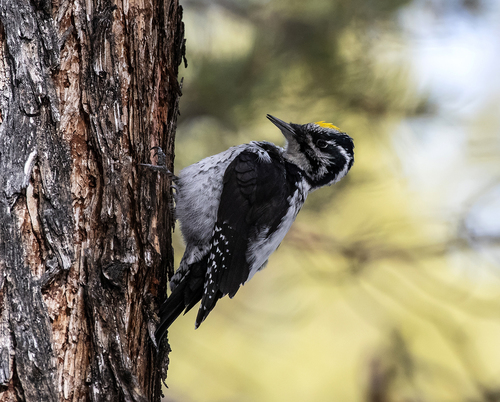
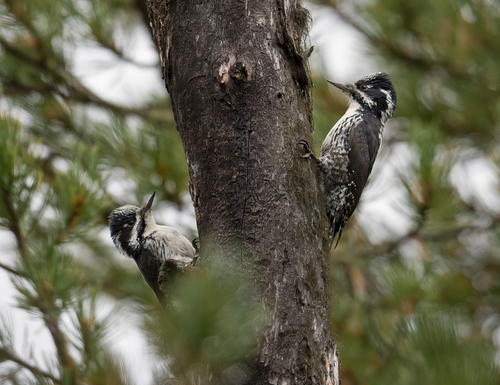
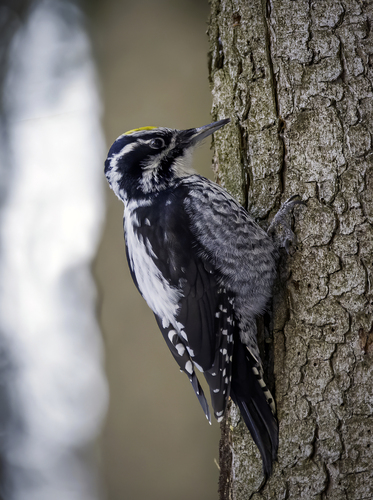
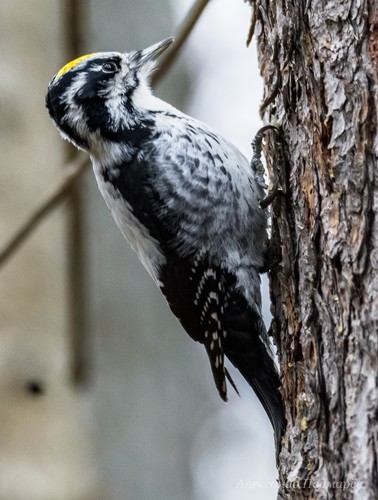
Picoides tridactylus (Linnaeus, 1758)
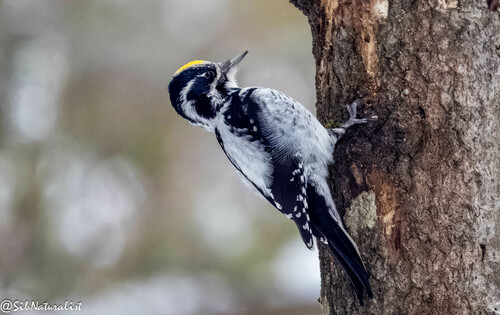
Source: Wikipedia
- 142,221 GBIF occurrences
- 3,519 iNaturalist observations
In North America, the total population size is estimated at 1,600,000 mature individuals in the USA and Canada (Partners in Flight 2024). This region forms under half (c. 35%) of the species' global range. Additionally, in Europe, the total population size is estimated at 603,000-1,120,000 mature individuals, with 301,000-559,000 breeding pairs (BirdLife International 2021), and comprises under a quarter (c. 20%) of the species' global range. A very preliminary estimate of the global population size is therefore between 4,010,000-4,950,000 mature individuals, although further validation of this estimate is desirable.
The species inhabits mature conifer forests, particularly spruce Picea spp., and is somewhat irruptive, being found commonly where disturbance such as fire has caused local outbreaks of insects (Winkler et al. 1995).
Large-scale commercial logging and modern forestry management practices, including fire suppression and removal of dead or insect-infested trees, have led to declines. It is susceptible to habitat loss, forest degradation and fragmentation. Its relatively small population sizes, dependence on snags, and preference for burnt forest and large stands of old-growth conifers make it vulnerable to forestry practices and its survival in managed forests is not guaranteed. Modern intensive forestry methods, including clear-cutting, fire suppression, removal of dead trees and pesticide use threaten the species (Winkler and Christie 2002).
Conservation Actions UnderwayBern Convention Appendix II. EU Birds Directive Annex I. There are no known current conservation measures for this species within its European range.Conservation Actions ProposedThe following information refers to the species's European range only: Intensive management of favoured habitats, such as old spruce- or fir-dominated forest with abundant dead wood in mountains or damp lowlands of this species should be avoided. Protected areas should cover at least 50 ha, in order to sustain a single pair. Within intensively managed mature forests, dying or dead trees should be left. If there is insufficient dead wood then cutting single mature trees to around 10 m and leaving to decay, may provide suitable nest sites (Tucker and Heath 1994).
This species has an extremely large range, and hence does not approach the thresholds for Vulnerable under the range size criterion (extent of occurrence under 20,000 km² combined with a declining or fluctuating range size, habitat extent/quality, or population size and a small number of locations or severe fragmentation). The population size is extremely large, and hence does not approach the thresholds for Vulnerable under the population size criterion (under 10,000 mature individuals with a continuing decline estimated to be over 10% in ten years or three generations, or with a specified population structure). The population trend is not known, but the population is not believed to be decreasing sufficiently rapidly to approach the thresholds under the population trend criterion (over 30% decline over ten years or three generations). For these reasons the species is evaluated as Least Concern.
Gallery