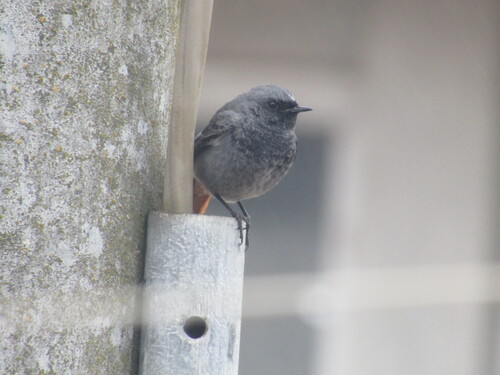
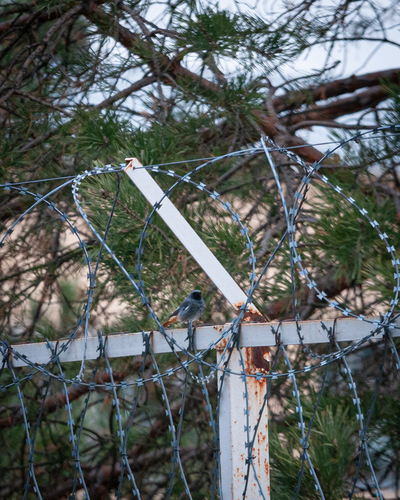
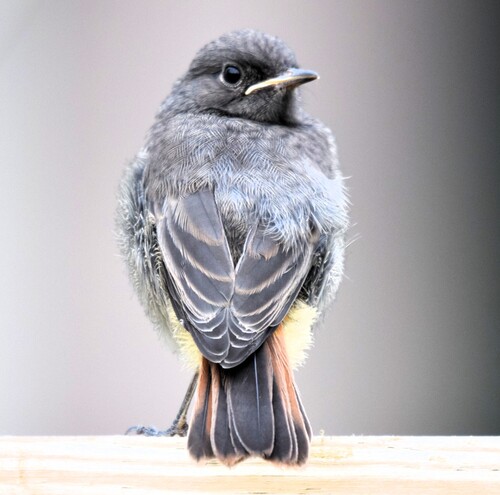
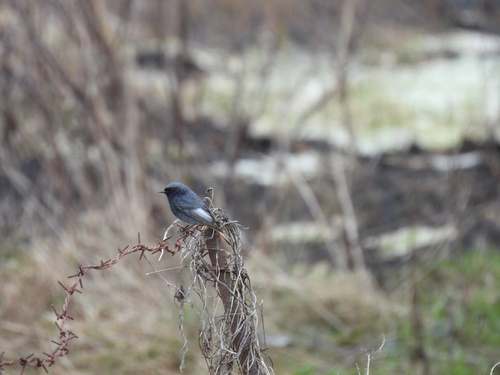
Phoenicurus ochruros (S. G. Gmelin, 1774)
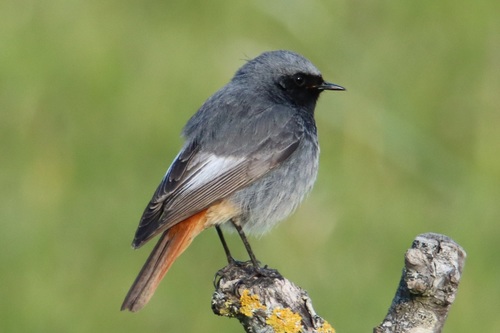
Source: Wikipedia
- 2,497,669 GBIF occurrences
- 94,187 iNaturalist observations
The European breeding population is estimated at 6,590,000-10,700,000 pairs (13,100,000-21,300,000 mature individuals). The breeding population in the EU28 is estimated at 4,870,000-7,750,000 pairs (9,750,000-15,500,000 mature individuals). For details of national estimates, see the supplementary information.
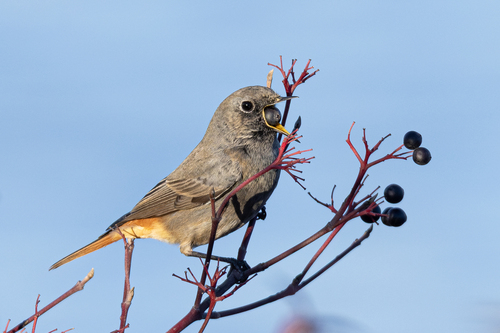
This species is found in sparsely vegetated rocky areas, including stony slopes with xerophytic vegetation, crags and gullies in high river valleys and rocky mountain tops up to snow-line as well as villages, towns and cities. In the Carpathians, it is mainly found on mountain slopes covered with juniper (Juniperus), scree and boulders. The breeding season runs from mid-April to mid-July in western Europe but can be up to two weeks later in eastern Europe.The nest is a loose cup of grass, moss, hair, wool and feathers, which is set in a crevice of a wall or rock, or in an earth bank, pile of stones or on the ground. Clutches are four to six eggs. The diet consists of invertebrates and berries. The species is resident, partially migrant, a vertical migrant and fully migrant (Billerman et al. 2020) in different parts of its range and the main wintering area for west Palearctic breeders is the Mediterranean basin (Snow and Perrins 1998).Although the generation length for both EU and Europe regional assessments were calculated using the same methodology, new information arriving after the EU assessments were undertaken gave rise to an update in the generation lengths. This new information was then used for the Europe level assessments giving rise to a difference between the generation lengths used for the EU and Europe regions.
It is thought large scale redevelopment and regeneration of city centre sites is causing the loss of suitable breeding habitat for the species. In addition nest sites are vulnerable to accidental removal or disturbance as they also nest in railway-sidings, lorry parks and similar locations (Wildlife Trust 2015).
Conservation Actions UnderwayCMS Appendix II. Bern Convention Appendix II. The species is a 'Species of Conservation Concern' in the U.K. Biodiversity Action Plan and subject to several local species action plans. Conservation Actions ProposedConservation measures should aim to maintain existing breeding populations and to establish population trends and its conservation status. Public awareness of the species should also be raised (Wildlife Trust 2015).
European regional assessment: Least Concern (LC)EU28 regional assessment: Least Concern (LC)In both Europe and the EU28, this species has an extremely large range (its extent of occurrence (EOO) is much larger than 20,000 km² and its area of occupancy (AOO) is much larger than 2,000 km²), and hence it does not approach the thresholds for Vulnerable under the range size criteria (criteria B and D2). The population size is extremely large (much larger than 10,000 mature individuals), and hence it does not approach the thresholds for Vulnerable under the population size criteria (criteria C and D). The population trend appears to be stable, and hence the species does not approach the thresholds for Vulnerable under the population size reduction criterion (criterion A). The probability of extinction has not been calculated for this species, therefore criterion E cannot be applied.For these reasons the species is evaluated as Least Concern in both Europe and the EU28.
Gallery