Pernis apivorus (Linnaeus, 1758)
Source: Wikipedia
Synonyms 1
- 754,747 GBIF occurrences
- 19,344 iNaturalist observations
Taking into account the proportion of the Mediterranean-country breeding range found in the Mediterranean hotspot (c. 27.9% of its breeding range within countries that fall in the Mediterranean region) gives a population size of 8,657-12,782 mature individuals, but given there is some uncertainty, a wider range of 8,500-13,000 mature individuals is used here (see BirdLife International 2021 for full range state estimates). Overall, based on the data in BirdLife International (2021), the population trend is thought to be approximately stable.
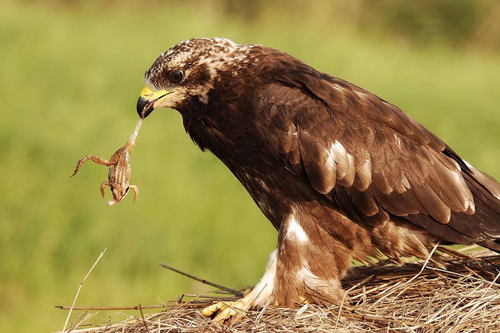
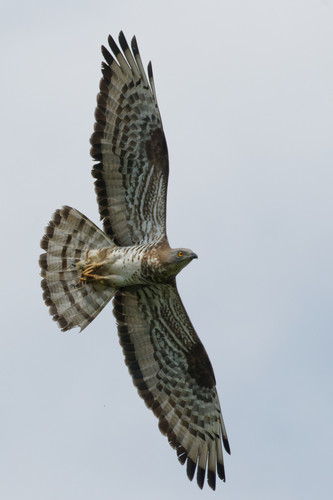
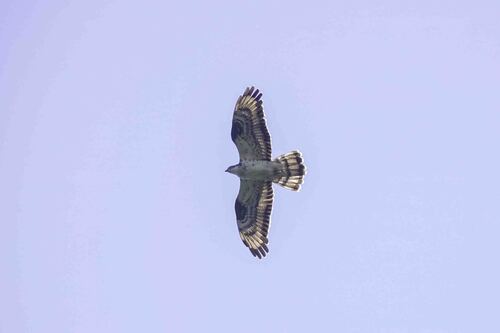
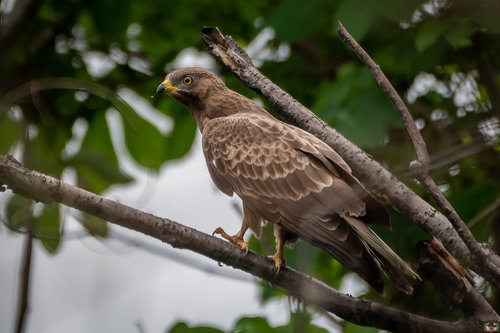
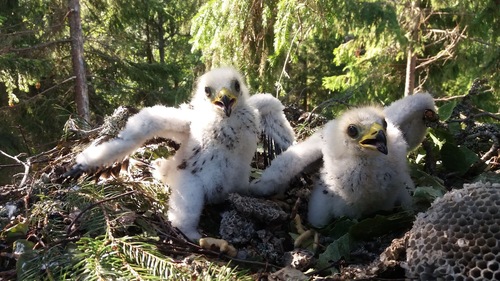
This is a migratory species, wintering in in tropical Africa. It leaves its breeding grounds in August and September, returning between April and June (Orta et al. 2020). Birds are mostly solitary except on migration, when they flock throughout, gathering in large numbers at preferred crossing points as well as roosting socially (Ferguson-Lees and Christie 2001, Porter and Aspinall 2010, Orta et al. 2020). They fly chiefly by soaring, although are able to cross wide stretches of water with flapping flight (Snow and Perrins 1998, Ferguson-Lees and Christie 2001). The species is diurnal (Snow and Perrins 1998). It is found in forests and woods, preferably deciduous, but also mixed forests in temperate and boreal zones. It also uses a variety of habitats with both wooded and open areas, including heathland and cultivated area. It feeds mainly on wasps and hornets. Nests are built in woods, preferentially in deciduous trees. Typically females lay two eggs (Orta et al. 2020).
Many birds are shot on migration, notably in Italy, Malta and Lebanon (Ferguson-Lees and Christie 2001, Orta et al. 2020). Population declines in northern Europe have resulted from deforestation, forest conversion and shooting. Human disturbance is also a threat. Pesticide use has not had significant impacts in Europe (due to the species living in woodland and feeding on wasps). It is very highly vulnerable to the effects of potential wind energy development (Strix 2012).
Conservation Actions UnderwayEU Birds Directive Annex I. CITES Appendix II. CMS Appendix II.Conservation Actions ProposedIllegal hunting should be prevented and low-intensity agriculture and forestry promoted. Disturbance during the breeding season should be minimised.
Mediterranean regional assessment: Least Concern (LC)This species has a large range in the Mediterranean region (its extent of occurrence (EOO) is much larger than 20,000 km² and its area of occupancy (AOO) is much larger than 2,000 km²), and hence it does not approach the thresholds for Vulnerable under the range size criteria (criteria B and D2). The population size is estimated to be in the range 8,500-13,000 mature individuals and hence it does not approach the thresholds for Vulnerable under the population size criterion D. The population trend appears to be stable, and hence the species does not approach the thresholds for Vulnerable under the population size reduction criterion (criterion A), and it would also not warrant listing under criterion C despite having a population size estimate that overlaps the Vulnerable threshold. The probability of extinction has not been calculated for this species, therefore criterion E cannot be applied. For these reasons the species is evaluated as Least Concern.
Gallery