Passer domesticus (Linnaeus, 1758)
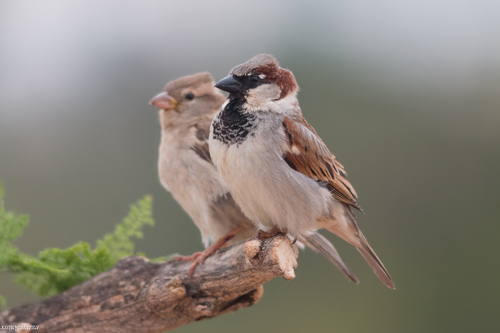
Source: Wikipedia
- 25,831,586 GBIF occurrences
- 553,799 iNaturalist observations
The European breeding population is estimated at 135,000,000-189,000,000 pairs, which equates to 270,000,000-378,000,000 mature individuals. The breeding population in the EU28 is estimated at 114,000,000-150,000,000 pairs, which equates to 228,000,000-300,000,000 mature individuals. For details of national estimates, see the Supplementary Information.
This species is often associated with man, living around buildings from isolated farms to urban centres and showing a preference for suburbs. In the south of its range it is more frequently found in open country, and has been recorded as breeding in small isolated colonies away from humans. It breeds from February to September, although timing varies with latitude. It breeds in loose colonies and nests are constructed mainly of plant stems, lined with feathers or other soft material. Its preferred site is a hole in a building, cliff or tree. Clutches are two to five eggs. The diet is mainly vegetable material, particularly seeds of grasses, cultivated cereals and low herbs, but also buds, berries and wide range of household scraps. It does take some animal matter (c. 10% of the diet in summer months). The species is mostly resident with some limited withdrawal of populations breeding at high latitudes and altitudes to less cold areas in winter (Summers-Smith et al. 2015).Although the generation length for both EU and Europe regional assessments were calculated using the same methodology, new information arriving after the EU assessments were undertaken gave rise to an update in the generation lengths. This new information was then used for the Europe level assessments giving rise to a difference between the generation lengths used for the EU and Europe regions.
Declines in western Europe have been attributed to a decrease in availability of suitable invertebrate food necessary for rearing young as well as possible reduced fitness of those young that fledge successfully (Summers-Smith et al. 2015). This may be as a result of changes in agricultural practices such as the increased use of pesticides and herbicides and the autumn sowing of cereals, which have lead to decreases in food for this species (Hagemeijer and Blair 1997).
Conservation Actions UnderwayThe species was Red-listed in the U.K. in 2002 and listed as Near-threatened in Germany as a result of declines (Summers-Smith et al. 2015).Conservation Actions ProposedThe conservation and habitat enhancement of even the smallest parks and gardens may be key in addressing the decline of this species in many cities (Summers-Smith et al. 2015).
European regional assessment: Least Concern (LC)EU28 regional assessment: Least Concern (LC)In Europe, this species has an extremely large range (its extent of occurrence (EOO) is much larger than 20,000 km² and its area of occupancy (AOO) is much larger than 2,000 km²), and hence it does not approach the thresholds for Vulnerable under the range size criteria (criteria B and D2). The population size is extremely large (much larger than 10,000 mature individuals), and hence it does not approach the thresholds for Vulnerable under the population size criteria (criteria C and D). Despite the fact that the population trend appears to be decreasing, the decline is not believed to be sufficiently rapid to approach the thresholds for Vulnerable under the population size reduction criterion (criterion A). The probability of extinction has not been calculated for this species, therefore criterion E cannot be applied. For these reasons the species is evaluated as Least Concern in Europe.Within the EU28, this species has an extremely large range (its extent of occurrence (EOO) is much larger than 20,000 km² and its area of occupancy (AOO) is much larger than 2,000 km²), and hence it does not approach the thresholds for Vulnerable under the range size criteria (criteria B and D2). The population size is extremely large (much larger than 10,000 mature individuals), and hence it does not approach the thresholds for Vulnerable under the population size criteria (criteria C and D). The population trend appears to be stable, and hence does not approach the thresholds for Vulnerable under the population size reduction criterion (criterion A). The probability of extinction has not been calculated for this species, therefore criterion E cannot be applied. For these reasons the species is evaluated as Least Concern within the EU28.
Gallery