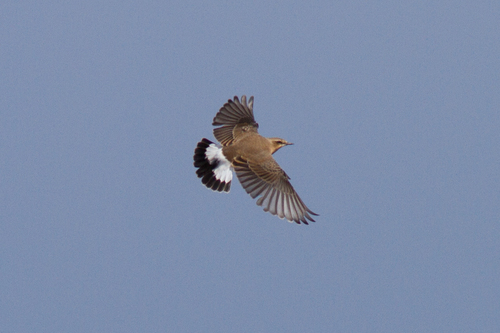
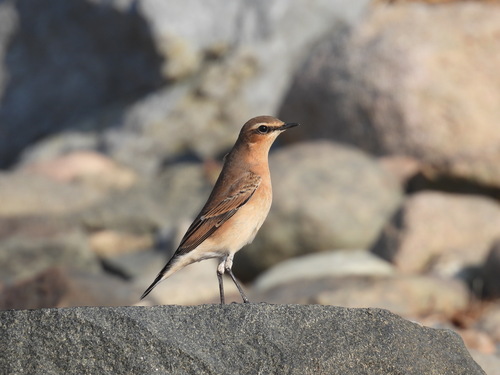
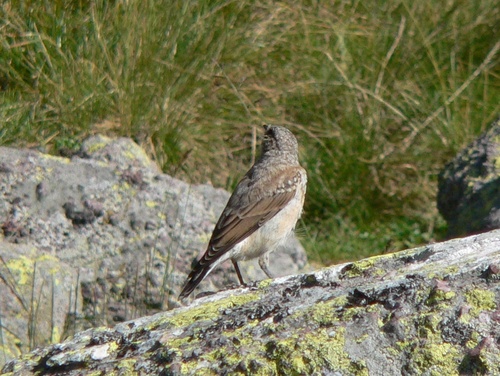
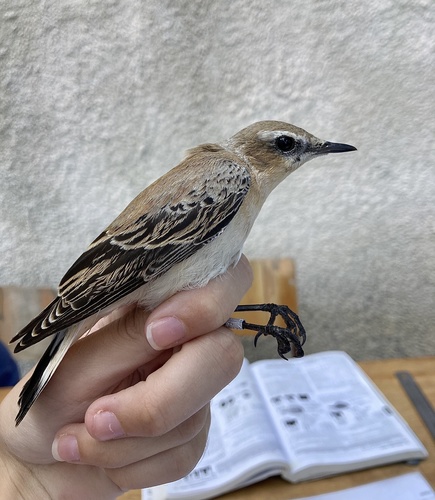
Oenanthe oenanthe (Linnaeus, 1758)
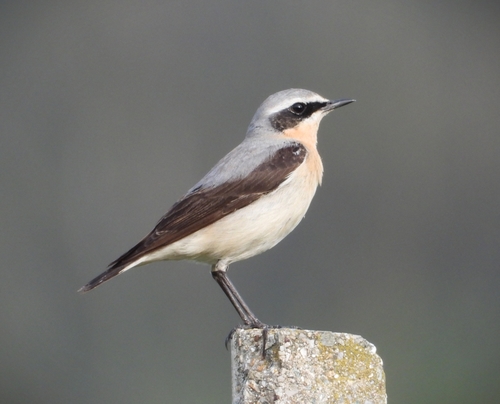
Source: Wikipedia
- 1,791,181 GBIF occurrences
- 49,229 iNaturalist observations
The European breeding population is suspected to be 5,410,000–14,700,000 pairs, which equates to 10,800,000–29,300,000 mature individuals. The breeding population in the EU28 is estimated at 2,030,000–3,820,000 pairs, which equates to 4,060,000–7,630,000 mature individuals. For details of national estimates, see the Supplementary Information.
During the breeding season this species occupies open ground including open stony estuarine plains with sparse clumps of vegetation, sand dunes, shingle stretches, clifftops, coastal islands, heavily grazed heathland and downland, moors, meadows, walled fields, stone-studded bogs, open submontane shrubland, rocky alpine meadows, streamside bluffs, lowland and montane tundra above tree-line.Breeding occurs from early May to June in central and southern Europe, early/mid-April to the end of July or early August in north-west Europe, late May and June in Iceland, and early or mid-May to early July in Scandinavia. The nest is an unlined cup of leaves, stems, moss, lichen, feathers and hair bedded on a cradle and foundation of dried stems and grasses and set in a well-sheltered rock cavity, narrow crevice, rodent burrow, hole in a wall or under stones. Clutches are four to eight eggs.It feeds on arthropods, particularly insects.The species is a long-distance migrant (Collar and de Juana 2015).Although the generation length for both EU and Europe regional assessments were calculated using the same methodology, new information arriving after the EU assessments were undertaken gave rise to an update in the generation lengths. This new information was then used for the Europe level assessments giving rise to a difference between the generation lengths used for the EU and Europe regions.
In many western and central European countries it has declined due to habitat change through agricultural intensification and urbanization. In some countries a reduction in sheep-farming has reduced the amount of short-grass habitat much favoured by species. In the past, droughts in the Sahel wintering quarters may also have caused declines. In Europe, it used to be trapped for food and is still taken in large numbers in parts of the Mediterranean Basin and northern Africa (Collar 2005).
Conservation Actions UnderwayCMS Appendix II. Bern Convention Appendix II. In Russia and most European countries the species is protected and in some parts of it range, such as in the UK, artificial nesting sites have been created leading to an increase in the number of breeding birds in these areas (Kren and Zoerb 1997).Conservation Actions ProposedResearch has proposed that landscape management for a mixture of short and tall vegetation would allow the dispersal of arthropods and be beneficial for this species (Oosten et al. 2014). It is also suggested the multi-site studies should be undertaken to determine appropriate conservation actions locally and in the short-term (Oosten et al. 2015).
European regional assessment: Least Concern (LC)EU28 regional assessment: Near Threatened (NT)In Europe, this species has an extremely large range (its extent of occurrence (EOO) is much larger than 20,000 km² and its area of occupancy (AOO) is much larger than 2,000 km²), and hence it does not approach the thresholds for Vulnerable under the range size criteria (criteria B and D2). The population size is extremely large, (much larger than 10,000 mature individuals), and hence it does not approach the thresholds for Vulnerable under the population size criteria (criteria C and D). The population trend is not known, but it is not believed to approach the thresholds for Vulnerable under the population size reduction criterion (criterion A). The probability of extinction has not been calculated for this species, therefore criterion E cannot be applied. For these reasons the species is evaluated as Least Concern in Europe.In the EU28, this species has an extremely large range (its extent of occurrence (EOO) is much larger than 20,000 km² and its area of occupancy (AOO) is much larger than 2,000 km²), and hence it does not approach the thresholds for Vulnerable under the range size criteria (criteria B and D2). The population size is extremely large, (much larger than 10,000 mature individuals), and hence it does not approach the thresholds for Vulnerable under the population size criteria (criteria C and D). The probability of extinction has not been calculated for this species, therefore criterion E cannot be applied. The population trend appears to be decreasing at a moderately rapid rate which approaches the thresholds for Vulnerable under the population size reduction criterion (criterion A), and the species is therefore assessed as Near Threatened (NT) in the EU28. There is not considered to be significant potential for rescue from outside the region, and therefore the final category remains unchanged.
Gallery