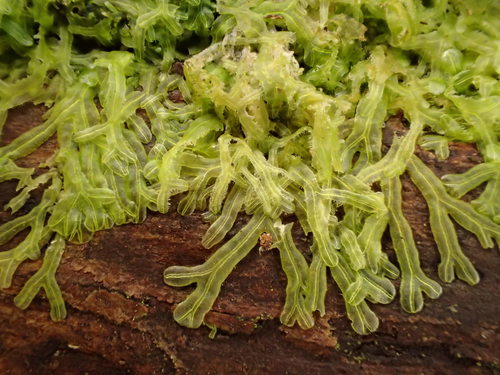
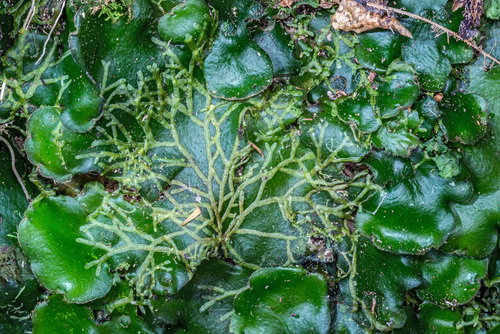
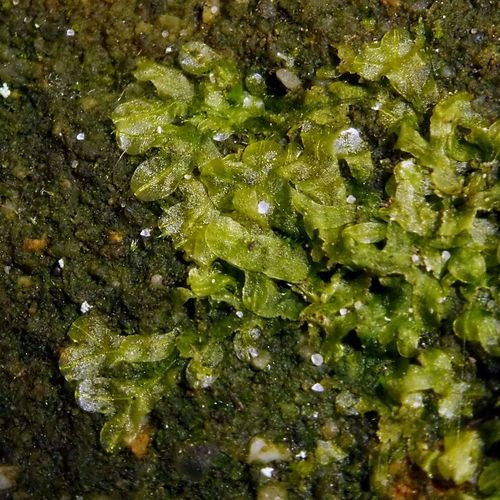
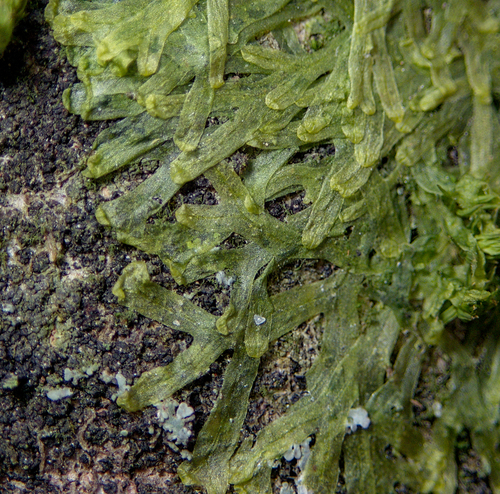
Metzgeria furcata (L.) Corda
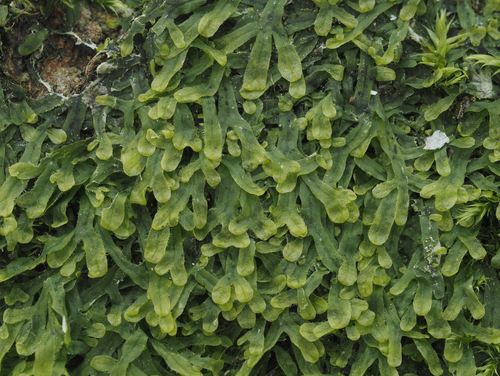
Source: Wikipedia
Synonyms 50
- 98,503 GBIF occurrences
- 6,885 iNaturalist observations
This is a common and widespread species across Europe. The population trend is stable or, in areas where
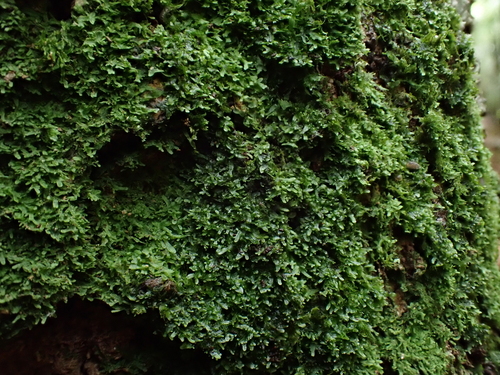
This species is the most common thallose liverwort growing epiphytically on trees and shrubs, and also on rocks. It has a wide ecological range, occurring on all but the most acid trees and rocks and being tolerant of drought. On trees it often grows alongside Frullania dilatata, Cryphaea heteromalla, Isothecium spp., Orthotrichum spp., Radula complanata, Ulota spp. and Zygodon viridissimus, and is typically a pioneer on the middle part of tree trunks. It is found on many broadleaved trees, especially ash, sycamore and willow, and there are also records from spruce and other conifers (Atherton et al. 2010). Associates on rocks may include Diplophyllum albicans, Hypnum spp. and Trichostomum brachydontium. Saxicolous populations of M. furcata are especially frequent near the coast, alongside H. cupressiforme var. resupinatum, and it sometimes extends into turf on coastal slopes. Several records come from anthropogenic habitats, including walls, bridges, concrete gutters and grave stones (Blockeel et al. 2014, Meinunger and Schröder 2007). Its altitudinal range is ca. 0-2,400 m.
There are no known threats to this species.
No conservation measures are required at present. This species is listed in the following National Red Lists: Latvia (Vulnerable) and Italy (Near Threatened) (Hodgetts 2015). It occurs in protected areas across Europe.
European regional assessment: Least Concern (LC) EU 28 regional assessment: Least Concern (LC)The Forked Veilwort (Metzgeria furcata) is assessed as Least Concern in Europe and the EU 28 in view of its large population and wide distribution, with an extent of occurrence (EOO) and area of occupancy (AOO) greatly surpassing the threshold values for application of a threatened category. The population is stable or in some areas increasing. There are no known threats to this species and so no conservation measures are required at present. It occurs in protected areas across Europe.
Gallery