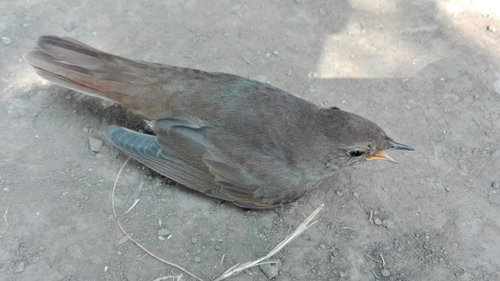
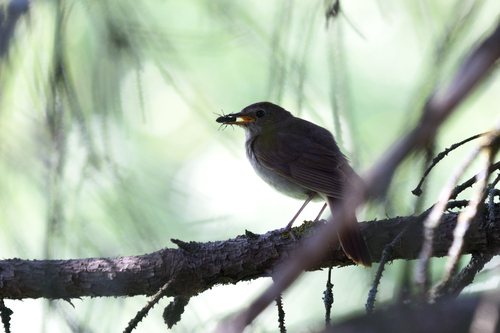
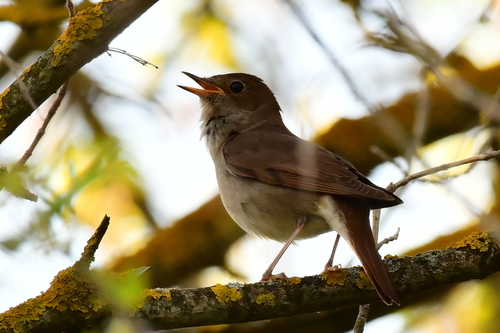
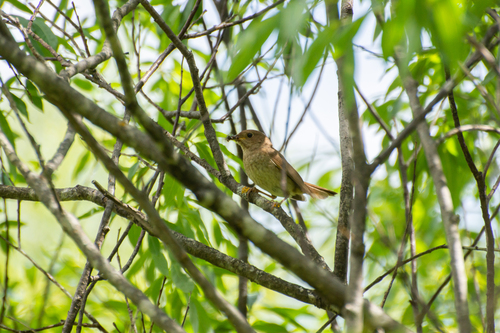
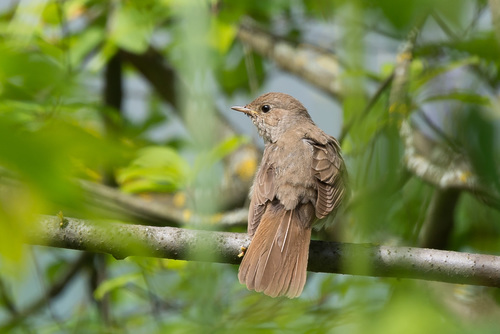
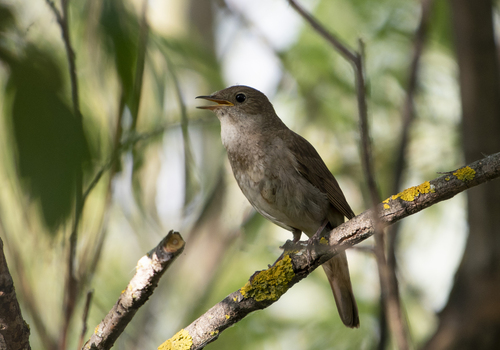
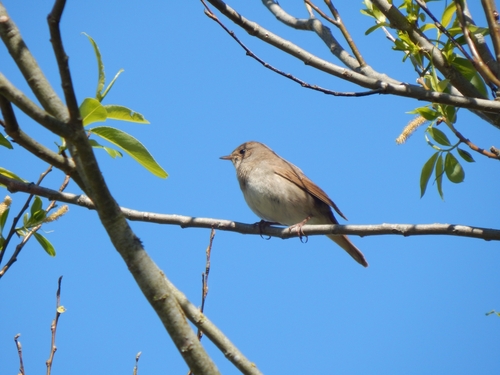
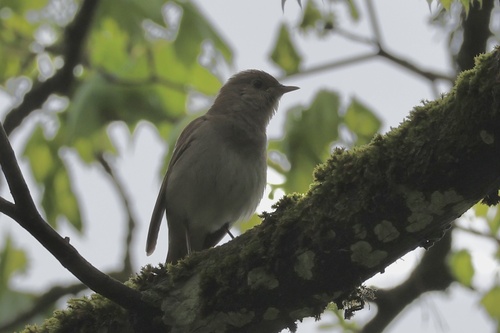
Luscinia luscinia (Linnaeus, 1758)
Source: Wikipedia
- 544,946 GBIF occurrences
- 11,265 iNaturalist observations
In Europe, the total population size is estimated at 8,790,000-14,300,000 mature individuals (BirdLife International 2021). Europe comprises c. 60% of the species' global range, so a very preliminary estimate of the global population size is 15,000,000-24,000,000 mature individuals, although further validation of this estimate is needed.
This species occupies lowland river valleys with deciduous and mixed woodland bordering waterbodies, beech (Fagus) and hornbeam (Carpinus) forest, small woodlots of young deciduous trees, dense thickets in forest edges, regenerating forest on clear-cut land, wet willow (Salix) thickets, alder (Alnus) carrs, lowland orchards, river gorges, urban scrub, parks and cemeteries. It requires deep soft humus with some leaf litter, tall, dense, patchy herbage, and thickets of brambles, bushes, shrubs and low trees typically along riverbanks, near standing water or in damp depressions. In African wintering range it uses damp rank vegetation, overgrown streamsides, thick hedges of Euphorbia and Lantana, woodland undergrowth and thickets at 500-1,500 m. Breeding occurs from mid-May to early July. The nest is a loose bulky cup of leaves and grass, lined with fine stems and hair, placed on ground in sheltered position among dead branches, roots or thick leaf litter. Clutches are four or five eggs. The diet is mainly invertebrates with some fruit. The species is migratory, wintering in Africa (Collar 2015).
Population fluctuations appear to correlate with changes in habitat composition and climate amelioration. During the 1900s, numbers fell with the decline of slash-and-burn cultivation which produced its preferred young deciduous woodlands (Hagemeijer and Blair 1997).
Conservation Actions UnderwayBern Convention Appendix II. There are currently no known conservation measures for this species within Europe.Conservation Actions ProposedNo conservation measures are currently needed for this species within Europe.
This species has an extremely large range, and hence does not approach the thresholds for Vulnerable under the range size criterion (extent of occurrence under 20,000 km² combined with a declining or fluctuating range size, habitat extent/quality, or population size and a small number of locations or severe fragmentation). The population size is extremely large, and hence does not approach the thresholds for Vulnerable under the population size criterion (under 10,000 mature individuals with a continuing decline estimated to be over 10% in ten years or three generations, or with a specified population structure). The population trend appears to be stable, and hence the species does not approach the thresholds for Vulnerable under the population trend criterion (over 30% decline over ten years or three generations). For these reasons the species is evaluated as Least Concern.
Gallery