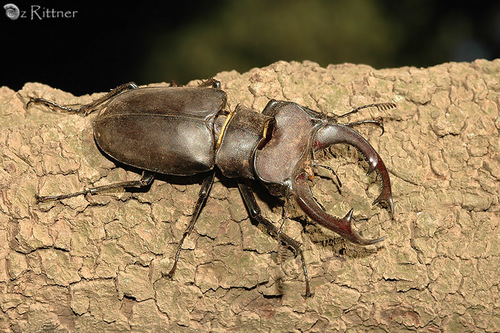
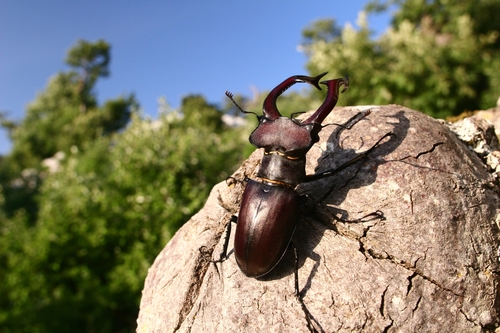
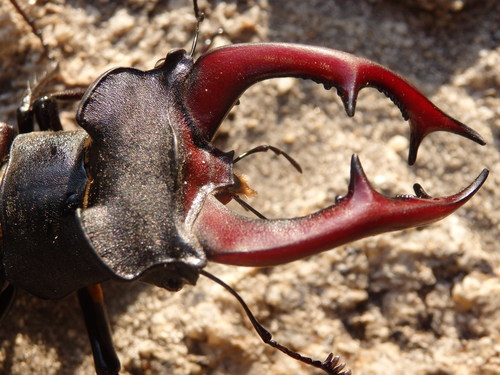
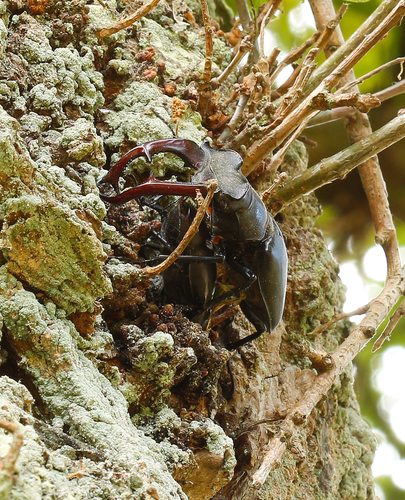
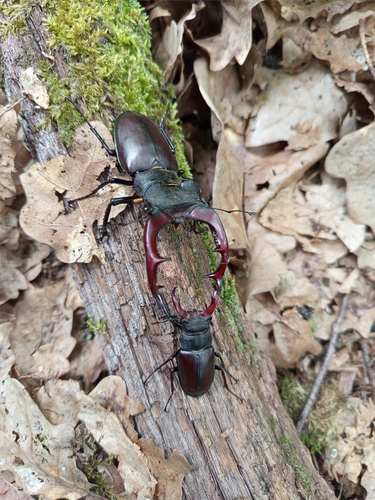
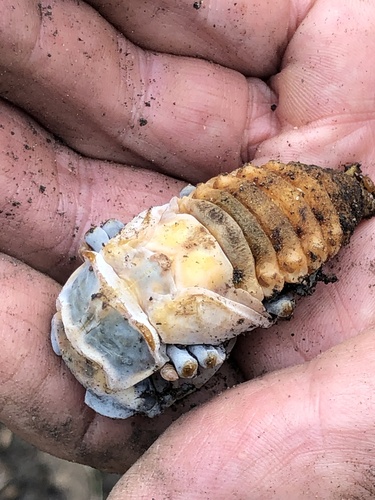
Lucanus cervus
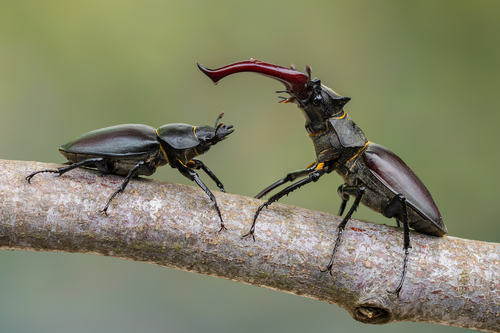
Source: Wikipedia
Synonyms 26
- 273,857 GBIF occurrences
- 57,381 iNaturalist observations
In Europe, Lucanus cervus appears more common in temperate zones rather than at the northern or southern limit of the distribution area. In the northern part of Europe, the species is decreasing, rare (Sweden) or very rare (e.g., Latvia). In Andorra, no data on populations exist, the population is considered small. In Great Britain, it has a highly fragmented distribution but with one large and strong population centred across the Lower Thames Basin, plus two smaller concentrations; there is no evidence for any substantial decline in recent decades, although sub-fossil remains have been found more widely (K. Alexander pers. comm. 2009). In Hungary, the population size and trend have not been quantified, but the species became somewhat rarer in the second half of the 20th century, however strong populations still occur in mature oak forests (O. Merkl pers. comm. 2009). In Italy, it is locally quite common but declining. In Latvia it was considered extinct since 1969 until one male was recorded in 2021 in the southern part of the country. The population size in Latvia is unknown. In Romania, well-preserved populations occur in the oak forests in the central region and other hilly areas; the species is much rarer in Dobroudjia (P. Istrate pers. comm. 2009). In Spain no systematic quantitative data exist on population size; locally it can be found in groups of over 100 mature individuals plus larvae; the subpopulations in the north are decreasing and the subpopulations in the south appear stable; pre-1980 there were only three 10x10 km squares known as inhabited by Lucanus cervus (M. Méndez pers. comm. 2009). However, a decline is projected for the Iberian subpopulation and, likely, the whole Mediterranean pat of the distribution range for the future (M. Mendez pers. comm. 2024). In Ukraine, Lucanus cervus is locally common. In European Türkiye, the population size and trend have not been quantified. In Czechia, its population is decreasing and in Sweden, a 15% decline has been recorded over 15 years. The population and habitat are not severely fragmented in temperate and southern Europe, it is fragmented in Scandinavia and the Baltic countries with a large gap between the northernmost known populations in Sweden and central Europe and in Latvia versus southern Belarus and Poland.
This is an obligate, xerophilic saproxylic species. Larvae develop in moist decaying wood at or below the soil surface, including old decaying stumps and logs, but also at the base of fence posts. Larvae require a white-rot kind of decay and strongly prefer light soils. Larval development takes about four years in Great Britain but five in European Türkiye, and four to five years in central and southern European Russia (Nikitsky 2016). Pupation occurs in September to October, adults are active in early June to July, are crepuscular, feed on fruits and tree sap and (males) actively fly on hot evenings (Lodos 1989, Alexander 2002).Sites in Great Britain are mostly in the cultural landscape and especially in human settlements which tend to be richer in suitable trees than open countryside (Alexander 2002). In Hungary, this species lives in xerothermic oak woods (mainly in Turkey Oak woods) in the hills and the lower mountain areas. Important populations occur in wood pastures and riverine forests, where European Oaks occur; sometimes it develops in other broadleaved trees (e.g. Salix spp.) (O. Merkl pers. comm. 2009). In European Russia, it is locally still very abundant in oak forests in the forest-steppe zone, where dozens of individuals can be observed under suitable weather conditions flying at one oak tree. In Spain, this species is very polyphagous on broad-leaved tree species. In the north, it is present in bocage landscapes, city gardens, riparian forests and forests below 700 m; towards the Spanish south, in Mediterranean areas, it is present at higher altitudes up to 2,000 m, in Quercus forests, including dense forests (Proyecto Ciervo Volante 1996, M. Méndez pers. obs. 2009). In Ukraine, larvae mostly live in wood of oak Quercus, and sometimes other broad-leaved trees. In European Türkiye, larvae develop in dead wood of Castanea, Fraxinus, Populus, Quercus, Salix, and Tilia. The species requires mid-sized to large wood pieces.
The overall decrease in the average age of forests due to more intense management and exploitation is a major threat. A future threat in non-EU countries is increasing forest exploitation, leading to a decline of this species. Abandonment of coppicing and pollarding will lead to forest closure and will negatively affect the species. Loss of dead wood and old trees, forest clearing and removal of living hedges are also potential threats. Threats in the Baltic countries are unknown. In Great Britain, suitable habitat has been disappearing from the wider countryside to such an extent that the species now has a more urban and suburban distribution pattern. Habitat regeneration can take over 100 years for a tree to grow, die, and its roots/stump/fallen trunk become suitable for larval development of Lucanus cervus. Fewer and fewer trees in Europe reach this age, which is likely to result in reduced continuity of its habitat. Abandonment of pasture meadows, and switching to extensive agriculture, is a real threat in Sweden. The species is also popular with amateur collectors, especially in Japan.
This species is listed in Annex II of the EU Habitats Directive, and the Revised Annex I (species requiring specific habitat conservation measures; year of revision 2011) and Annex III (protected fauna species) of the Bern Convention.The species is reported as present in a significant number (2,578) of Natura 2000 sites across the European Union (EEA 2023). In Great Britain it has conservation status as Nationally Scarce (Hyman and Parsons 1992), it also has legal protection from trade and a few key sites are designated as Special Areas of Conservation (SAC). It is a priority species under the UK Biodiversity Action Plan; there has been extensive publicity led by the People's Trust for Endangered Species (K. Alexander pers. comm. 2009). Important populations of this species live in protected areas and Natura 2000 areas in Hungary and the species is legally protected there (O. Merkl pers. comm. 2009). Also in Romania and in Ukraine the species occurs in large protected areas. In Spain, it is protected at the national level as being of 'Special interest' and is also present in regional protection lists. It is present in several Natura 2000 areas and national parks in Spain and was assessed as Least Concern in the Spanish national Red Data Book (Verdú and Galante 2006). In Poland, Germany and Czechia it is considered Endangered (Pawłowski et al. 2002, Hejda et al. 2017, Bense et al. 2021), but as Least Concern in Sweden (SLU Artdatabanken 2020) and Bulgaria (Golemansky et al. 2011). In Denmark, the species was assessed as Regionally Extinct in 2003 but was assessed as Not Applicable (Jørum 2019) on the basis that successful reproduction of the species had not yet been shown (there is now evidence of successful reproduction). In Latvia recently assessed Data Deficient (D. Telnov pers. comm. 2023). The species is also included in the Red Data books of Belarus, Russia, and Ukraine. The assessments of the conservation status of the habitat types and species of community interest compiled as part of the Habitats Directive - Article 17 reporting process for Lucanus cervus carried out in EU 25 for the period 2001-2006, in EU 27 for the period 2007-2012 and in EU 28 for the period 2013-2018 demonstrate, on one hand, a large proportion of the EU countries with the habitat, population and future status of the Lucanus cervus populations as favourable, but on the other hand, about 20% of the Member States reported their status as unfavourable.
European regional assessment: Near Threatened (NT)EU 27 regional assessment: Near Threatened (NT)Lucanus cervus is the largest beetle species in Europe distributed across most of the geographic Europe except for the northern and north-eastern territories. The species is still widespread and locally common, but its habitat is in continuous decline due to various factors including changes in land use, abandoning traditional agriculture (e.g., pasture meadows), the general decline of decaying wood in European landscape, and logging (commercial and subsistence). Habitat regeneration can take over 100 years for this species which may reduce the continuity of its habitat. The European and EU 27 extent of occurrence (EOO) and area of occupancy (AOO) are large, both strongly exceeding the thresholds for threatened species primarily as a result of increased attention to this species as one of the European flagship taxa for invertebrate conservation. The high number of new records of Lucanus cervus in the EU 27 in the past two decades is to be explained also by the rapidly growing public interest in Europe to citizen science. However, for such a large insect with moderate dispersal (flight) ability, every single record does not necessarily indicate a breeding site or suitable habitat which this saproxylic beetle is bound to. Individual records of beetles made in unsuitable or occasional habitats comprise no less than 30% of all recent records of Lucanus cervus on citizen science portals (personal extrapolation by the author). Therefore, the real European and EU 27 AOO is likely at least one-third smaller than it appears from known records, and is estimated to be between 2,000 – 3,500 km², The lower value is precautionarily chosen for this assessment. The population and habitat is not severely fragmented in temperate and southern Europe, but it is considered fragmented and somewhat isolated in Scandinavia and the Baltic countries with large gaps between the northernmost known populations in Sweden and central Europe and in Latvia versus southern Belarus and Poland. The European and EU 27 population is still large but considered not increasing since the available habitat is rare and in continuous decline across most of the range for several decades. The assessments of the conservation status of the habitat types and species of community interest compiled as part of the Habitats Directive - Article 17 reporting process for Lucanus cervus carried out in EU 25 for the period 2001-2006, in EU 27 for the period 2007-2012 and in EU 28 for the period 2013-2018 demonstrate, that about 20% of the Member States reported their status as unfavourable, suggesting the species is still in decline in several European countries. Considering the long development cycle of larvae (takes 4-5 years), the threats to the European population in the next 15 years appear real. The continuing decline in AOO is inferred since no major European-wide progress on the restoration of the habitat for Lucanus cervus has yet been reported in spite of several small successful local project. The habitat of this species is inferred to stay in continuous decline at least in some parts of Europe. Lucanus cervus is therefore precautionarily assessed as Near Threatened B2b(ii,iii) in Europe and the EU 27 region.
Gallery