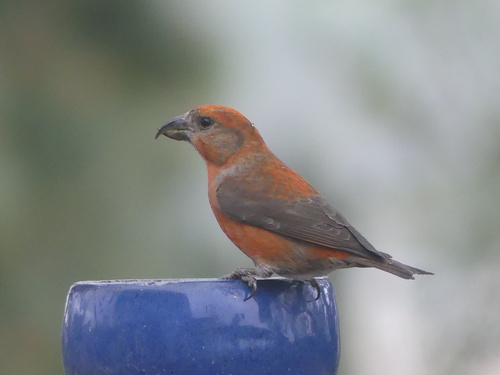
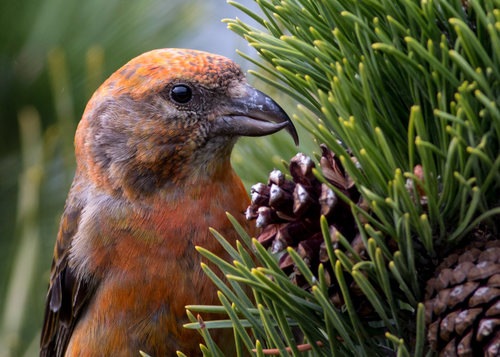
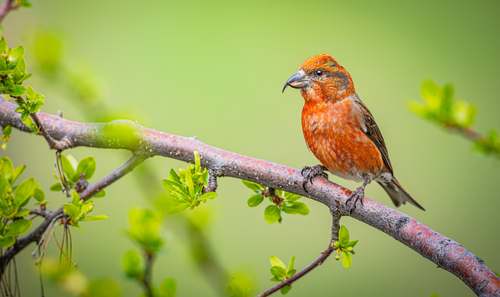
Loxia curvirostra Linnaeus, 1758
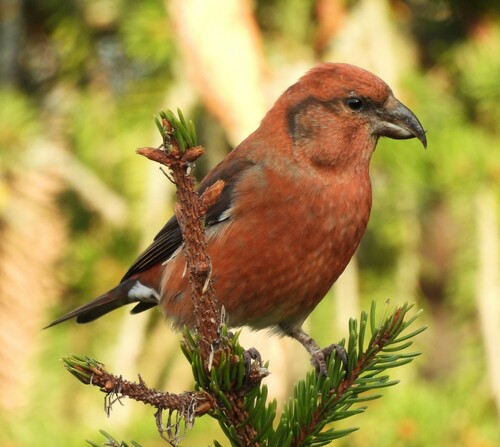
Source: Wikipedia
Synonyms 2
- 1,537,170 GBIF occurrences
- 28,871 iNaturalist observations
In North America, the total population size is estimated at 9,600,000 mature individuals in the USA and Canada (Partners in Flight 2024). This region forms c. 25% of the species' global range. Additionally, in Europe, the total population size is estimated at 5,600,000-14,000,000 mature individuals (BirdLife International 2021), and comprises c. 25% of the species' global range. A very preliminary estimate of the global population size is therefore between 30,000,000-48,000,000 mature individuals, although further validation of this estimate is desirable.
This is a species of lowland to submontane conifer forests and woodlands. Northern Palearctic populations are mostly found in taiga forests of spruce (Picea) and southern breeders (southern Britain south to the Mediterranean region) in pines (Pinus), including Scots pine (Pinus sylvestris). Race guillemardi occupies black pine (Pinus nigra) and race corsicana occurs in cultivated Corsican pine (P.n. larico). It also uses larch (Larix), cedar (Cedrus), alder (Alnus) and birch (Betula). In North America it also uses hemlock (Tsuga) and Douglas-fir (Pseudotsuga). In North Africa it breeds mostly in Aleppo pine (Pinus halepensis), less commonly in maritime pine (Pinus pinaster), almond (Prunus dulcis), walnut (Juglans), poplar (Populus), hornbeam (Carpinus), beech (Fagus), oak (Quercus) and hazel (Corylus). In the Himalayas it is mostly found in high-altitude hemlocks, spruce, fir (Abies) and pine forests. On passage and in the non-breeding season it occurs in pine and deciduous trees in coastal woodlands, parks and gardens, including in suburban areas and city centres, also exceptionally along tideline. The breeding season is generally determined by food abundance but is typically from August to April/May in northern and central Europe, mid-January to mid-May in Scandinavia, February to mid-May in northern Russia, March to early November in Cyprus and December-January in the Philippines. It breeds at any time of year in the Indian Subcontinent and in most months in North America. The nest is a deep cup of conifer twigs, bark or rotting wood strips, plant fibres, grass, moss, lichens, animal hair and feathers. It is sited 3–35 m above the ground, usually beneath the outermost foliage, close to the crown of a tall conifer and often close to the trunk in a spruce or along the branch of a pine. Clutches are three to four eggs. The species is resident and a partial migrant and is commonly irruptive and nomadic in the non-breeding season (Clement and Christie 2016).
In Finland, the species has declined due to forest fragmentation. This is principally as a result of overall shortening of rotation times leading to a reduction in the average age of forests. In Canada and the USA, increased logging of old-growth habitats may depress populations because conifers produce their largest cone crops after about 60 years of age. The population in Newfoundland has undergone a steady decline over the last 50 years possibly owing to competition for cone crops from introduced American red squirrels (Tamiasciurus hudsonicus) and accelerated logging of old-growth woods (Clement and Christie 2016).
Conservation Actions UnderwayBern Convention Appendix II. There are currently no known conservation measures for this species.Conservation Actions ProposedLarge areas of mature forest should be protected for this species. Management should include increasing rotation times and setting aside core tracts of old-growth forest and be applied over as much as of the species' range as possible, owing to its habit of travelling over extremely large areas (Clement and Christie 2016).
This species has an extremely large range, and hence does not approach the thresholds for Vulnerable under the range size criterion (extent of occurrence under 20,000 km² combined with a declining or fluctuating range size, habitat extent/quality, or population size and a small number of locations or severe fragmentation). The population size is extremely large, and hence does not approach the thresholds for Vulnerable under the population size criterion (under 10,000 mature individuals with a continuing decline estimated to be over 10% in ten years or three generations, or with a specified population structure). Despite the fact that the population trend appears to be decreasing, the decline is not believed to be sufficiently rapid to approach the thresholds for Vulnerable under the population trend criterion (over 30% decline over ten years or three generations). For these reasons the species is evaluated as Least Concern.
Gallery