Juniperus communis L.
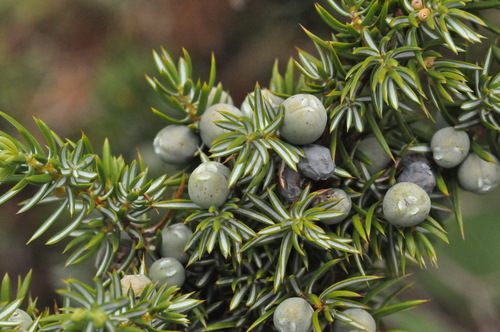
Source: Wikipedia
Synonyms 48
- 815,079 GBIF occurrences
- 86,342 iNaturalist observations
The species is very widespread with presumed stable populations although it may be locally declining in limited parts of its range.
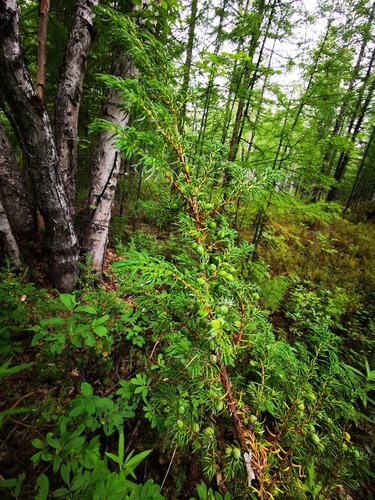
This is largely a pioneer woodland species, occupying natural rock outcrops and other places with skeletal soil and abundant sunlight in woodland and light forest, both broadleaf and coniferous forest (especially Pinus sylvestris-Betula spp.-Quercus spp.), in which it can obtain local dominance after disturbances (non-fire). It is also prevalent in the ecotone between open woodland and grassland on poor sandy soils and on stabilised inland sand dunes. It occurs often with Calluna vulgaris, Erica spp., Vaccinium spp., Arbutus spp., Cytisus scoparius, Ulex spp., Salix spp., and the above-mentioned tree genera, in Russia also in grass steppes (Castroviejo et al. 1986, Botanical Society of Britain and Ireland 2023).It seems very indifferent to soil type and occurs in dry sand, chalk downs, and loose (dolomitic) scree, as well as in acidic peat, with low or fluctuating groundwater levels (Botanical Society of Britain and Ireland 2023).
No range-wide threats likely to have a significant impact on the species' population have been identified for this species. Land clearance, particularly through fire, has impacted some subpopulations. Range expansions at the edges of the species' range are likely to balance population losses resulting from habitat quality declines. Substantial population losses have occurred on a local level as a result of the fungal pathogen Phytophthora austrocedri (Botanical Society of Britain and Ireland 2023). Given the species' extremely large range, it is unlikely that these threats will substantially impact the species' population.
This species occurs in many protected areas across its range, including Natura 2000 sites (UNEP-WCMC and IUCN 2023). It is included in the following national red lists:
- Endangered in Luxembourg (Colling 2005);
- Vulnerable in Belgium (Van Landuyt et al. 2006) and Czech Republic (Holub and Procházka 2000);
- Near Threatened in the Netherlands (van der Meijden et al. 2000);
- Least Concern in Denmark (NERI 2007), Norway (Solstad et al. 2021), Sweden (SLU ArtDatabanken 2023), Switzerland (Moser et al. 2002), and the United Kingdom (Cheffings and Farrell 2005, Stroh et al. 2014).
The species is widely included in the collections of botanical gardens (BGCI 2023), and numerous germplasm collections are included in European institutions (EURISCO 2023).
European regional assessment: Least Concern (LC)EU27 regional assessment: Least Concern (LC)Common Juniper (Juniperus communis) is the most widespread species of conifer in the world, and it and its varieties are widespread in the European region. While it is struggling to survive in some areas, e.g. Belgium, it is increasing elsewhere; both phenomena in its population dynamics are related to shifts in agricultural practices and general land use. It is assessed as Least Concern for both Europe and for the EU27 Member States.
Gallery