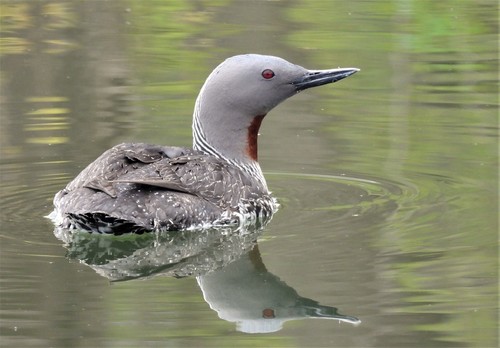
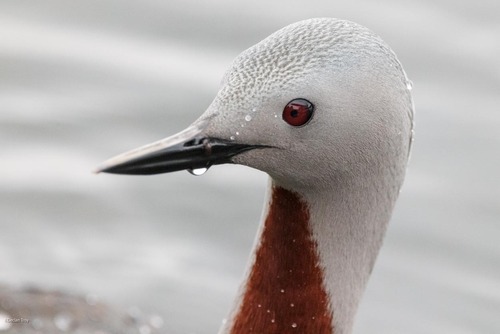
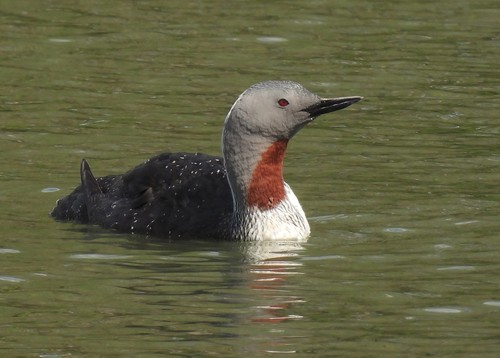
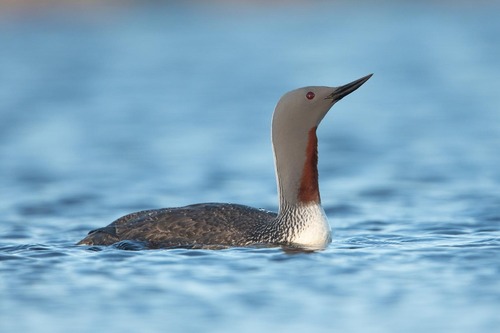
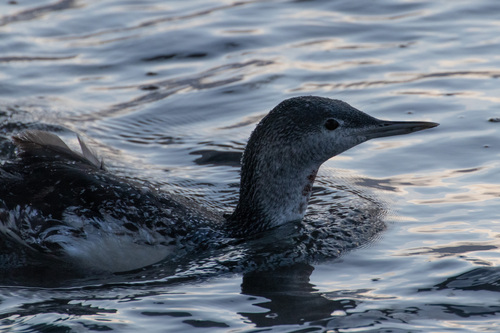
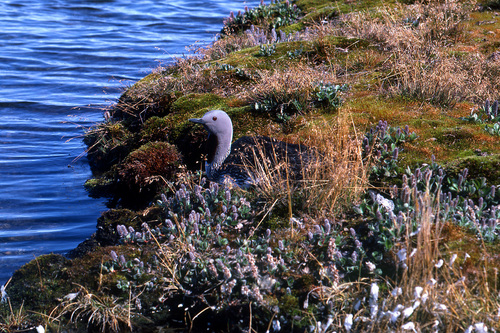
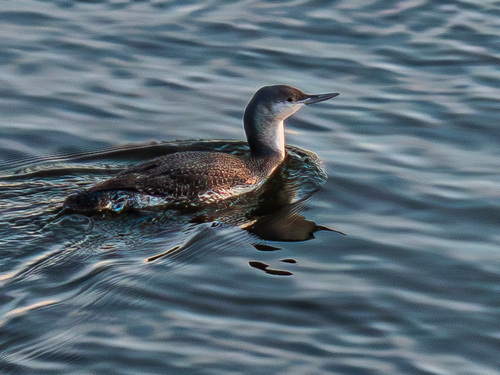
Gavia stellata (Pontoppidan, 1763)
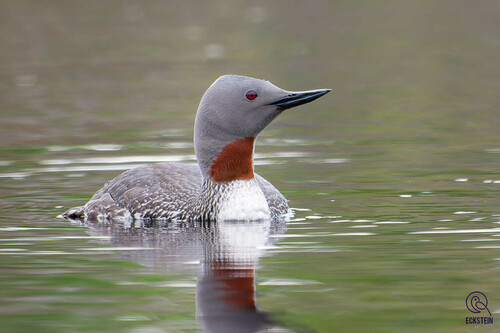
Source: Wikipedia
Synonyms 1
- 1,443,307 GBIF occurrences
- 15,501 iNaturalist observations
The European breeding population is estimated at 45,500-72,800 pairs (91,100-146,000 mature individuals), and the wintering population is estimated at 56,100-72,200 individuals (37,400-48,100 mature individuals). The breeding population in the EU28 is estimated at 3,000-4,800 pairs (6,000-9,600 mature individuals), and the wintering population at 52,400-66,800 individuals (34,900-44,600 mature individuals). For details of national estimates, see the supplementary information.
On migration this species may form large flocks of 200–1,200 individuals, with similar concentrations occurring on rich marine fishing grounds during the winter (Billerman et al. 2020). The species breeds on freshwater pools or lakes in open moorland, blanket bogs (Billerman et al. 2020) or open and wet peatland habitats (Campbell 1987). Outside of the breeding season the species frequents inshore waters along sheltered coasts, occasionally occurring inland (Billerman et al. 2020) on lakes, pools, reservoirs and rivers (Snow and Perrins 1998). Its diet consists predominantly of fish as well as crustaceans, molluscs, frogs, fish spawn (Billerman et al. 2020), aquatic insects, annelid worms (Snow and Perrins 1998) and plant matter (Billerman et al. 2020). In winter its diet is almost predominantly fish, and in the Baltic Sea they opportunistically feed on spawning Herring, Smelt and Percids.Although the generation length for both EU and Europe regional assessments were calculated using the same methodology, new information arriving after the EU assessments were undertaken gave rise to an update in the generation lengths. This new information was then used for the Europe level assessments giving rise to a difference between the generation lengths used for the EU and Europe regions.
When breeding the species is threatened by water level fluctuations and acidification of breeding waters heavy metal pollution and the afforestation of peatland or moorland habitats (Billerman et al. 2020). It is also sensitive to human disturbance from recreational activities and shoreline development (e.g. construction work near breeding lakes) (Meek et al. 1993) and will desert sites if there is too much human activity (Billerman et al. 2020). During the winter the species is highly vulnerable to coastal oil spills, especially in areas where large concentrations form (e.g. on rich fishing grounds) (Skov et al. 2011, Billerman et al. 2020). The North, Baltic and Mediterranean Seas have experienced severe oil spill events in the past, and remain regions at risks of future spills particularly with expanding oil exploration activity. This species is also highly sensitive to disturbance from coastal wind farms (wind turbines) during winter, causing a risk for habitat displacement and collision (Garthe and Huppop 2004, Bradbury et al. 2014). The species suffers mortality at sea and on large lakes due to entanglement and drowning in inshore gillnets (Billerman et al. 2020), with potentially significant impacts on the breeding and wintering population within the Baltic Sea, where large numbers of birds overlap with intensive gillnet fisheries (Žydelis et al. 2013). It is also highly sensitive to disturbance at sea, particularly from vessel traffic along shipping lanes, a particular problem in North Sea and the Baltic region due to high numbers of vessels passing (Schwemmer et al. 2011) It is susceptible to avian influenza so may be threatened by future outbreaks of the virus (Melville and Shortridge 2006). As a species which breeds in the Arctic it is likely to be affected by impacts from climate change, including habitat changes and prey availability (Ganter et al. 2014).
Conservation Actions UnderwayThe species is listed on Annex II of the Convention on Migratory Species, and is listed under the African Eurasian Waterbird Agreement. Listed on Annex II of the Bern Convention, and Annex I of the EU Birds Directive. Listed as critically endangered on the HELCOM convention. There are 58 Important Bird and Biodiversity Areas for this species. Within the EU it occurs and is protected in 426 Special Protection Areas. Since the 1970s, conservation work in Finland has included building artificial rafts for this species to reduce predation risk, which has led to higher breeding success in some areas. Within the North Sea (Germany) work is underway to test alternative fishing gears to gillnets, while in Lithuania gillnet bycatch mitigation is being trialled. Conservation Actions ProposedDevelopment of mitigation measures for gillnet bycatch for commercial and artisanal fishing vessels. Prevention of chronic oil pollution and oil spill events, and development of rapid, trans-boundary plans for oil spill response. Protection of feeding grounds, and regulations for vessel traffic, management of recreational activities at important breeding and non-breeding sites, careful siting of windfarms away from critical habitat or migration pathways.
European regional assessment: Least Concern (LC)EU28 regional assessment: Least Concern (LC)In Europe, this species has an extremely large range (its extent of occurrence (EOO) is much larger than 20,000 km² and its area of occupancy (AOO) is much larger than 2,000 km²), and hence it does not approach the thresholds for Vulnerable under the range size criteria (criteria B and D2). The population size is very large (larger than 10,000 mature individuals), and hence it does not approach the thresholds for Vulnerable under the population size criteria (criteria C and D). The population trend is not known, but the population is not believed to be decreasing sufficiently rapidly to approach the thresholds for Vulnerable under the population size reduction criterion (criterion A). The probability of extinction has not been calculated for this species, therefore criterion E cannot be applied. For these reasons the species is evaluated as Least Concern in Europe.In the EU28, this species has a very large range (its extent of occurrence (EOO) is larger than 20,000 km² and its area of occupancy (AOO) is much larger than 2,000 km²), and hence it does not approach the thresholds for Vulnerable under the range size criteria (criteria B and D2). The population size is very large (larger than 10,000 mature individuals), and hence it does not approach the thresholds for Vulnerable under the population size criteria (criteria C and D). The population trend appears to be increasing, and hence the species does not approach the thresholds for Vulnerable under the population size reduction criterion (criterion A). The probability of extinction has not been calculated for this species, therefore criterion E cannot be applied. For these reasons the species is evaluated as Least Concern in the EU28.
Gallery