Fraxinus excelsior L.
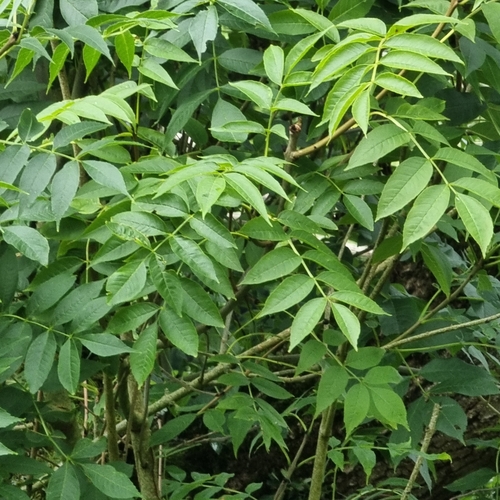
Source: Wikipedia
Synonyms 50
- 1,713,247 GBIF occurrences
- 59,549 iNaturalist observations
The Common Ash's total population size in Europe is unknown. It remains widespread and common, but the population is declining as a result of Ash Dieback Disease. Across northerly portions of the species' range (where Ash Dieback Disease was first detected), tree mortality in impacted subpopulations was initially low (1-3% between 2000 and 2010). Since this time, mortality from diebacks has accelerated across nearly all of the species' range. In northern Europe, survival probability 30 years after the introduction of Ash Dieback Disease was estimated at 0.2. Local extirpations have been observed in monitored stands. More southerly regions have experienced much more modest declines with survival probability following 30 years of exposure estimated at 0.8. Overall survival probability is estimated at 0.5 over 30 years (George et al. 2022). While the models employed by George et al. (2022) show continuing declines following introduction of Ash Dieback Disease, other models suggest an inflection point, with populations declining by 70% over the course of 15 years after exposure, before stabilising (Coker et al. 2019).Studies showing some level of mortality stabilisation following the introduction of Ash Dieback Disease note that the health of remaining trees is poor (Coker et al. 2019). It is likely that recruitment of remaining trees will be negatively impacted by pathogen pressure and that long-term population declines will occur nonetheless (George et al. 2022).Given the species' long generation length (see below), the species' future population decline is evaluated over a 100 year time frame under criterion A3. Over this time period, several possibilities may be considered. Assuming recruitment is minimally impacted and that stabilisation of mortality results in some level of stabilisation of population, population declines are likely to hold at a level between 60 and 70%. Projecting the declines noted by George et al. (2022) over the course of 100 years results in declines of 90% of the population.Population declines vary based on area and are most acute in Scandinavia, Poland, and the Baltic States. This reflects both early introduction to the region, and climate that is highly favourable to the disease (Enderle et al. 2019). In Lithuania and Poland, where the disease was first discovered, approximately 60% of the Ash population was lost within a decade (SLU ArtDatabanken 2024). At the southern margin of the species' range in Italy, infection rates of 50% and mortality rates of 17% were observed at some sites just five years after the initial infection was recorded (Giongo et al. 2017). This species is widely planted and therefore it can be difficult to determine which populations are native and which are alien (Botanical Society of Britain and Ireland 2024). It is very similar to Fraxinus angustifolia and the two species have hybridised in areas where their range overlaps, such as the Balkans, Italy and southern France, even though they have different flowering phenologies (Fraxigen 2005, Gerard et al. 2006). A study in Gotland island in the Baltic Sea surveyed 20 stands and found at least 50 hybrid individuals (Jonsson and Thor 2012).
This is a wind pollinated tree of deciduous broadleaved Tilio-Acerion forests but also found in scrub, hedgerows, rock scars and cliffs, and stable scree slopes. It is tolerant of waterlogged but not flooded soils and only grows in lime rich soils. It occurs in pure stands, mixed woodland or scattered trees and is a dominant species in young and juvenile stages of forests. Its natural distribution in central Europe is defined by its low tolerance to cold winters and hot dry summers as young shoots are sensitive to spring frost. It is a rapid coloniser of waste ground, disused quarries and railway banks (Fraxigen 2005, Botanical Society of Britain and Ireland 2024), and is found in urban areas, gardens, parks etc. It grows in the Habitats Directive listed habitats 91E0 "Alluvial forests with Alnus glutinosa and Fraxinus excelsior (Alno-Padion, Alnion incanae, Salicion albae)" (a priority habitat) and 91F0 " Riparian mixed forests of Quercus robur, Ulmus laevis and Ulmus minor, Fraxinus excelsior or Fraxinus angustifolia, along the great rivers (Ulmenion minoris)".The species first sets seed at 20 to 30 years of age (Beck et al. 2016). Ash species frequently live in excess of 150 years. Based on this information, the generation length for the species is certainly greater than 33 years, and likely falls within the range of 50 to 75 years.
The pathogenic fungal organism Hymenoscyphus fraxineus has been causing severe Ash dieback disease in central and northern Europe since the early 1990s, particularly in the Baltic States, Poland, Scandinavia, Germany and Austria (Bakys et al. 2008, Kirisits et al. 2010). Tree epidemics cause secondary impacts to biodiversity, other tree species composition, structure and ecosystem functioning of woodland (Jonsson and Thor 2012). The incidence of infection has been increasing throughout Europe. The disease causes dieback of the crown and loss of leaves and can lead to death of the tree ultimately resulting in increased mortality. Norwegian data suggests mortality increases of 74% in infected subpopulations (Díaz-Yáñez et al. 2020). A wide range of Fraxinus species have reportedly been infected with this disease, although F. excelsior is the most severely affected species (Enderle et al. 2019). As of 2024, H. fraxineus has been detected all countries where Common Ash is native with the exception of Albania, Bulgaria, Greece, Kosovo, and Moldova (EPPO 2024).Common Ash subpopulations in natural habitats fare better in the face of Ash dieback disease than those in plantations (Coker et al. 2019). Several explanations for this observation have been proposed, but there is currently no consensus on the underlying cause. Patterns of dieback vary based on a number of environmental factors. Approximately 1% of Common Ash trees appear to be resistant to the disease and show no symptoms, even after exposure to the pathogen (Enderle et al. 2019). The severity of Ash dieback is related to temperature and moisture levels, with cooler and wetter conditions resulting in more severe symptoms. Male trees are apparently more susceptible to dieback than female trees (Enderle et al. 2019), and trees appear most susceptible at lower altitudes (Enderle et al. 2019, Giongo et al. 2017). Other environmental factors vary considerably and are not well established (Enderle et al. 2019).The pathogen was first recorded in northeastern Poland, though it may have been present earlier in Estonia (Agan et al. 2023). The disease is most commonly spread via wind. Contaminated forest nurseries are another source of the infection, which then spreads through afforestation. The resultant spread generally occurred in a concentric manner, radiating outward from northeastern Poland at a rate of 30 to 70 km per year, with sporadic introductions caused by the anthropogenic introduction of contaminated horticultural materials (Enderle et al. 2019). Testing confirms that spread within Croatian seedling farms results not from contaminated seeds, but from native spread of the pathogen within the country suggesting that newly impacted areas quickly become sources of wind dispersed spores (Kranjec Orlović et al. 2019).Additional threats include degradation of the riverside woodlands habitat due to unregulated logging, clearance of riverbeds, construction of infrastructure and building of micro-water electric power stations (Bulgarian Academy of Sciences and Ministry of Environment and Water 2011).Browsing of fodder and bark stripping by deer is a minor threat, as it frequently damages young trees in natural regeneration and plantations (Fraxigen 2005b).
Common Ash is classified as Least Concern in Belgium (Van Landuyt et al. 2006), Denmark (NERI 2007, Aarhus Universitet 2019), Estonia (eElurikkus 2024), France (UICN France et al. 2018), Germany (Metzing et al. 2018), Ireland (Wyse Jackson et al. 2016), Luxembourg (Colling 2005), Switzerland (Moser et al. 2002, Bornand et al. 2016) and the United Kingdom (Cheffings and Farrell 2005, Stroh et al. 2025). Most listings under Least Concern status cite the impact of Ash Dieback Disease, but mention that the impact is not well understood and that population declines cannot be quantified at this time.In Finland it is considered Near Threatened (Hyvärinen et al. 2019). It is considered to be 'seriously threatened' in Hungary (Koltay et al. 2012). It has been classified as Endangered in Norway (Solstad et al. 2021), Sweden (SLU ArtDatabanken 2024), and Albania, and as 'Rare/Endangered' in Serbia and Montenegro (FAO 2006).In Spain, this species is listed as Vulnerable in Castilla-La Mancha, and as a 'Taxon sensitive to habitat alteration' in Madrid (Anthos 2024). It is found in many Natura 2000 sites and protected areas throughout its range (European Environment Agency 2010, UNEP-WCMC and IUCN 2024). The species is represented by 125 germplasm accessions held at European institutions (EURISCO 2024), and is included in the living collection of at least 215 botanical gardens (BGCI 2024).Hymenoscyphus fraxineus is not listed in the EC Plant Health Directive 2000/29/EC including under its synonyms. In Bulgaria, its riverside woodland habitat is considered to be Vulnerable, but the species is included in Annex 1 of the National Biodiversity Act, it occurs in protected areas and national parks and is part of the Natura 2000 network (Bulgarian Academy of Sciences and Ministry of Environment and Water 2011). The habitats 91E0 "Alluvial forests with Alnus glutinosa and Fraxinus excelsior (Alno-Padion, Alnion incanae, Salicion albae)" (a priority habitat) and 91F0 " Riparian mixed forests of Quercus robur, Ulmus laevis and Ulmus minor, Fraxinus excelsior or Fraxinus angustifolia, along the great rivers (Ulmenion minoris)" are listed on Annex I of the Habitats Directive.As Ash Dieback Disease is spread by wind, it is extremely difficult to reduce or prevent spread of the disease, which can even reach isolated trees found more than 10 km from the nearest tree; the best hope for control of the outbreak is that natural resistance will develop. Additional research is needed to determine the level of resistance European trees have to different strains of H. fraxineus. To date, two lineages of the fungus have been introduced to Europe. Should additional strains be introduced, it is unclear whether trees resistant to existing strains will retain this resistance. Populations should be monitored for signs of resistance to the disease, in the hopes that resistant stands may be found. One potentially effective way of reducing the spread of the disease may be by removal of all ash leaf litter from trees in autumn to reduce local sources of spores the following summer (Forestry Commission 2013). It is important to try to manage Ash trees and their habitat to minimise the threat of Ash dieback, which can occur within protected areas.
European regional assessment: Endangered (NT)EU 27 regional assessment: Endangered (EN)Common Ash (Fraxinus excelsior) has a very large distribution and is a keystone species of European temperate forests, forming vast pure stands in some areas. It occurs in all European countries except Portugal. It is a hardwood species and is important for silviculture, and is an economically valuable source of timber from tree nurseries and plantations. Ash Dieback is an infectious disease that has caused severe dieback of Common Ash throughout Europe. This is the most serious threat to the species, with recorded incidence in all but three countries in the species' range. There is a high risk of spread to areas where it has not yet been observed. This species is considered to be seriously threatened in Hungary, Norway, and Sweden. As Ash Dieback Disease is spread by wind, it is extremely difficult to reduce or prevent spread of the disease and the entire population is at risk of further disease outbreaks. The overall population decline has not been quantified but modelling suggests that population declines accelerate 30 years after the introduction of the pathogen. Given the dramatic declines seen in some parts of the species range, a future decline (occurring between 2024 and 2124) within the future three generation length period (150-225 years) of at least 60-70% across Europe is plausible. This species is therefore precautionarily listed as Endangered under criterion A3be at both the European and EU 27 levels. Potential immigrants from outside Europe are also susceptible to the disease and will not be able to rescue the European population; the category therefore remains unchanged.More information is needed on how much the population has declined from fungal infection, particularly in the southern portions of the species' range where the pathogen has been introduced more recently. Management of infected stands for preventative spread of the disease should be attempted, though the best hope for control of the outbreak is that natural resistance will develop. Resistant trees make up approximately 1% of the total population and further research is needed to determine how resistance is distributed across the species' range and where unique genetic material may exist which is not protected by resistance. It is strongly recommended to collect detailed population information and decline rates from each country and to re-assess the species when all the data is available.
Gallery