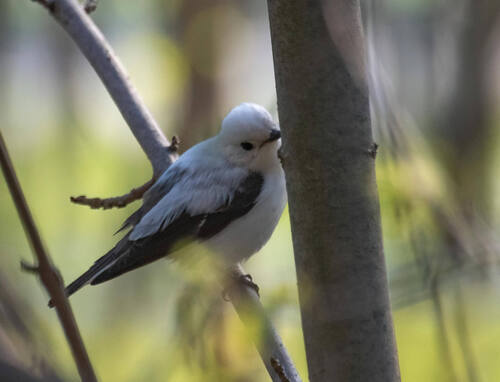
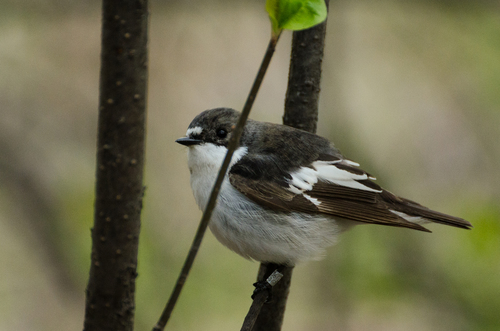
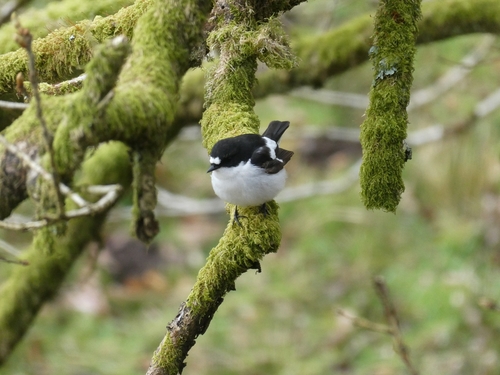
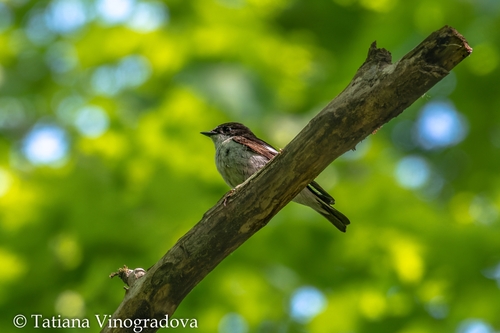
Ficedula hypoleuca (Pallas, 1764)
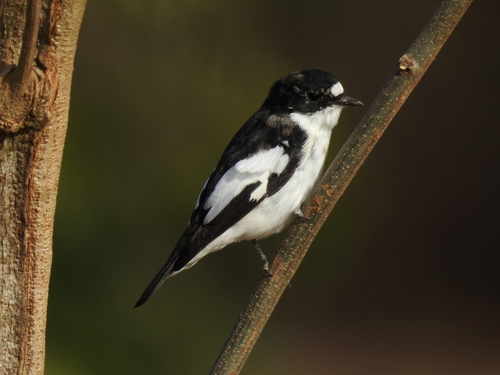
Source: Wikipedia
- 2,574,430 GBIF occurrences
- 30,915 iNaturalist observations
The European breeding population is estimated at 7,750,000–12,500,000 pairs, which equates to 15,500,000–24,900,000 mature individuals. The breeding population in the EU28 is estimated at 2,220,000–3,080,000 pairs, which equates to 4,440,000–6,160,000 mature individuals. For details of national estimates, see the Supplementary Information.
This species breeds in most well-wooded and forest habitats, so long as suitable cavities for nest-sites are present. It prefers deciduous forests (which contain more natural cavities) over coniferous forest. In Europe, its typical habitat is deciduous and mixed, sunny, open mature woodland, supplemented by orchards, avenues, parks, and even gardens in low-density human settlements. Breeding occurs from late April to the end of June. The nest is a loose cup of dead leaves, plant stems and moss, which is lined with rootlets, fine grasses, hair and (sometimes) feathers. It is sited 1.8–10 m above the ground in a hole in a tree, wall or building. In western Europe it mainly uses nest boxes. Clutches can be from three to ten eggs, but usually four to eight.The diet is mostly insects, both flying and non-flying, but it will take other invertebrates and some fruit and seeds.The species is migratory, wintering in west Africa (Taylor and Christie 2015).Although the generation length for both EU and Europe regional assessments were calculated using the same methodology, new information arriving after the EU assessments were undertaken gave rise to an update in the generation lengths. This new information was then used for the Europe level assessments giving rise to a difference between the generation lengths used for the EU and Europe regions.
The main threat to this species is earlier peaks of invertebrate populations resulting in a mismatch with breeding as a result of climate change (Both et al. 2006).
Conservation Actions UnderwayCMS Appendix II. Bern Convention Appendix II. There are currently no known conservation measures for this species.Conservation Actions ProposedThe provision of nestboxes can assist in significantly increasing population densities (Taylor and Christie 2015).
European regional assessment: Least Concern (LC)EU28 regional assessment: Least Concern (LC)At both European and EU28 scales, this species has an extremely large range (its extent of occurrence (EOO) is much larger than 20,000 km² and its area of occupancy (AOO) is much larger than 2,000 km²), and hence it does not approach the thresholds for Vulnerable under the range size criteria (criteria B and D2). The population size is extremely large, (much larger than 10,000 mature individuals), and hence it does not approach the thresholds for Vulnerable under the population size criteria (criteria C and D). Despite the fact that the population trend appears to be decreasing, the decline is not believed to be sufficiently rapid to approach the thresholds for Vulnerable under the population size reduction criterion (criterion A). The probability of extinction has not been calculated for this species, therefore criterion E cannot be applied. For these reasons, the species is evaluated as Least Concern in both Europe and the EU28.
Gallery