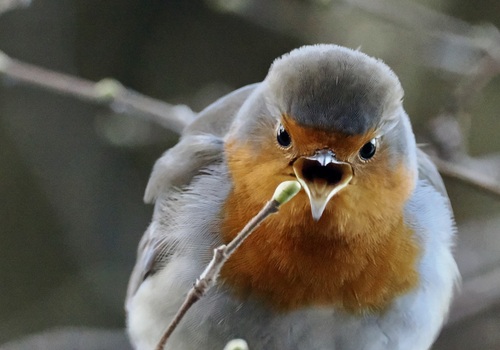
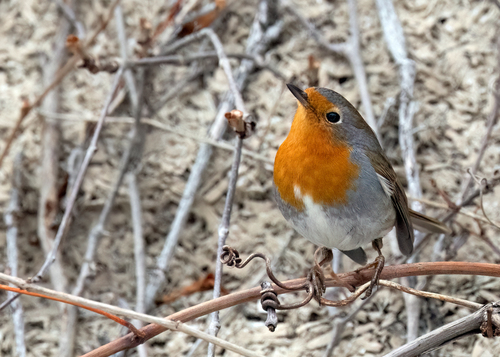
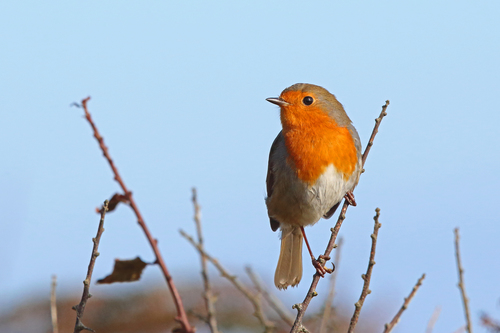
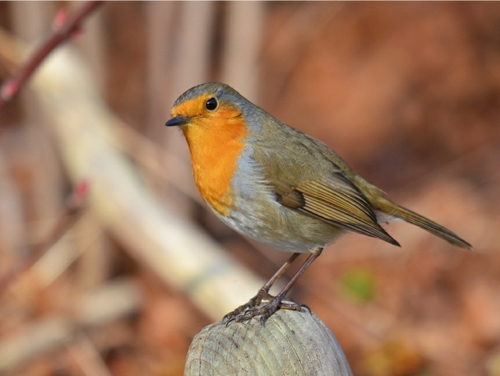
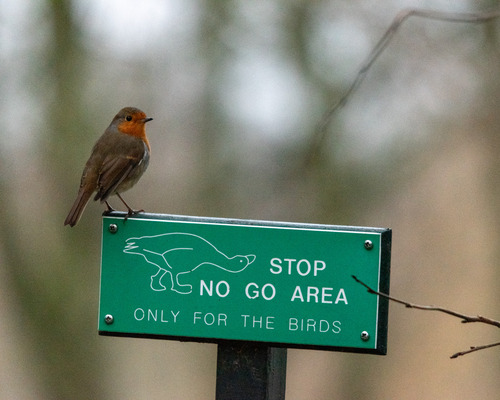
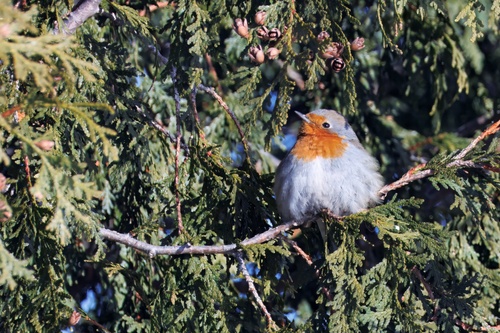
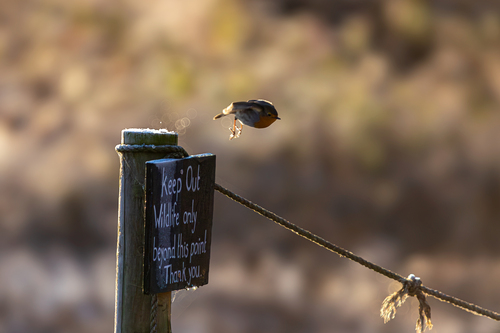
Erithacus rubecula (Linnaeus, 1758)
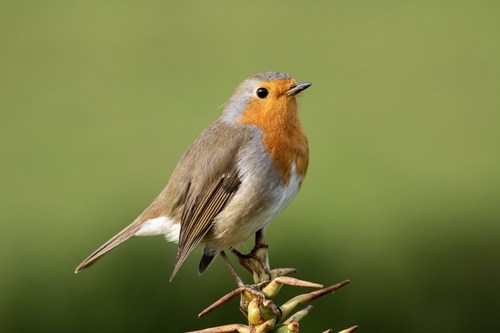
Source: Wikipedia
- 10,924,801 GBIF occurrences
- 188,341 iNaturalist observations
The European breeding population is estimated at 39,000,000–58,000,000 pairs, which equates to 78,000,000–116,000,000 mature individuals. The breeding population in the EU28 is estimated at 54,500,000–84,000,000 pairs, which equates to 109,000,000–168,000,000 mature individuals. For details of national estimates, see the Supplementary Information.
This species is found in forest undergrowth and edge, preferring conifer tracts in some parts of its range and deciduous woodland in others. It uses copses and adjacent open land, farmland woodlots, thickets along watercourses, hedgerows with some tall trees, orchards, gardens and parks and is also found in urban areas in parts of Europe. It requires cool shade, medium-height cover with perches, and patches of bare ground.Breeding occurs from mid-March to August, however timing varies with population across Europe. The nest is a cup of moss, grass, leaves and twigs and lined with fine grass and hair. It is placed on a bulky mat of leaves and is always sited in a recess, usually in low undergrowth, a hedge, grass bank, wall, rock face, tree cavity, tree roots or a nest box. Typically, this species lays four to seven eggs.The diet is mainly invertebrates, fruits and seeds, but it will also take very small vertebrates, carrion, left-overs and bird table foods.Migration in this species is poorly understood, but in general it is thought eastern populations are migratory while more western populations are resident or partially migratory (Collar 2015).Although the generation length for both EU and Europe regional assessments were calculated using the same methodology, new information arriving after the EU assessments were undertaken gave rise to an update in the generation lengths. This new information was then used for the Europe level assessments giving rise to a difference between the generation lengths used for the EU and Europe regions.
The species is subject to hunting for food around the Mediterranean basin (Collar 2015). Population fluctuations are normally driven by severe, hard winters (Hagemeijer and Blair 1997).
Conservation Actions UnderwayBern Convention Appendix II. There are currently no known conservation measures for this species.Conservation Actions ProposedNo conservation measures are currently needed for this species.
European regional assessment: Least Concern (LC)EU28 regional assessment: Least Concern (LC)At both European and EU28 scales, this species has an extremely large range (its extent of occurrence (EOO) is much larger than 20,000 km² and its area of occupancy (AOO) is much larger than 2,000 km²), and hence it does not approach the thresholds for Vulnerable under the range size criteria (criteria B and D2). The population size is extremely large, (much larger than 10,000 mature individuals), and hence it does not approach the thresholds for Vulnerable under the population size criteria (criteria C and D). The population trend appears to be stable, and hence the species does not approach the thresholds for Vulnerable under the population size reduction criterion (criterion A). The probability of extinction has not been calculated for this species, therefore criterion E cannot be applied. For these reasons, the species is evaluated as Least Concern in both Europe and the EU28.
Gallery