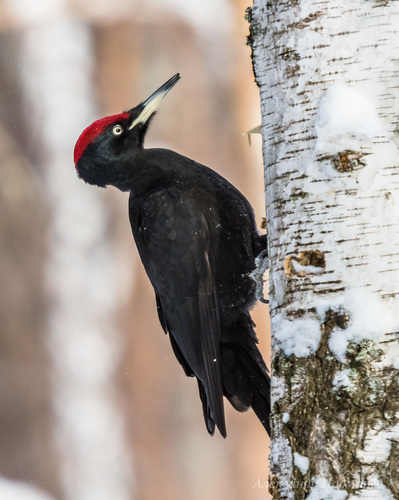
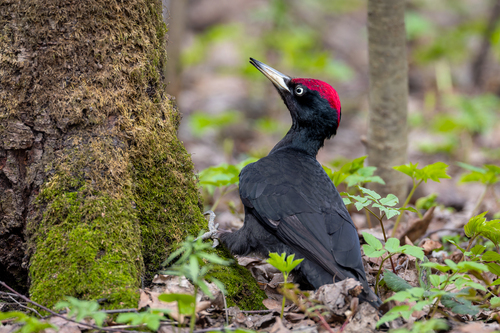
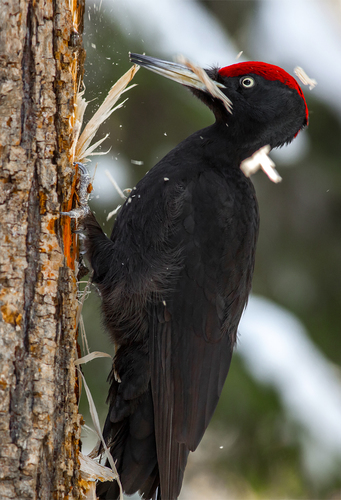
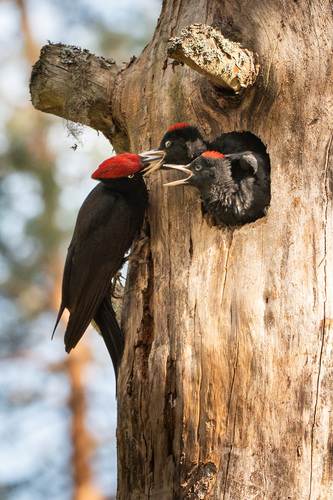
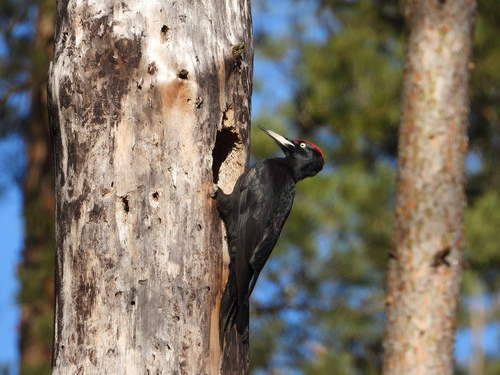
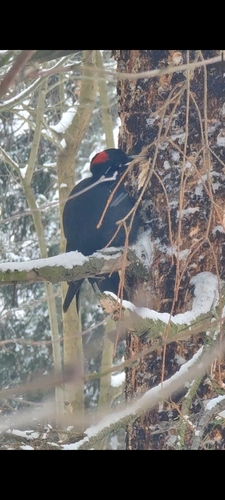
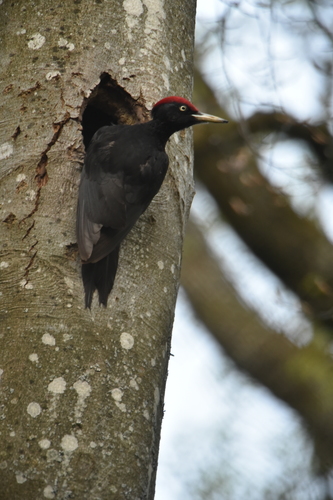
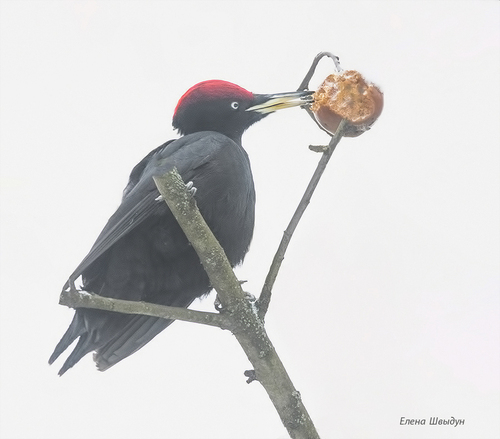
Dryocopus martius (Linnaeus, 1758)
Source: Wikipedia
- 1,221,069 GBIF occurrences
- 25,502 iNaturalist observations
In Europe, the total population size is estimated at 1,240,000-2,270,000 mature individuals, with 622,000-1,140,000 breeding pairs (BirdLife International 2021), and comprises approximately 35% of the species' global range, so a very preliminary estimate of the global population size is between 3,540,000-6,490,000 mature individuals, although further validation of this estimate is desirable. The European trend for this species is not known (BirdLife International 2021). This species is considered to have a medium dependency on forest habitat, which is estimated to be declining at a rate of 6.9% over the past three generations (11.6 years) within its mapped range (Global Forest Watch 2024). Therefore, as a precautionary measure, it is tentatively suspected that this loss of cover may have led to a slow decline over the same time frame.
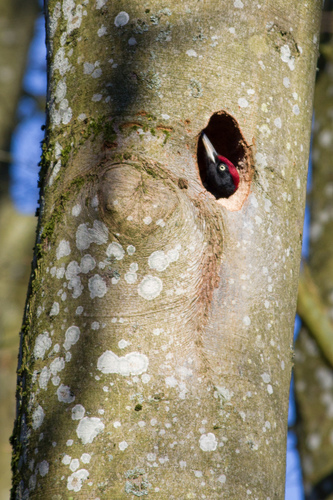
The species is found in all types of mature forest, so long as it is not extremely dense and gloomy and it also uses forest edges. In Scandinavia and Siberia it occupies spruce (Picea) and pine (Pinus) forests with larch (Larix), birch (Betula), aspen (Populus) and alder (Alnus); In Poland all habitat types in primeval forests; in central Europe occurs in all types of not over-dense deciduous, mixed or coniferous forest, from riparian woodland to subalpine forest. In Japan it uses open boreal mixed or coniferous forest at 100-1,000 m. Mating behaviour may begin in mid-January although egg-laying is generally from mid-March to mid-May. The nest is excavated in a tall tree, usually living and either coniferous or deciduous. Clutch size is typically three to five eggs. Its diet consists mainly of ants (Camponotus, Formica, Lasius) and their brood. Wood-boring beetles and bark beetles and their larvae (e.g. Cerambycidae, Elateridae) are also taken, as well as various other arthropods, and occasionally snails, fruits and berries. It has been reported to break into beehives. In most areas the species is resident and even northern populations only partially migratory (Winkler and Christie 2002).
The species is not threatened across its range (Winkler and Christie 2002), however locally within Europe, logging and forestry management do pose a risk (Garmendia et al. 2006, Zhelezov 2010).
Conservation Actions UnderwayBern Convention Appendix II. There are no known current conservation measures for this species.Conservation Actions ProposedMonitoring should be established to ensure logging and forest management does not become a serious threat.
This species has an extremely large range and the population size is extremely large, hence does not approach threatened thresholds for the range or population size criteria. The population trend is not known, but the population is not believed to be decreasing sufficiently rapidly to approach the thresholds under the population trend criterion. For these reasons the species is evaluated as Least Concern.
Gallery