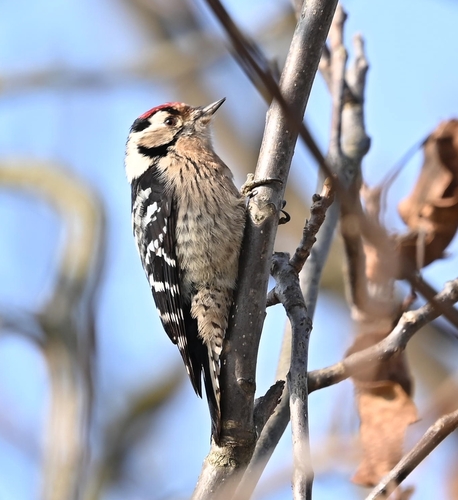
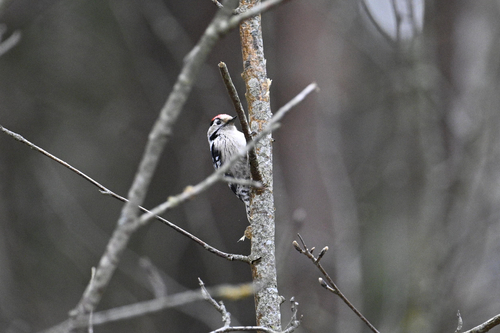
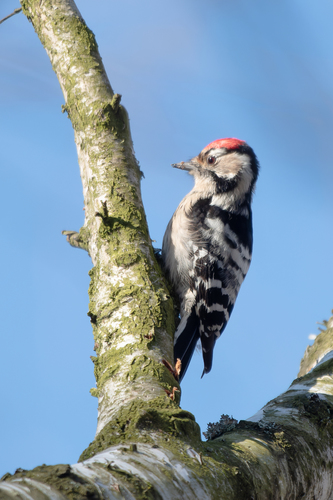
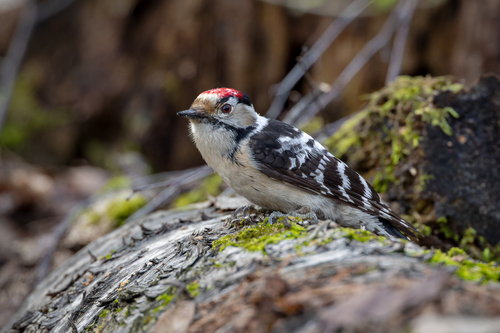
Dryobates minor (Linnaeus, 1758)
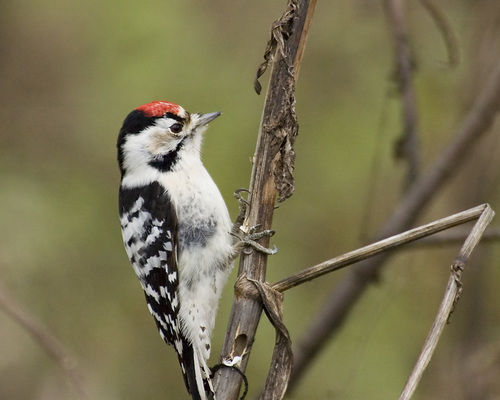
Source: Wikipedia
Synonyms 14
- 724,369 GBIF occurrences
- 16,979 iNaturalist observations
The European breeding population is estimated at 757,000–1,510,000 pairs, which equates to 1,510,000–3,020,000 mature individuals. The breeding population in the EU28 is estimated at 188,000–395,000 pairs, which equates to 376,000–789,000 mature individuals. For details of national estimates, see the Supplementary Information.
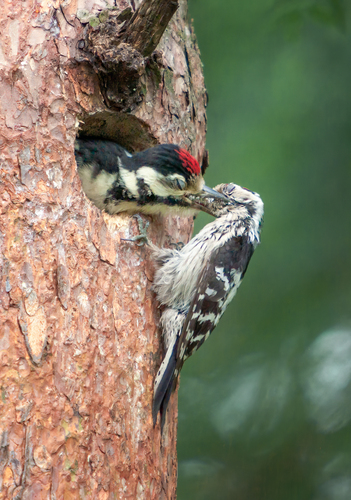
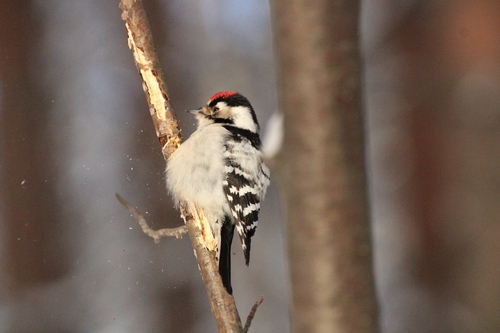
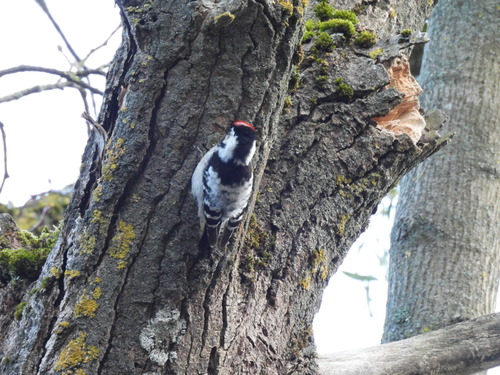
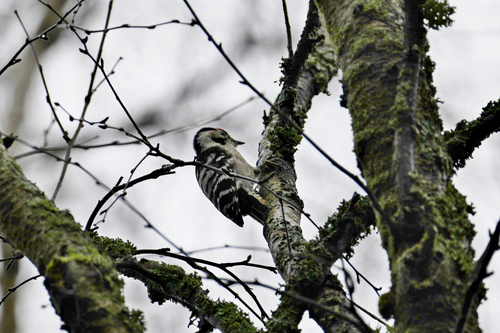
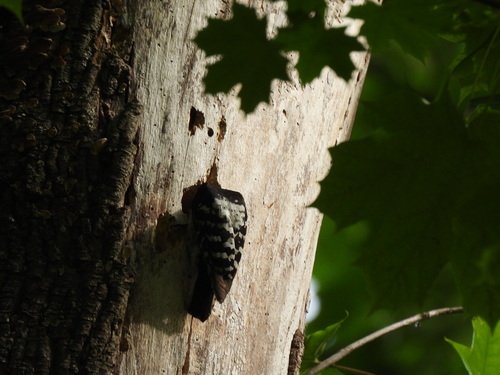
The species is present in temperate and boreal deciduous woodland in lowlands. It prefers open forest with softwood deciduous trees in vicinity of lakes or rivers, as well as forest edge, parks, orchards and gardens. It requires a good number of thin snags, as in old stands or in riparian woodland.Courtship begins in February and laying takes place from April to May (June in the north). Clutches are usually five or six eggs. It is monogamous and the pair-bond may continue for several years. The nest is excavated by both sexes, in soft wood of a dead or decaying trunk, a stump or the underside of a branch.Its diet comprises mainly of small insects; in the summer mostly caterpillars, aphids, ants, beetles, and other surface-dwelling arthropods and in the winter, wood-boring larvae and those living under the bark become important (Winkler and Christie 2002).The species is essentially sedentary but dispersal movements in August and November may give rise to eruptive movements in the north (Hagemeijer and Blair 1997).Although the generation length for both EU and Europe regional assessments were calculated using the same methodology, new information arriving after the EU assessments were undertaken gave rise to an update in the generation lengths. This new information was then used for the Europe level assessments giving rise to a difference between the generation lengths used for the EU and Europe regions.
This species has declined due to a loss of deciduous habitats, especially riverine forest and old orchards and due to the admixture of conifers (Winkler and Christie 2002). It is sensitive to forest fragmentation due to its large home range (Hagemeijer and Blair 1997).
Conservation Actions UnderwayBern Convention Appendix II. Monitoring of the species is generally poor with some exception; declines of the species have been well observed in Finland, Sweden and England (Hagemeijer and Blair 1997).Conservation Actions ProposedMost important is the conservation of adequate suitable habitat remains for this species (Winkler and Christie 2002).
European regional assessment: Least Concern (LC)EU28 regional assessment: Near Threatened (NT)In Europe, this species has an extremely large range (its extent of occurrence (EOO) is much larger than 20,000 km² and its area of occupancy (AOO) is much larger than 2,000 km²), and hence it does not approach the thresholds for Vulnerable under the range size criteria (criteria B and D2). The population size is extremely large (much larger than 10,000 mature individuals), and hence it does not approach the thresholds for Vulnerable under the population size criteria (criteria C and D). The population trend appears to be increasing, and hence does not approach the thresholds for Vulnerable under the population size reduction criterion (criterion A). The probability of extinction has not been calculated for this species, therefore criterion E cannot be applied. For these reasons the species is evaluated as Least Concern in Europe.Within the EU28, this species has an extremely large range (its extent of occurrence (EOO) is much larger than 20,000 km² and its area of occupancy (AOO) is much larger than 2,000 km²), and hence it does not approach the thresholds for Vulnerable under the range size criteria (criteria B and D2). The population size is very large (larger than 10,000 mature individuals), and hence it does not approach the thresholds for Vulnerable under the population size criteria (criteria C and D). The probability of extinction has not been calculated for this species, therefore criterion E cannot be applied. The population trend appears to be undergoing a moderately rapid decline which approaches the thresholds for Vulnerable under the population size reduction criterion (criterion A), therefore it is assessed as Near Threatened (NT) in the EU28. There is not considered to be significant potential for rescue from outside the region and therefore the category remains unchanged.
Gallery