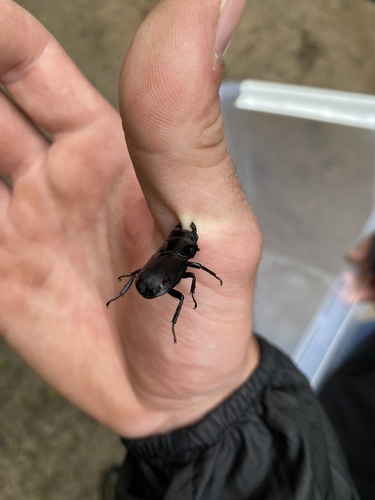
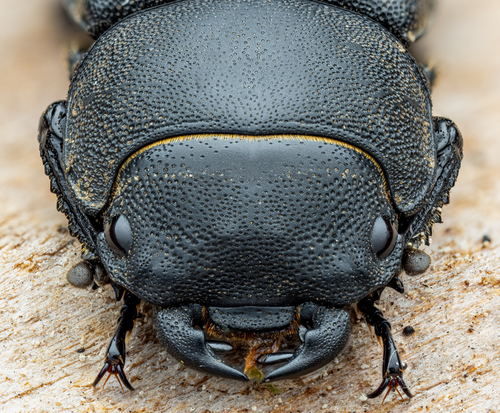
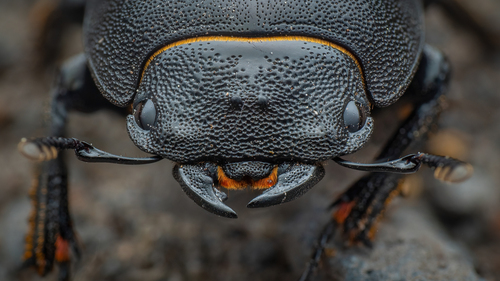
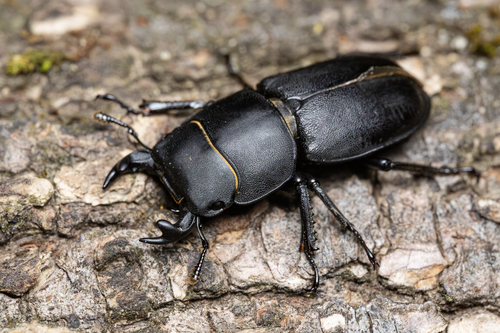
Dorcus parallelipipedus (Linnaeus, 1758)

Source: Wikipedia
Synonyms 8
- 99,274 GBIF occurrences
- 48,654 iNaturalist observations
This is a widespread and common species with stable populations across its European range. In Andorra, there are no recent data on the presence of the species. It is widespread across much of lowland England; with a large strong population (K. Alexander pers. comm. 2009). In Hungary the population size and trend have not been quantified, although the species is regarded as very common in its localities (O. Merkl pers. comm. 2009). In Latvia, more than 300 localities are known with Dorcus parallelipipedus, the species is common, including in cultural landscape. In Romania it is widespread and it is considered the most common lucanid species. It is abundant in European Russia and not rare. In Spain there are no data on local population size; a study of road casualties revealed local densities in the order of 10-20 individuals (M. Méndez pers. comm. 2009). In European Türkiye its population was very high in the 1940s, however the population size and trend have not been quantified recently. In Ukraine it is very common (A. Putchkov pers. comm. 2009). Generally, it is abundant even in highly urbanised environments and rural landscapes.
This is an obligate saproxylic species of temperate, southern boreal forests and cultural landscape. Larvae develop in white-rot decaying heartwood of many deciduous tree species. Adults and larvae hibernate. Adults are active in summer and are rarely attracted to light. In Great Britain, suitable trees may occur in a very wide variety of situations, especially across the cultural landscape (Alexander 2002) and also found on exposed sap of trees. In Hungary this species lives in all kinds of broad-leaved forests, and in any wooded places, including city parks, suburbs, and villages. In Latvia it develops in decaying wood of most local broad-leaved (Acer, Aesculus, Fraxinus, Tilia, Quercus) and in Betula pendula and Salix sp.; specimens occur beneath loose bark, in or beneath fallen trunks and logs, on tree sap; particularly abundant in parks and old avenues and pasture meadows. In Romania adults have been found in association with Cerambyx cerdo and Lucanus cervus at the tree sap. In Spain adults have been found all year round but mainly in May to August (M. Méndez pers. comm. 2009), and in Moscow Oblast of Russia until September (Nikitsky 2016). In Spain it is present in bocage landscapes, riparian forests and closed forests (M. Méndez pers. comm. 2009). In European Türkiye larvae develop in dead wood of Castanea, Fagus, Juglans, Populus, Quercus, Salix; adults are active in April to August (Canakcioglu 1993). The development cycle in European Russia and the Baltic countries is two to three years (Nikitsky 2016).
The species does not seem to be currently threatened. However some local threats can include the loss of old trees and decaying wood, particularly in Great Britain. Decline of decaying wood in forests and cultural landscape, decline in old and veteran trees in all kinds of habitats could negatively affect the European and EU 27 population, but these populations are very large and the decline, if in place, is negligible.
There are no specific conservation measures in place. The species is very common and occurs in many nature conservation areas across the range (e.g. France, Germany, Great Britain, Hungary, Latvia, Russia). The species is legally protected in Hungary.
European regional assessment: Least Concern (LC)EU 27 regional assessment: Least Concern (LC)Dorcus parallelipipedus is an obligate saproxylic stag beetle species dependent on whit-rot decaying wood. The European and EU 27 extent of occurrence (EOO) and area of occupancy (AOO) are very large, both exceeding the thresholds for threatened species. The distribution is wide, the population is large with a stable trend, and no major threats are identified. The species occurs in a large number of nature conservation areas and is unlikely to be declining fast enough to qualify for listing in a threatened category.
Gallery