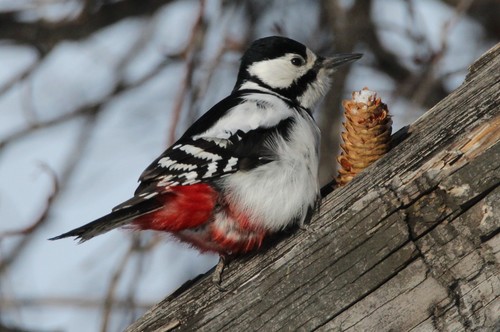
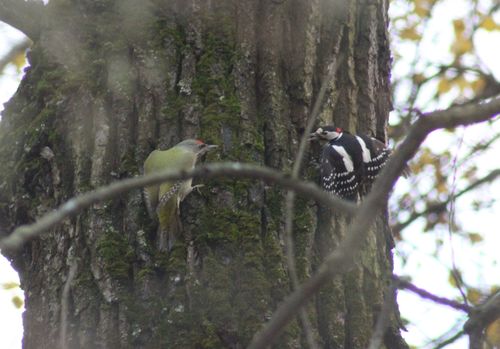
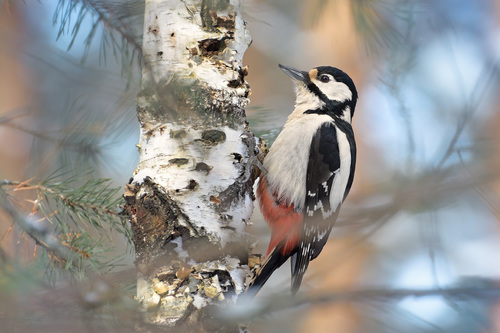
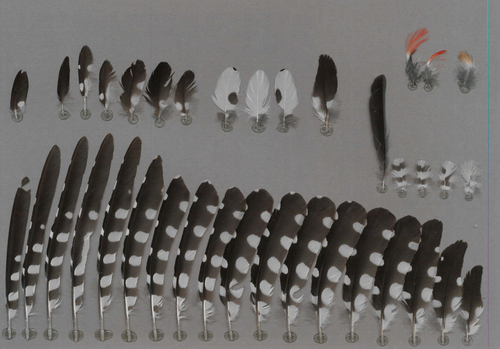
Dendrocopos major (Linnaeus, 1758)
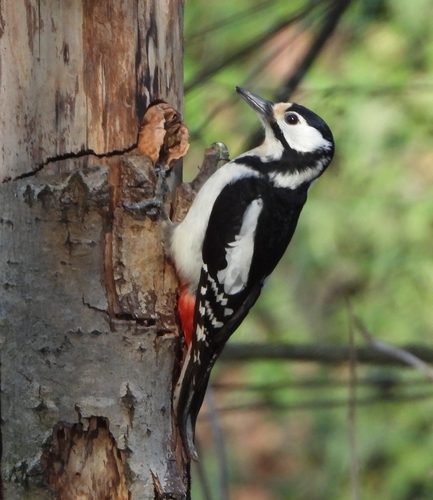
Source: Wikipedia
- 5,380,989 GBIF occurrences
- 150,634 iNaturalist observations
In Europe, the total population size is estimated at 17,000,000-27,000,000 mature individuals (BirdLife International 2021). As Europe comprises c. 35% of the species' global range, the global population size has therefore been provisionally estimated at 49,000,000-78,000,000 mature individuals, although this requires further validation.
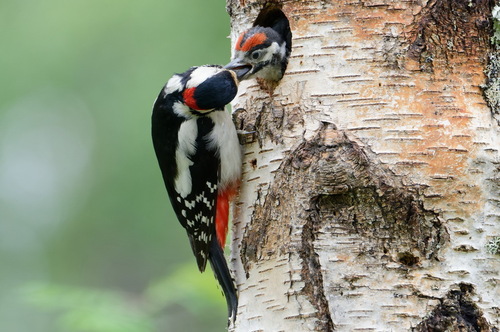
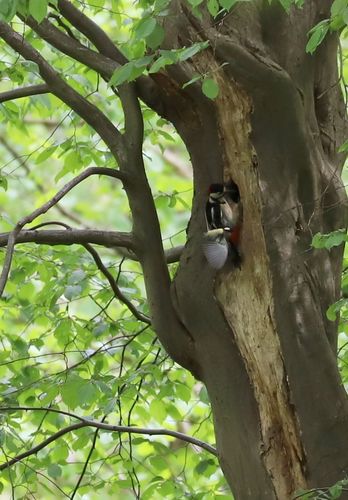
This species uses all kinds of woodland and forest, from pure broadleaved forest to unmixed stands of conifers. It is also common in copses, tree avenues, parks and gardens. It uses olive and poplar (Populus) plantations and up to cedar (Cedrus), pine (Pinus), pine-oak and cork oak (Quercus suber) woods in North Africa. It is found in alder (Alnus) and rhododendron in northern Myanmar and common in deciduous, mixed or coniferous woods and parks in Japan (Winkler et al. 2015). Egg-laying is from mid-April to June (later in the far north and at higher altitudes). The species is monogamous and both sexes excavate a new hole each year, in a dead or living tree of a wide variety of species. Occasionally utility poles are used and nest boxes as well. Clutches can be four to eight eggs but normally five to seven. Its diet is varied and displays clear seasonal changes in more seasonal habitats. It feeds mainly on invertebrates but will also take crustaceans and mussels, coniferous seeds, nuts, acorns, buds, tree sap, berries, fruit and possibly nectar. It is also notorious for taking the eggs and young of other birds. It is mostly resident and dispersive although northern populations are also subject to eruptive migration (Winkler et al. 2015).
Harsh winters can cause significant mortality in this species. Fragmentation of habitat is a threat locally. The Canary Island races canariensis and thanneri are currently probably the most vulnerable, especially the former, which may be at some risk because of human exploitation of Canarian pine forest (Winkler et al. 2015). Air pollution, causing die-back in forests, in central and eastern Europe appears to have mixed effects; where damage is heavy, nesting possibilities, food supply and food quality deteriorate causing a decline in woodpeckers, although the impact of this is unknown. Hybridization is known to occur with Syrian Woodpeckers (Dendrocopos syriacus) (Hagemeijer and Blair 1997).
Conservation Actions UnderwayBern Convention Appendix II. Canary Island races canariensis and thanneri are listed on Annex I of the EU Birds Directive. There are currently no known conservation measures for this species.Conservation Action ProposedThe following information refers to the species's European range only: Protection of areas of Canarian pine from exploitation would help secure this species in the Canary Islands. Research into the long term effects of air pollution on forests in central and eastern Europe is needed in order to determine its impact on this species.
This species has an extremely large range, and hence does not approach the thresholds for Vulnerable under the range size criterion (extent of occurrence under 20,000 km² combined with a declining or fluctuating range size, habitat extent/quality, or population size and a small number of locations or severe fragmentation). The population size is extremely large, and hence does not approach the thresholds for Vulnerable under the population size criterion (under 10,000 mature individuals with a continuing decline estimated to be over 10% in ten years or three generations, or with a specified population structure). Despite the fact that the population trend appears to be decreasing, the decline is not believed to be sufficiently rapid to approach the thresholds for Vulnerable under the population trend criterion (over 30% decline over ten years or three generations). For these reasons the species is evaluated as Least Concern.
Gallery