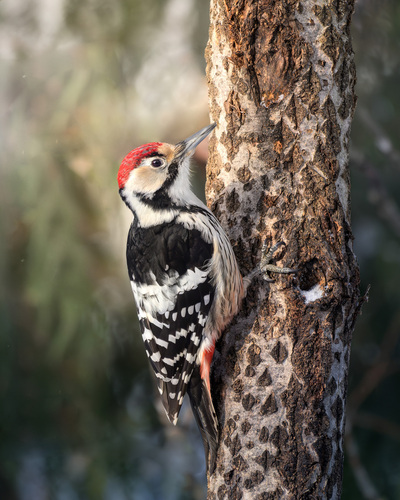
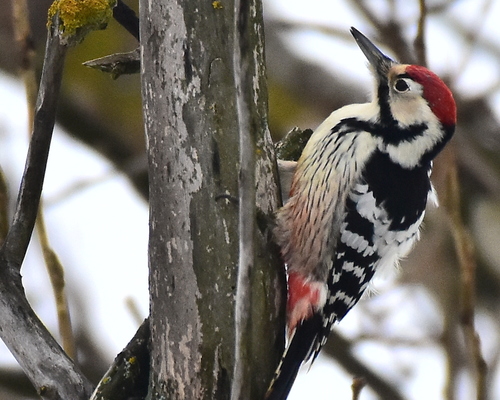
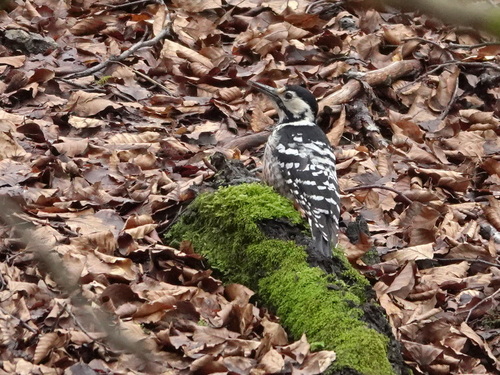
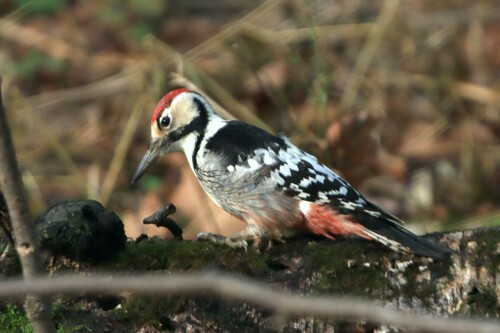
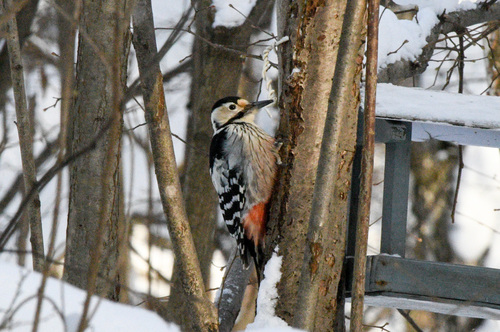
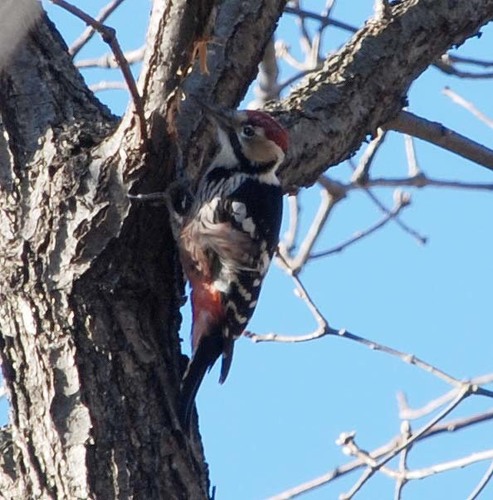
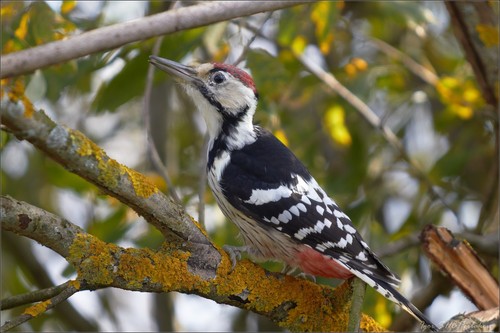
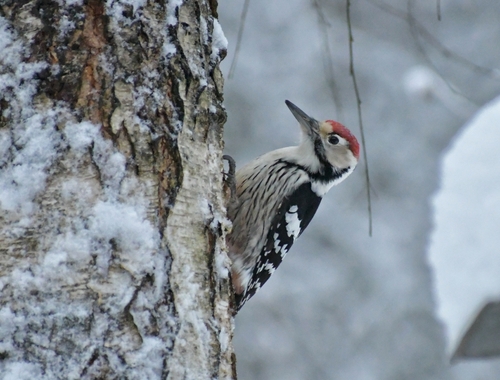
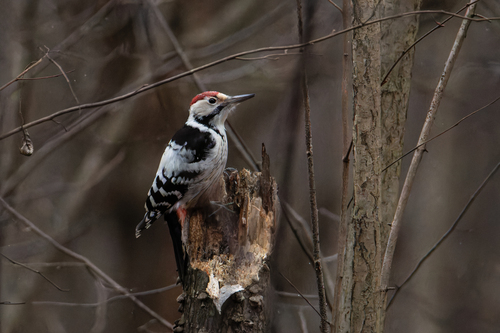
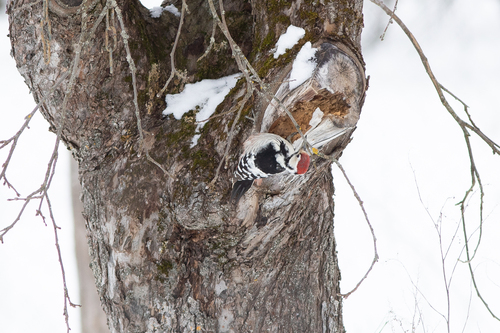
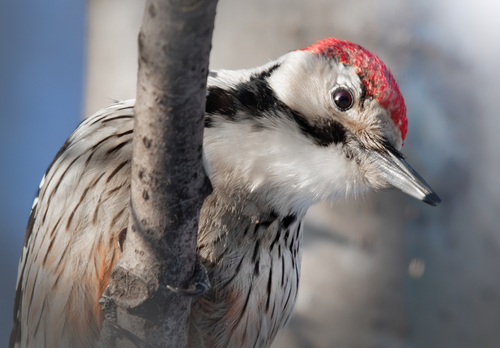
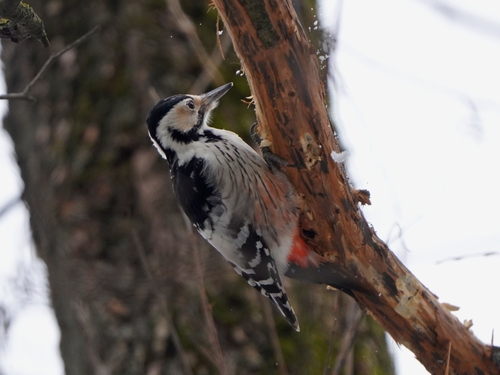
Dendrocopos leucotos (Bechstein, 1802)
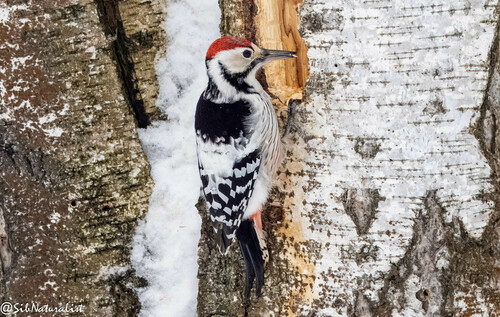
Source: Wikipedia
- 90,602 GBIF occurrences
- 14,547 iNaturalist observations
The European breeding population is estimated at 210,000–411,000 pairs, which equates to 420,000–822,000 mature individuals. The breeding population in the EU28 is estimated at 36,400–88,000 pairs, which equates to 72,900–176,000 mature individuals. For details of national estimates, see the Supplementary Information.
The species occurs in broad-leaved forest. In central and Southern Europe it is found in forests dominated by beech (Fagus spp.), hornbeam (Carpinus betulus) and oak (Quercus spp.) and in northern and Eastern Europe forests dominated by birch (Betula spp.) and aspen (Populus tremula) (Hagemeijer and Blair 1997).Courtship begins in February and egg-laying from late April to May or June. Both sexes excavate the nest in the soft wood of a dead or decaying tree, stump or branch, or in a utility pole. Clutch size generally three to five eggs (Winkler and Christie 2002).It is highly insectivorous and only occasionally takes plant matter. It specialises on wood-boring beetle larvae, particularly longhorn species (Coleoptera) but also feeds on flies, carpenter moths and carpenter ants (Gorman 2014).The species is generally resident with some local movements (Winkler and Christie 2002).Although the generation length for both EU and Europe regional assessments were calculated using the same methodology, new information arriving after the EU assessments were undertaken gave rise to an update in the generation lengths. This new information was then used for the Europe level assessments giving rise to a difference between the generation lengths used for the EU and Europe regions.
Intense forest management, leading to a reduction of dead wood or the introduction of conifers results in a reduction in population size (Winkler and Christie 2002, Håpnes 2003), accompanied by loss of genetic diversity (Winkler and Christie 2002).
Conservation Actions UnderwayBern Convention Appendix II. EU Birds Directive Annex I. The species is listed as Critically Endangered on the Swedish Red List (Gärdenfors 2010) and a national Species Action Plan was published in 2005 (Mild and Stighäll 2005). Norwegian birds were translocated to Sweden (Håpnes 2003) and a captive breeding programmes set up in order to supplement the dwindling population there. Some reserves were established as was successful management to create dead wood, however the achievement of the targets planned in 2005–2008 was on average much lower than planned (Blicharska et al. 2014).Conservation Actions ProposedEverywhere, this species' survival is dependent on preservation of reasonably large areas of unmanaged deciduous forest (Winkler and Christie 2002, Håpnes 2003), including dead wood. Restoration of natural habitats is also important (Håpnes 2003).
European regional assessment: Least Concern (LC)EU28 regional assessment: Least Concern (LC)In Europe, this species has an extremely large range (its extent of occurrence (EOO) is much larger than 20,000 km² and its area of occupancy (AOO) is much larger than 2,000 km²), and hence it does not approach the thresholds for Vulnerable under the range size criteria (criteria B and D2). The population size is very large (larger than 10,000 mature individuals), and hence it does not approach the thresholds for Vulnerable under the population size criteria (criteria C and D). Despite the fact that the population trend appears to be decreasing, the decline is not believed to be sufficiently rapid to approach the thresholds for Vulnerable under the population size reduction criterion (criterion A). The probability of extinction has not been calculated for this species, therefore criterion E cannot be applied. For these reasons the species is evaluated as Least Concern in Europe.In the EU28, this species has an extremely large range (its extent of occurrence (EOO) is much larger than 20,000 km² and its area of occupancy (AOO) is much larger than 2,000 km²), and hence it does not approach the thresholds for Vulnerable under the range size criteria (criteria B and D2). The population size is very large (larger than 10,000 mature individuals), and hence it does not approach the thresholds for Vulnerable under the population size criteria (criteria C and D). The population trend is not known, but it is not believed to approach the thresholds for Vulnerable under the population size reduction criterion (criterion A). The probability of extinction has not been calculated for this species, therefore criterion E cannot be applied. For these reasons the species is evaluated as Least Concern within the EU28.
Gallery