Delichon urbicum (Linnaeus, 1758)
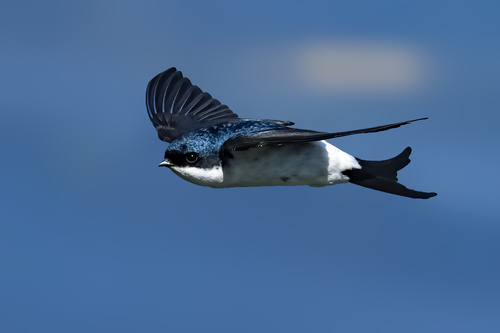
Source: Wikipedia
Synonyms 7
- 2,582,803 GBIF occurrences
- 37,639 iNaturalist observations
In Europe, the total population size is estimated at 23,000,000-48,100,000 mature individuals, with 11,500,000-24,100,000 breeding pairs (BirdLife International 2021), and comprises approximately 60% of the species' global range, so a very preliminary estimate of the global population size is between 38,300,000-80,200,000 mature individuals, although further validation of this estimate is desirable. Following earlier declines, the species' population in Europe is considered to have remained relatively stable over three generations (10 years) (BirdLife International 2021). As this region holds the majority of the species' global range, the global population size is currently considered to be stable over three generations.
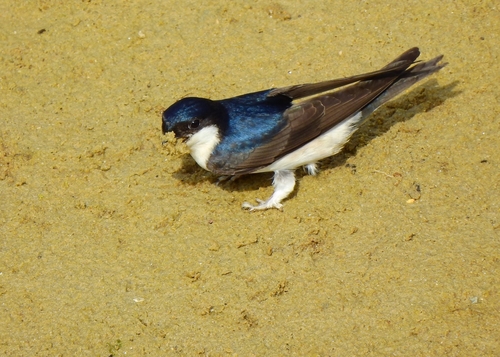
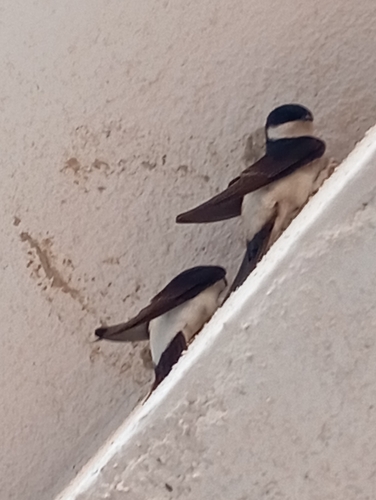
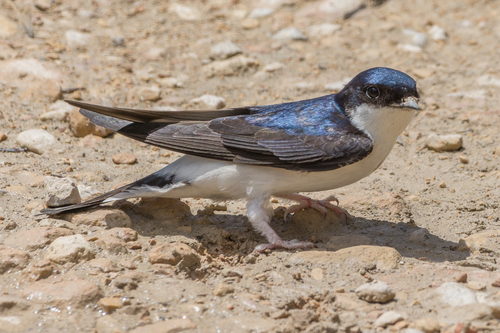
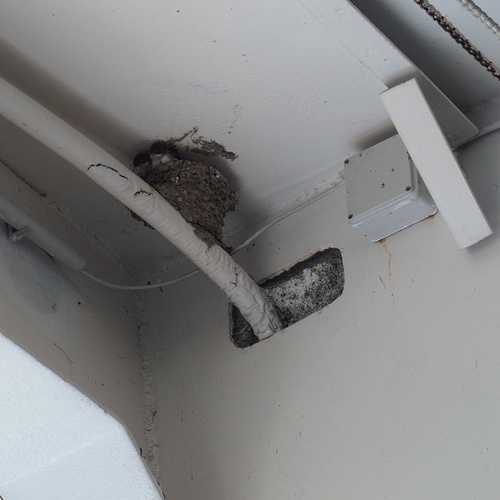
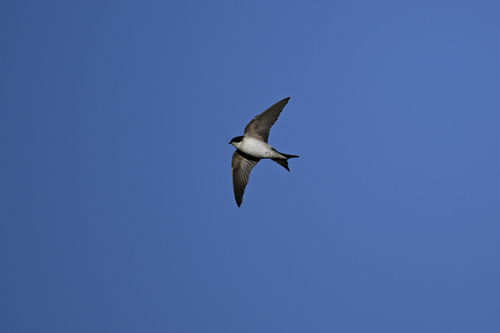
This species occupies open areas, coastal cliffs, cultivation, and human habitations, including towns and cities. In north-west and central Europe, egg-laying occurs from May and in northern and north-east Europe from the end of May. In southern Spain and north Africa laying occurs from March to May and in June-July on the north Indian Subcontinent. The nest is built by both sexes and is enclosed with a small entrance hole near the top. It is made of mud pellets, lined with vegetable fibres and feathers and is attached to the outside of a building or, less often, a bridge, usually under an overhang and sometimes inside buildings. It will also occasionally use a natural sea cliff or rock face and rarely a cave or tree (Turner 2004). Clutches are normally three to five eggs. It feeds almost entirely on flying insects, almost always taken by aerial-pursuit (Snow and Perrins 1998). The species is migratory, with European birds wintering south of the Sahara (Turner 2004).
The species is affected by adverse weather which can have significant impacts during breeding and migration. It is also thought to compete for nest sites with House Sparrows (Passer domesticus) and a study conducted in Poland attributed recent changes in breeding sites to this (Turner 2004).
Conservation Actions UnderwayBern Convention Appendix II. The species has benefited from building developments which provide additional nesting sites. Reductions in air pollution resulting in increased numbers of insects in cities have also lead to an increase in population numbers in some cities (Turner 2004). The Clean Air Act in the U.K. saw increases of this species in London, Birmingham and Manchester, and in Berlin (Germany) there was a 36% increase between 1979 and 1983-1984 (Hagemeijer and Blair 1997).Conservation Actions ProposedIt is known to readily use specially designed nestboxes (Turner 2004). Although the species is not threatened, populations should be monitored to detect changes in numbers. Continued reductions in air pollution are likely to benefit the species.
This species has an extremely large range and the population size is extremely large, hence does not approach threatened thresholds for the range or population size criteria. The population trend appears to be stable, and hence the species does not approach the thresholds for Vulnerable under the population trend criterion. For these reasons the species is evaluated as Least Concern.
Gallery