Curruca communis (Latham, 1787)
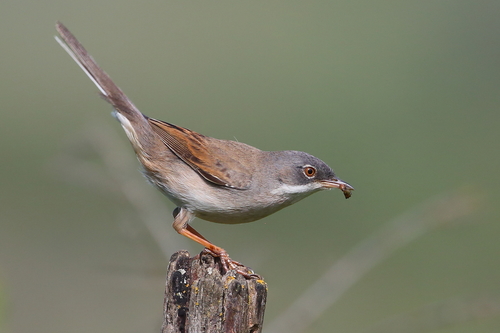
Source: Wikipedia
Synonyms 6
- 1,406,421 GBIF occurrences
- 39,715 iNaturalist observations
In Europe, the total population size is estimated at 39,200,000-59,200,000 mature individuals, with 19,600,000-29,600,000 breeding pairs (BirdLife International 2021), and comprises approximately 65% of the species' global range, so a very preliminary estimate of the global population size is between 60,300,000-91,100,000 mature individuals, although further validation of this estimate is desirable. The species' population in Europe is considered to have undergone a suspected increase over three generations (10 years) (BirdLife International 2021). As this region holds the majority of the species' global range, the global population size is considered to be increasing over three generations.
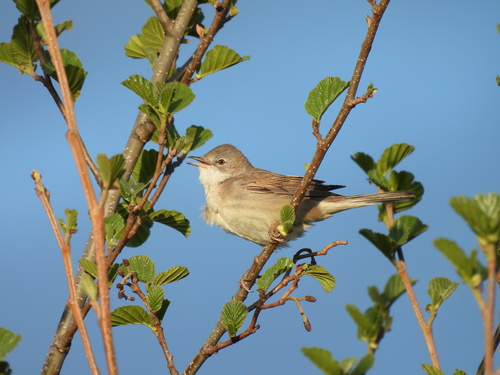
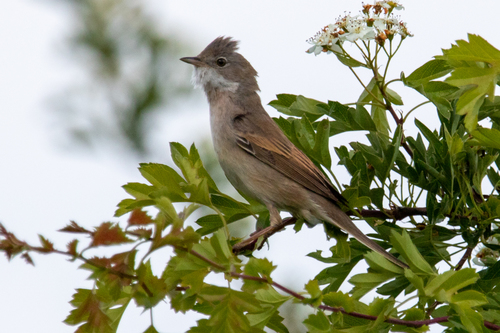
This species occupies open country in a wide variety of landscapes, mostly sunlit areas with scattered bushes and shrubs close to grassy patches. It breeds in plantation clearings, orchards, hedgerows along roads or railway lines, shrubs near watercourses, pastures with junipers (Juniperus) and in steppes. It is also found in hedges around field crops, especially those of appropriate height such as cereals or lucerne (Medicago). It breeds mostly from April to July and generally lays four to five eggs. The nest is a fairly deep cup constructed from grass, leaves, rootlets, spider cocoons and hair and is concealed low down in a bush or tall grass (Aymí and Gargallo 2015). During the breeding season it feeds mainly on insects but in the late summer the proportion of fruit taken increases and in autumn and winter it feeds primarily on berries (Snow and Perrins 1998). The species is migratory and winters in sub-Saharan Africa (Aymí and Gargallo 2015).
In the past, central and western populations have declined due to drought in the Sahel zone of west Africa from 1968–1975. Human pressure in the Sahel region has led to increased desertification. In Europe, suitable breeding habitat has been lost to changes in land use through the intensification of agriculture, combined with the destruction of hedgerows and bushes (Aymí and Gargallo 2015). The species is also sensitive to severe winters, such as that of 1968-1969 (Hagemeijer and Blair 1997).
Conservation Actions UnderwayCMS Appendix II. Bern Convention Appendix II. There are currently no known conservation measures for this species within Europe.Conservation Actions ProposedThe maintenance or increase of structural heterogeneity of linear habitats may be beneficial for this species (Szymański and Antczak 2013).
This species has an extremely large range and the population size is extremely large, hence does not approach threatened thresholds for the range or population size criteria. The population trend appears to be increasing, and hence the species does not approach the thresholds for Vulnerable under the population trend criterion. For these reasons the species is evaluated as Least Concern.
Gallery