Cuculus canorus Linnaeus, 1758
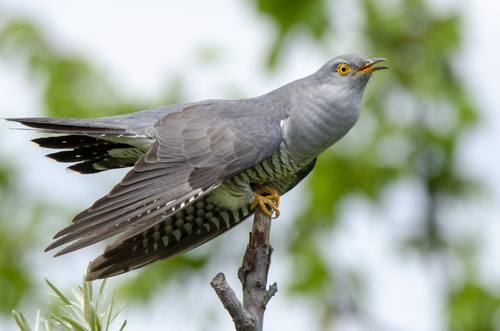
Source: Wikipedia
- 2,077,251 GBIF occurrences
- 32,173 iNaturalist observations
In Europe, the total population size is estimated at 8,640,000-13,600,000 mature individuals, with 4,320,000-6,800,000 breeding calling males (BirdLife International 2021), and comprises approximately 25% of the species' global range, so a very preliminary estimate of the global population size is between 34,600,000-54,400,000 mature individuals, although further validation of this estimate is desirable. In Europe, the species' population has declined in the west of its range but remained stable in the east, and is thus considered likely to have undergone only a small overall decrease over three generations (11.37 years) (BirdLife International 2021). Based on these data, and the proportion of the species' global range that this region holds, the global population size is considered to be stable over three generations.
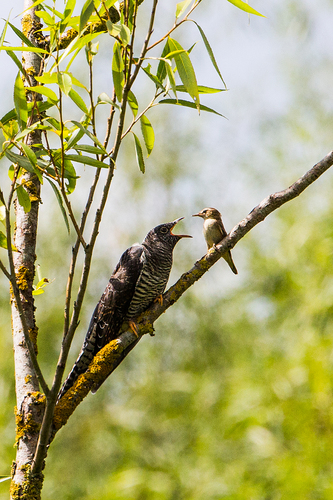
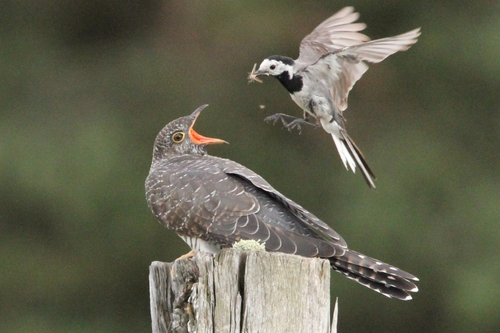
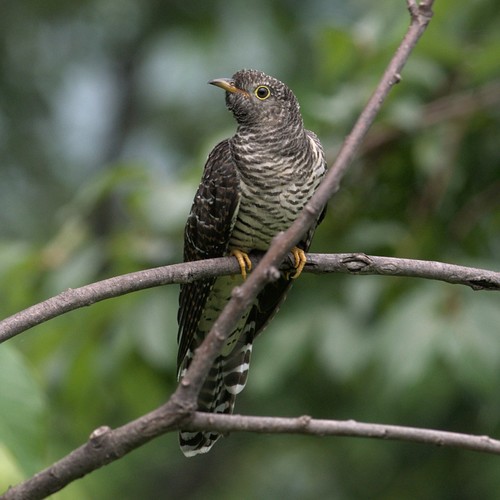
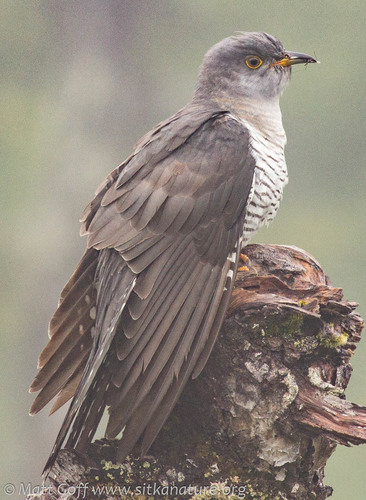
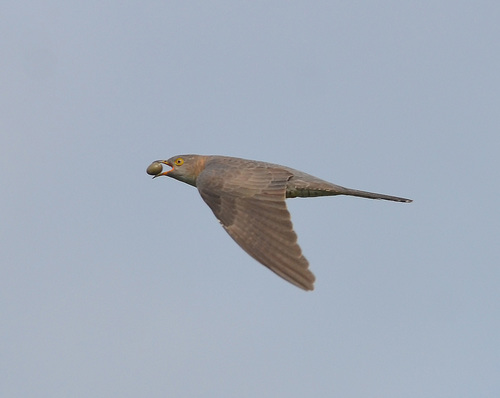
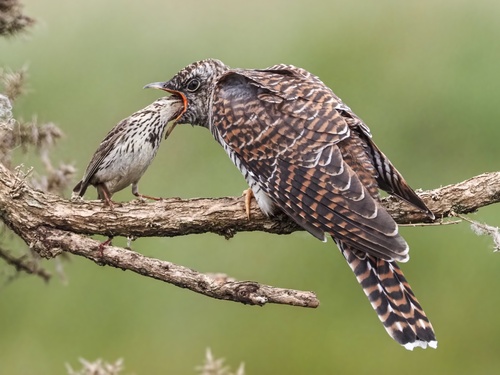
The species inhabits forests and woodlands, both coniferous and deciduous, second growth, open wooded areas, wooded steppe, scrub, heathland, meadows, reedbeds, lowlands and moorlands. In north-west Europe it breeds between May and June. It is a brood parasite; host species include many insectivorous songbirds such as flycatchers, chats, warblers, pipits, wagtails and buntings. Over 100 host species have been recorded. The species feeds on insects, spiders and snails and rarely on fruit. Individuals of the nominate race breeding from the British Isles and Scandinavia east to Russia winter in central and southern Africa. Individuals of the bangsi race that breed in Iberia spend the winter south of the equator from west Africa to Lake Tanganyika. Individuals of the nominate and bakeri races breeding in Asia winter in India, south-east Asia, the Philippines and Africa. Individuals of the subtelephonus race migrate through the Middle East and winter in Africa (Payne and Christie 2013).
Declines in northern Europe have been attributed to the intensification of agriculture, resulting in fewer insects and hosts. Climate change is also an important factor where short-distance migrating host species have advanced their arrival more than the cuckoos resulting in a mismatch of nesting times (Erritzøe et al. 2012).
Conservation Actions UnderwayThe species is listed as 'red' on the U.K. National Red List (Eaton et al. 2007).Conservation Actions ProposedThe following information refers to the species's European range only: Traditional farming methods that protect and create habitats and food sources for host species should be promoted. Further research on the effects of climate change and monitoring of populations should be undertaken.
This species has an extremely large range and the population size is extremely large, hence does not approach threatened thresholds for the range or population size criteria. Despite the fact that the population trend may be decreasing, the decline is not believed to be sufficiently rapid to approach the thresholds for Vulnerable under the population trend criterion. For these reasons, the species is evaluated as Least Concern.
Gallery