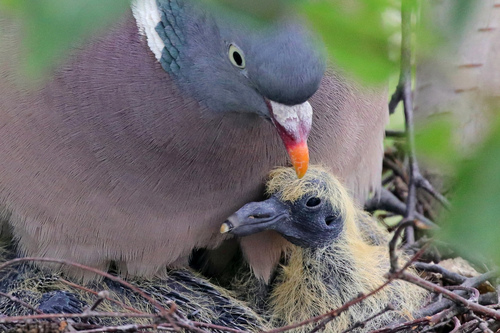
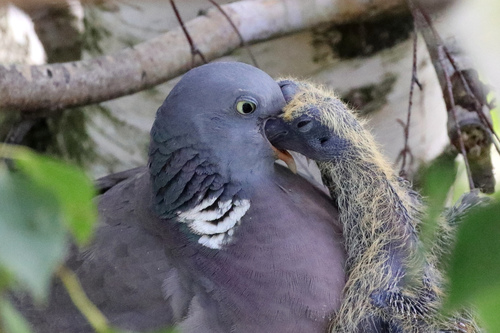
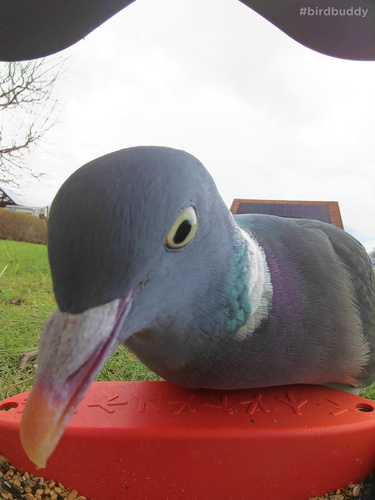
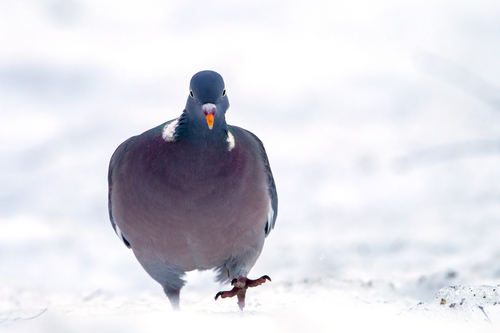
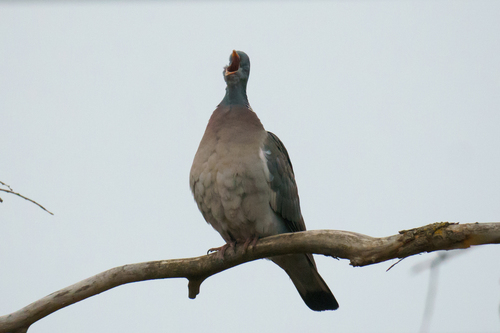
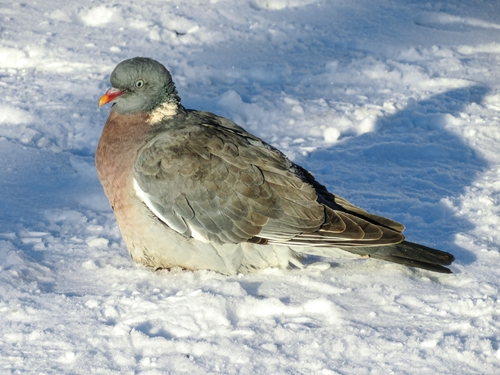
Columba palumbus Linnaeus, 1758
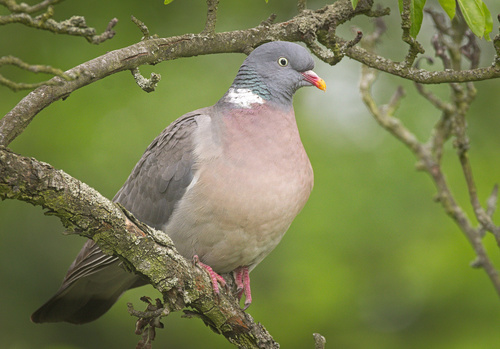
Source: Wikipedia
- 9,377,921 GBIF occurrences
- 182,271 iNaturalist observations
The European breeding population is estimated at 20,700,000-28,800,000 pairs, which equates to 41,400,000-57,600,000 mature individuals. The breeding population in the EU28 is estimated at 19,200,000-26,400,000 pairs, which equates to 38,500,000-52,700,000 mature individuals. For details of national estimates, see the Supplementary Information.
The species is found in a mosaic of woodland and open ground, notably farmland, parks and suburban gardens (Tucker and Heath 1997). It is typically a species of ecotone in deciduous or coniferous woodland. Its breeding season varies between regions, ranging from late February to early September. It normally lays two eggs. The nest is built of twigs and lined with more twigs, grasses and leaves usually 1.5-2.5 m above ground in trees and on building ledges or occasionally in thick vegetation or under a hedge. It takes food from the ground and also feeds in trees, mainly taking plant matter such as green leaves, buds, flowers, seeds, berries, grain and occasionally invertebrates. It is mainly migratory in northern and eastern Europe and partially migratory or resident in the rest of Europe (Baptista et al. 1997).Although the generation length for both EU and Europe regional assessments were calculated using the same methodology, new information arriving after the EU assessments were undertaken gave rise to an update in the generation lengths. This new information was then used for the Europe level assessments giving rise to a difference between the generation lengths used for the EU and Europe regions.
There are currently no known significant threats to this species.
Conservation Actions UnderwayEU Birds Directive Annex II and III; C. p. azorica on Annex I. There are no known conservation measures for this species.Conservation Actions ProposedNo conservation measures are currently needed for this species.
European regional assessment: Least Concern (LC)EU28 regional assessment: Least Concern (LC)At both European and EU28 scales, this species has an extremely large range (its extent of occurrence (EOO) is much larger than 20,000 km² and its area of occupancy (AOO) is much larger than 2,000 km²), and hence it does not approach the thresholds for Vulnerable under the range size criteria (criteria B and D2). The population size is extremely large, (much larger than 10,000 mature individuals), and hence it does not approach the thresholds for Vulnerable under the population size criteria (criteria C and D). The population trend appears to be increasing, and hence the species does not approach the thresholds for Vulnerable under the population size reduction criterion (criterion A). The probability of extinction has not been calculated for this species, therefore criterion E cannot be applied. For these reasons the species is evaluated as Least Concern within both Europe and the EU28.
Gallery