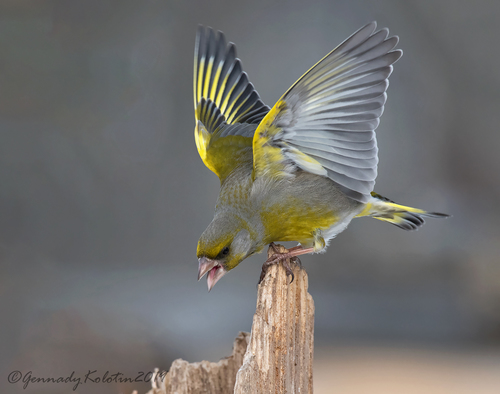
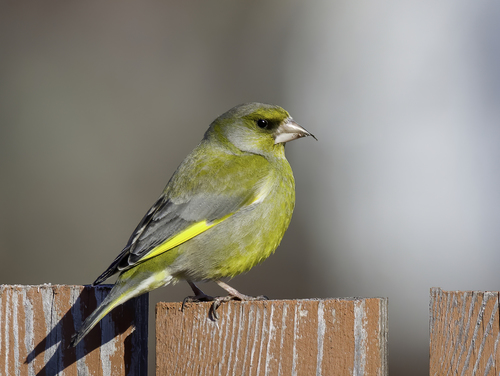
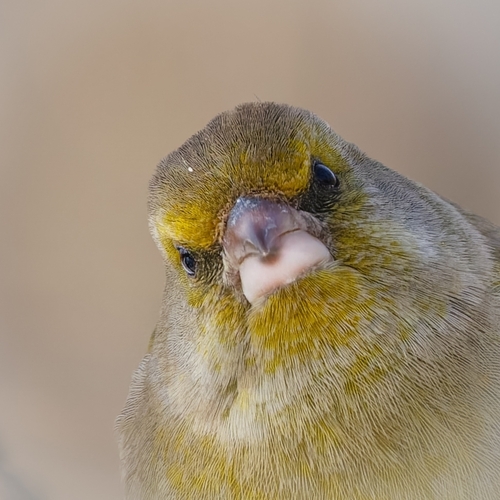
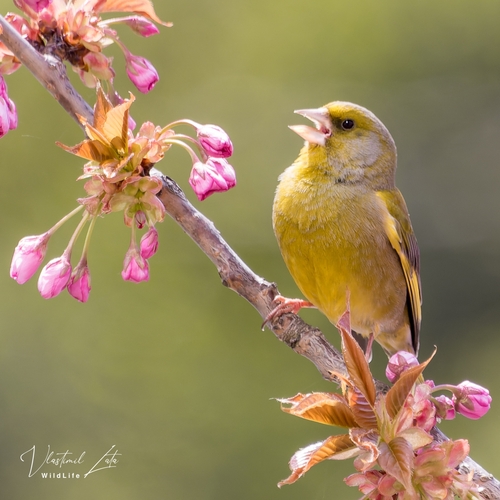
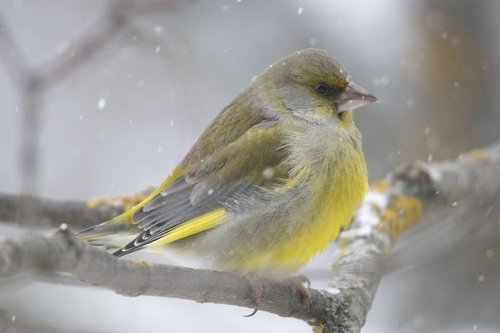
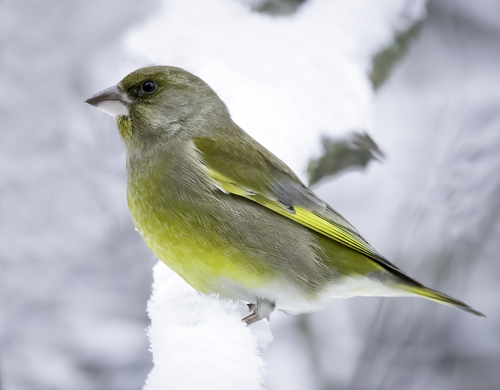
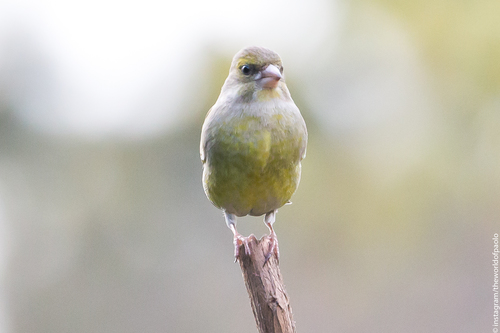
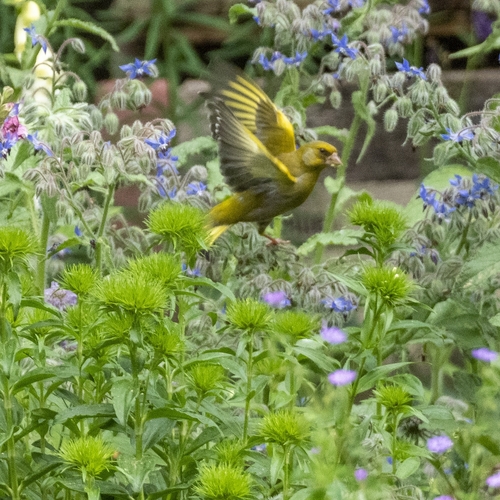
Chloris chloris (Linnaeus, 1758)
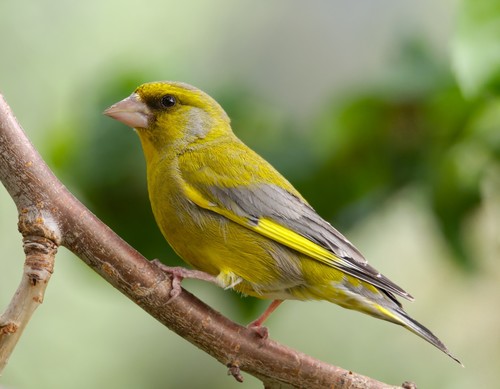
Source: Wikipedia
Synonyms 12
- 102,189 iNaturalist observations
The European breeding population is suspected to be 20,700,000–32,200,000 pairs, which equates to 41,500,000–64,400,000 mature individuals. The breeding population in the EU28 is estimated at 16,500,000–23,200,000 pairs, which equates to 33,100,000–46,400,000 mature individuals. For details of national estimates, see the Supplementary Information.
This species inhabits a wide variety of habitats in boreal, temperate, steppe and Mediterranean zones, including the edges of lowland forest, deciduous and mixed forests, woods, plantations, copses and groves, orchards, churchyards, hedgerows, parks, edges of cultivation and gardens. Outside the breeding season it is found in similar habitats, but also in open fields, marshes and along the shoreline of open coasts.It breeds from mid-March to mid-August and is principally monogamous, although occasionally polygamous. The nest is built 1–20 m from the ground in a bush, hedge, tree, creepers and occasionally in old or disused nests of other species or sometimes in an artificial site. It is a well-made cup of dry twigs, grasses, moss, lichens, plant fibres and down, animal hair, feathers and occasionally some man-made material. Clutches are four to six eggs.The diet is made up of a wide range of seeds, buds, flowers, berries and fruit as well as some arthropods.Some populations of the species are migratory while others are sedentary (Clement and de Juana 2016).Although the generation length for both EU and Europe regional assessments were calculated using the same methodology, new information arriving after the EU assessments were undertaken gave rise to an update in the generation lengths. This new information was then used for the Europe level assessments giving rise to a difference between the generation lengths used for the EU and Europe regions.
The species has suffered significant declines in the U.K. from trichomonosis, caused by the protozoan parasite Trichomonas gallinae, which lead to a fall in the population of ca. 35% between 2005 and 2010 (Lawson et al. 2012). The species is trapped in some parts of its range.
Conservation Actions UnderwayBern Convention Appendix II. There are currently no known specific conservation measures for this species.Conservation Actions ProposedResearch on how trichomonosis developed as an emerging infectious disease is required to determine if and how outbreaks would occur in the future (Lawson et al. 2012).
European regional assessment: Least Concern (LC)EU28 regional assessment: Least Concern (LC)At both European and EU28 scales, this species has an extremely large range (its extent of occurrence (EOO) is much larger than 20,000 km² and its area of occupancy (AOO) is much larger than 2,000 km²), and hence it does not approach the thresholds for Vulnerable under the range size criteria (criteria B and D2). The population size is extremely large, (much larger than 10,000 mature individuals), and hence it does not approach the thresholds for Vulnerable under the population size criteria (criteria C and D). Despite the fact that the population trend appears to be decreasing, the decline is not believed to be sufficiently rapid to approach the thresholds for Vulnerable under the population size reduction criterion (criterion A). The probability of extinction has not been calculated for this species, therefore criterion E cannot be applied. For these reasons, the species is evaluated as Least Concern in both Europe and the EU28.
Gallery