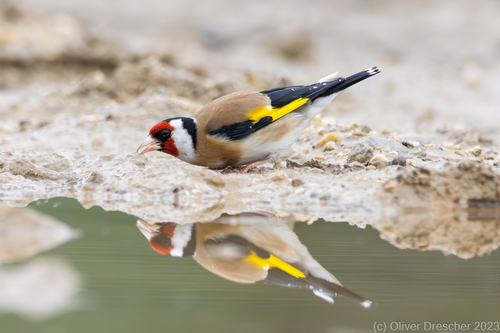
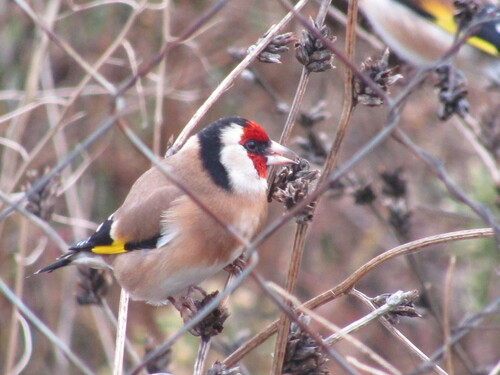
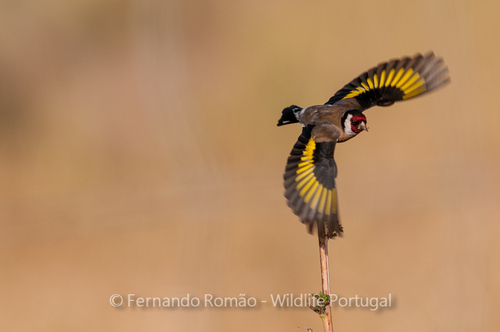
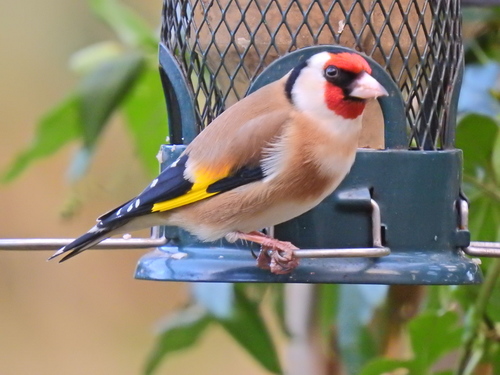
Carduelis carduelis (Linnaeus, 1758)

Source: Wikipedia
Synonyms 1
- 6,433,284 GBIF occurrences
- 126,490 iNaturalist observations
The European breeding population is estimated at 28,000,000–44,400,000 pairs, which equates to 56,100,000–-88,700,000 mature individuals. The breeding population in the EU28 is estimated at 24,000,000–34,700,000 pairs, which equates to 48,000,000–69,400,000 mature individuals. For details of national estimates, see the Supplementary Information.
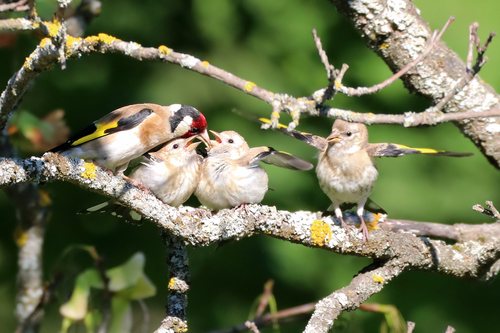
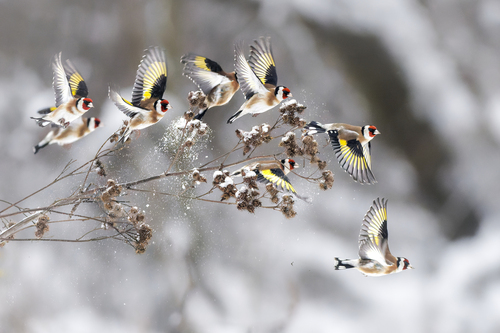
This species inhabits open or sparse deciduous woodland and mixed deciduous and conifer woods, forest edges, thickets, heaths, hedgerows, streams, riverine and marshy areas with bushes and trees, roadside verges, steppe grasslands with scattered trees to edges of semi-desert areas, scrub, orchards, edges of cultivation and parks and gardens.Breeding occurs from April to early August. The nest is a compact small cup of grasses, moss, plant fibres and down, cobwebs, animal hair and feathers, a few aromatic flowers on the outside, placed up to 10 m from the ground, concealed beneath foliage. Clutches are four to six eggs.It feeds mostly on seeds (ripe and unripe), buds, flowers and the fruits of plants but also takes arthropods (Clement 2016).The species is partially migratory, wintering almost entirely within its breeding range and some Mediterranean populations may be sedentary (Snow and Perrins 1998).Although the generation length for both EU and Europe regional assessments were calculated using the same methodology, new information arriving after the EU assessments were undertaken gave rise to an update in the generation lengths. This new information was then used for the Europe level assessments giving rise to a difference between the generation lengths used for the EU and Europe regions.
The species is caught over most of its range and is popular as a cage bird (Hagemeijer and Blair 1997).
Conservation Actions UnderwayBern Convention Appendix II. The decline of commercial bird catching may have been responsible for population increases in Britain, Ireland and Belgium since 1950 (Hagemeijer and Blair 1997). Conservation Actions ProposedNo conservation measures are currently needed for this species.
European regional assessment: Least Concern (LC)EU28 regional assessment: Least Concern (LC)In Europe, this species has an extremely large range (its extent of occurrence (EOO) is much larger than 20,000 km² and its area of occupancy (AOO) is much larger than 2,000 km²), and hence it does not approach the thresholds for Vulnerable under the range size criteria (criteria B and D2). The population size is extremely large (much larger than 10,000 mature individuals), and hence it does not approach the thresholds for Vulnerable under the population size criteria (criteria C and D). The population trend appears to be increasing, and hence does not approach the thresholds for Vulnerable under the population size reduction criterion (criterion A). The probability of extinction has not been calculated for this species, therefore criterion E cannot be applied. For these reasons the species is evaluated as Least Concern in Europe.Within the EU28, this species has an extremely large range (its extent of occurrence (EOO) is much larger than 20,000 km² and its area of occupancy (AOO) is much larger than 2,000 km²), and hence it does not approach the thresholds for Vulnerable under the range size criteria (criteria B and D2). The population size is extremely large (much larger than 10,000 mature individuals), and hence it does not approach the thresholds for Vulnerable under the population size criteria (criteria C and D). The population trend appears to be stable, and hence does not approach the thresholds for Vulnerable under the population size reduction criterion (criterion A). The probability of extinction has not been calculated for this species, therefore criterion E cannot be applied. For these reasons the species is evaluated as Least Concern in the EU28.
Gallery