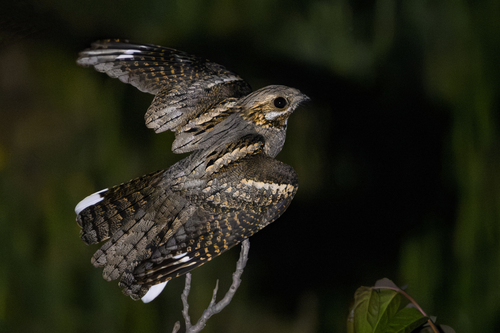
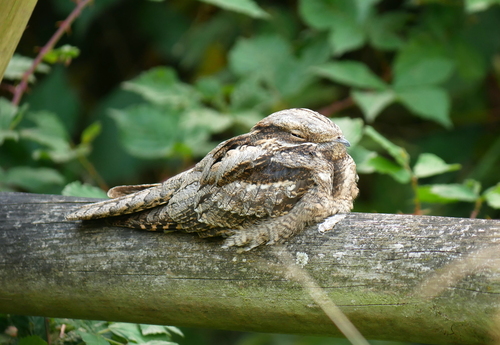
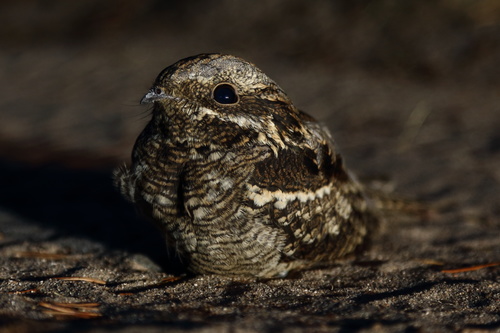
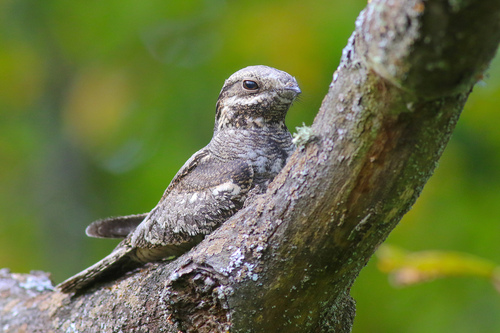
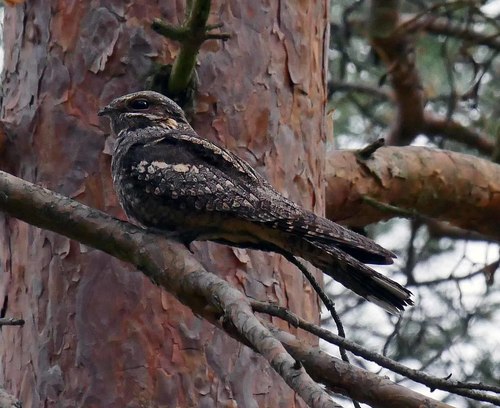
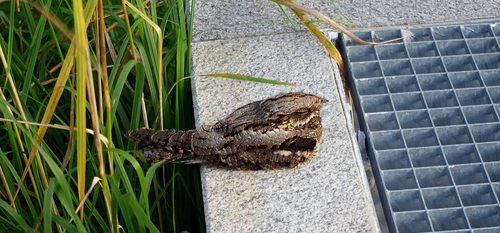
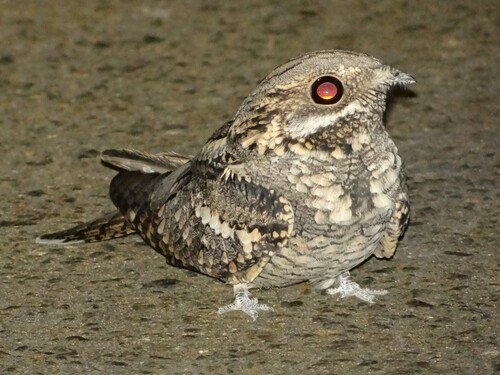
Caprimulgus europaeus Linnaeus, 1758
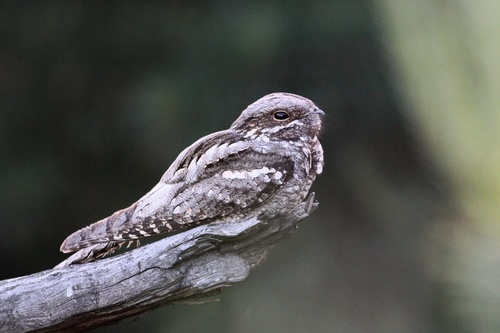
Source: Wikipedia
Synonyms 2
- 299,249 GBIF occurrences
- 5,923 iNaturalist observations
In Europe, the total population size is estimated at 1,190,000-2,220,000 mature individuals (BirdLife International 2021). Europe comprises c. 40% of the species' global range, so a very preliminary estimate of the global population size is 3,000,000-5,500,000 mature individuals, although further validation of this estimate is needed.
The species nests on bare or sparsely vegetated ground, often on free-draining soils (Cramp 1985). It uses mainly dry, open country including lowland heaths with scattered trees and bushes, commons and moorland, forest and woodland (especially glades, clearings and edges), recently felled woodland and young forestry plantations. It also uses chalk downland, industrial waste tips, wooded or scrub-covered steppe, sparsely forested or stony hillsides, oak scrubland, dense coppices, shingle, sand dunes, semi-deserts and deserts. It breeds between late May and August. It usually lays one to two eggs. Eggs are laid directly on the ground on leaf litter, pine needles or bare soil. It feeds on flying insects. It hunts over open country in clearings, along woodland edges and borders, in woodland glades and rides, in gardens and orchards, over wetlands, in meadows and farmland, around grazing animals, and over stagnant ponds. The species is highly migratory wintering mainly in south and east Africa, although small numbers may winter in West Africa (Cleere and Christie 2013).
The main threats to this species are the reduction of insect availability due to pesticide use (Tucker and Heath 1994, Cleere and Christie 2013) and habitat loss or degradation, generally caused through the grazing of heathlands and pastoral woodlands and conversion of such habitats to agricultural land, vineyards, commercial forestry and urban areas. Disturbance from recreational use of heathlands and road deaths are additional threats (Tucker and Heath 1994). The species has numerous predators, especially of eggs and chicks, including: crows (Corvus), Magpies (Pica pica), Jays (Garrulus glandarius), owls (Strigidae), Sooty Falcon (Falco concolor), hedgehogs (Erinaceus europaeus), weasels (Mustela nivalis) and domestic dogs (Cleere and Christie 2013). Nitrogenous pollutants in rain may lead to eutrophication of dry-land breeding areas and unsuitable vegetation structure. Climate change may affect the species' geographic range in the future (Tucker and Heath 1994).
Conservation Actions UnderwayEU Birds Directive Annex I. Bern Convention Appendix II. The following information refers to the species's European range only: In some areas, such as Britain, creation of habitat through commercial forestry has seen an increase in numbers in recent years, though habitats are not permanent and stability of higher population levels is not guaranteed (Cleere and Christie 2013). It is a U.K. Biodiversity Action Plan species. Conservation actions targeted at the nightjar will also likely help the woodlark (Lullula arborea) (Langston et al. 2007).Conservation Actions ProposedThe following information refers to the species' European range only: The maintenance and enhancement of existing forest and heathland habitats is essential. Further work should be undertaken to restore heathlands, including those in planted forests to prevent fragmentation and increase spatial connectivity. Agri-environment schemes to help provide foraging habitat should be developed. Visitor numbers to important heathland areas should be minimised to reduce disturbance and the development of urban areas nearby prevented. Research should focus on the role of foraging habitat on population processes (Langston et al. 2007).
This species has an extremely large range, and hence does not approach the thresholds for Vulnerable under the range size criterion (extent of occurrence under 20,000 km² combined with a declining or fluctuating range size, habitat extent/quality, or population size and a small number of locations or severe fragmentation). The population size is extremely large, and hence does not approach the thresholds for Vulnerable under the population size criterion (under 10,000 mature individuals with a continuing decline estimated to be over 10% in ten years or three generations, or with a specified population structure). The population trend is not known, but the population is not believed to be decreasing sufficiently rapidly to approach the thresholds under the population trend criterion (over 30% decline over ten years or three generations). For these reasons the species is evaluated as Least Concern.
Gallery