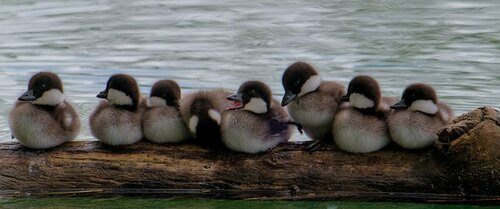
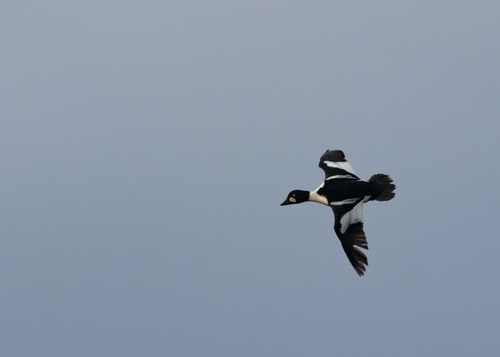
Bucephala clangula (Linnaeus, 1758)
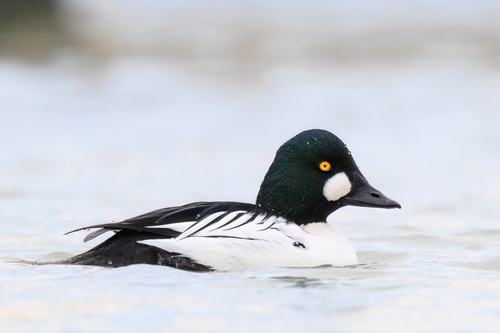
Source: Wikipedia
Synonyms 2
- 5,982,300 GBIF occurrences
- 102,137 iNaturalist observations
The European breeding population is estimated at 385,000-495,000 pairs, which equates to 770,000-990,000 mature individuals. The breeding population in the EU28 is estimated at 187,000-241,000 pairs, which equates to 374,000-481,000 mature individuals. For details of national estimates, see the Supplementary Information.
The species is restricted to water close to the shore and less than 10 m deep (Scott and Rose 1996). When breeding the species shows a preference for oligotrophic lakes devoid of fish (Kear 2005) but with abundant invertebrate life (Johnsgard 1978), and requires tree-holes (or artificial nestboxes) for nesting. Suitable habitats include freshwater lakes, pools, rivers (Carboneras et al. 2014) and deep marshes (Johnsgard 1978) surrounded by coniferous forest (Carboneras et al. 2014). The species winters mainly at sea (Scott and Rose 1996) on inshore waters, estuaries, coastal lagoons (Carboneras et al. 2014) and shallow bays (Kear 2005), especially in the vicinity of sewage outfalls (Carboneras et al. 2014). Further to the south and on migration the species may also frequent large rivers, lakes and reservoirs (Scott and Rose 1996). The species breeds from April in solitary pairs. The species nests in hollows of mature trees (Carboneras et al. 2014) formed by woodpeckers or by bacterial or fungal heart-rot invasions (Kear 2005). The species will also nest in artificial nest boxes. Clutches are usually between eight and eleven. It feeds predominantly on aquatic invertebrates such as molluscs, worms, crustaceans, aquatic insects and insect larvae, as well as amphibians, small fish and some plant material (mainly in the autumn) such as seeds, roots and the vegetative parts of aquatic plants (Carboneras et al. 2014). Most of this species is fully migratory although it may only travel short distances (Kear 2005), but certain populations in the north-west of Europe may also be sedentary (Carboneras et al. 2014).Although the generation length for both EU and Europe regional assessments were calculated using the same methodology, new information arriving after the EU assessments were undertaken gave rise to an update in the generation lengths. This new information was then used for the Europe level assessments giving rise to a difference between the generation lengths used for the EU and Europe regions.
The species is very sensitive to habitat alterations. In the winter, the main threats for this species are from major oil incidents near the coast or from eating contaminated food (organochlorines and polychlorinated biphenyls are elevated in some important wintering areas), as large flocks will often gather to feed around sewer outfalls. The species is hunted sustainably in Denmark (Bregnballe et al. 2006); however the impact of hunting of this species across its range is unknown, although an estimated 100,000–250,000 were once shot annually in north-west and central Europe. Lead shot ingestion however, does not appear to be a significant risk, at least compared to some other species of seaducks (Carboneras et al. 2014). Modern forestry management work is limiting as it does not favour the retention of old and decaying trees with likely nest holes (Hagemeijer and Blair 1997).
Conservation Actions UnderwayCMS Appendix II. EU Birds Directive Annex II. In some areas nestbox erection programmes have been shown to cause significant range expansions and population increases (Dennis 1987, Carboneras et al. 2014), although an experiment in southern Finland found that even though nestbox provision increased breeding numbers of the species there was a negative density-dependent effect on reproductive output (i.e. the number of fledged young did not increase despite an increase in breeding pairs) (Poysa and Poysa 2002). Conservation Actions ProposedIn general nesting habitats may benefit from a more extended rotation of timber harvesting (Kear 2005) and the species may benefit from the introduction of strict legislation on oil transportation. Monitoring and research should be introduced to determine the impact of hunting on this species.
European regional assessment: Least Concern (LC)EU28 regional assessment: Least Concern (LC)At both European and EU28 scales, this species has an extremely large range (its extent of occurrence (EOO) is much larger than 20,000 km² and its area of occupancy (AOO) is much larger than 2,000 km²), and hence it does not approach the thresholds for Vulnerable under the range size criteria (criteria B and D2). The population size is very large, (much larger than 10,000 mature individuals), and hence it does not approach the thresholds for Vulnerable under the population size criteria (criteria C and D). Despite the fact that the population trend appears to be decreasing, the decline is not believed to be sufficiently rapid to approach the thresholds for Vulnerable under the population size reduction criterion (criterion A). The probability of extinction has not been calculated for this species, therefore criterion E cannot be applied. For these reasons the species is evaluated as Least Concern within both Europe and the EU28.
Gallery