Athyrium filix-femina (L.) Roth
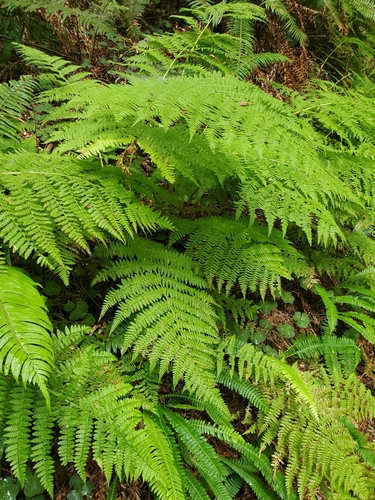
Source: Wikipedia
Synonyms 49
- 703,589 GBIF occurrences
- 62,545 iNaturalist observations
When in suitable habitats, this species can be very abundant, occurring in large numbers. The more humid summers in western Europe have resulted in local increase in numbers (M. Christenhusz pers. comm. 2015), although it is rare on the Canary Islands (Sanchez Velazquez 2002). The population trend is increasing.
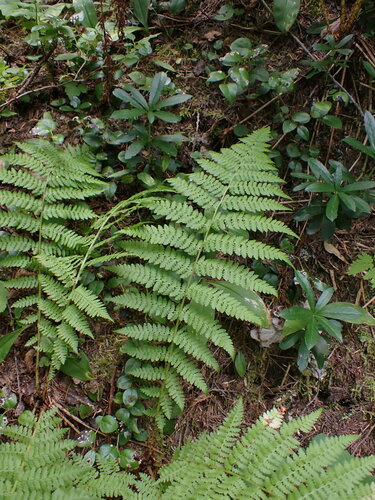
This species is frequently found on understory vegetation of deciduous and lighter patches in coniferous forest and in broadleaved woodland, hedgerows, rocky gorges, marshlands and swamps, usually on damp or wet soil, often along stream courses and in moist rocky habitats in the mountains. It can also be found in less natural sites, such as in the shade of walls, gardens, alleyways, drainage ditches and shady wet roadsides (Page 1997). It is usually found on soils that have good drainage but are permanently moist. Its altitudinal range is 0 - 2,300 m Asl. It is a vigorous species that can easily colonize disturbed habitats by spores on many types of wet soil and is tolerant to mild disturbance and pollution, even high concentrations of heavy metal contaminants. In heavily polluted areas, its rapid growth and density of vegetation cover may be of particular ecological importance (Page 1997).
There are no threats to this species.
No conservation measures are currently in place and none are needed as the species is common and gregarious throughout its range. It occurs in protected areas throughout its range. It is listed as Least Concern in Switzerland (Moser et al. 2002) and Germany (Ludwig and Schnittler 1996).
European regional assessment: Least Concern (LC)EU 28 regional assessment: Least Concern (LC)This fern is a widespread and common species in many places and has an increasing population trend. It is frequently present in protected areas and resilient to disturbance and pollution. In addition, it is a good coloniser and there are no major threats to the species. It is therefore listed as Least Concern.
Gallery