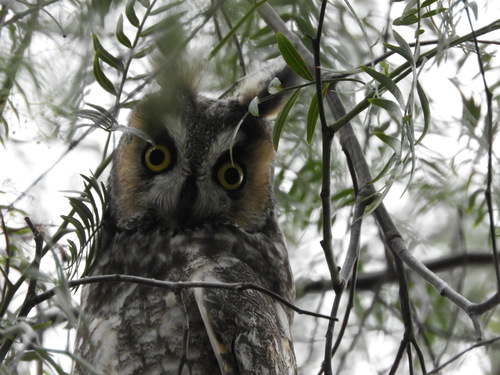
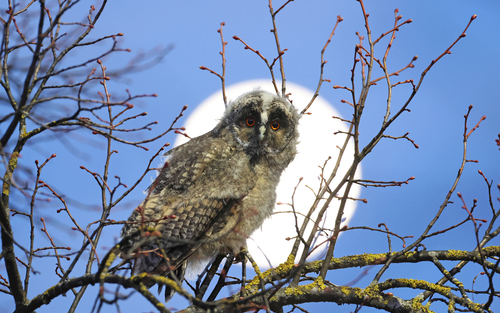
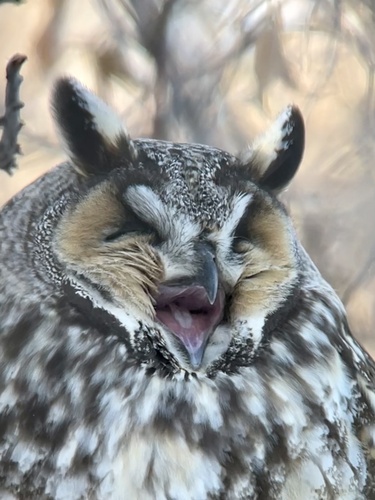
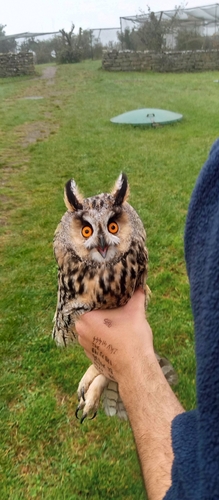
Asio otus (Linnaeus, 1758)
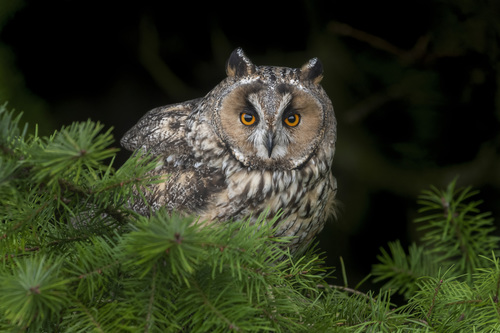
Source: Wikipedia
Synonyms 3
- 463,633 GBIF occurrences
- 23,531 iNaturalist observations
The population size has not been accurately quantified for the region, but based on the figures in BirdLife International (2021) the population size is likely to significantly exceed the thresholds for consideration as threatened. The population trend is unknown.
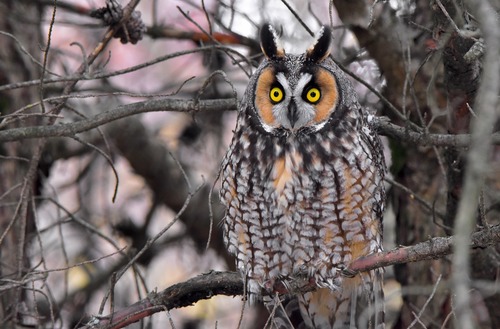
This species breeds in dense vegetation adjacent to open areas such as grassland or shrubland, including open forest, nesting and roosting in forest. In mainland Europe, breeding occurs in edge woodland and scrub. Outside the breeding season it is found in similar habitats, including farmland with hedgerows. The breeding season is from February to July (Olsen 1999). It uses the abandoned stick nests of other species, such as crows (Corvus), magpies (Pica), raptors, herons (Ardea) (König and Weick 2008). It also accepts artificial baskets, and sometimes lays in cavities in trees or cliffs, or on the ground. Clutches are generally five to seven eggs. It feeds principally on small mammals, although some studies have found birds to be important (Olsen 1999). The species is mainly migratory in Fennoscandia and Russia but further south in Europe it is more sedentary (Hagemeijer and Blair 1997).
Agricultural intensification and declining vole populations are also driving declines in Europe (Hagemeijer and Blair 1997). Locally, threats include pesticide use, persecution and road traffic collisions (König and Weick 2008). There is evidence of illegal trade of all owl species in North Africa (Brochet et al. 2016, O. Haitham pers. obs.) and there is a risk that individuals may be taken from nest sites for trade (Symes et al. 2015) or because people accidentally think that chicks have been abandoned (Karim Rousselon 2019, unpublished data). The growth and spread of the human population is causing habitat destruction and disturbance in forests because of the use of wood as fuel for cooking and heating, and for the expansion of agricultural fields for crops and livestock (Bergier 1987, Cherkaoui et al. 2009, Tellería et al. 2019). Destruction and disturbance due to intense human use of forests especially threatens tree-nesting raptors like the Northern Long-eared Owl and leads to the abandonment of the breeding territories. In Tunisia fire may be a threat in the forests, but no loss of habitat has been observed (N. Hamdi pers. obs.), and it may be be affected by competition with Pharaoh Eagle-Owl (N. Hamdi pers. obs.).
Conservation Actions UnderwayCITES Appendix II. Bern Convention Appendix II.Conservation Actions ProposedIt is suggested that road collisions could be decreased by reducing the availability of small rodents in close proximity to roads, through allowing vegetation to grow naturally or by planting short bushes (Baudvin 1997). Management to prevent vole declines should involve the creation of a mosaic of different habitat types with grassland mown at different times of the year together with undisturbed strips (Aschwanden et al. 2005). Breeding can be encouraged through the provision of artificial nesting platforms and open fronted nestboxes (Olsen 1999). In addition in harsh winters, food supplies can be augmented through the provision of feeding stations near day roosts (König and Weick 2008). The use of pesticides and rodenticides should be also controlled. Monitoring of population size, trend and threats would be useful, including studies into the incidence of possible harvesting in population dynamics.
Mediterranean regional assessment: Least Concern (LC)This species has an extremely large range (its extent of occurrence (EOO) is much larger than 20,000 km² and its area of occupancy (AOO) is much larger than 2,000 km²), and hence it does not approach the thresholds for Vulnerable under the range size criteria (criteria B and D2). The population size is very large, (much larger than 10,000 mature individuals), and hence it does not approach the thresholds for Vulnerable under the population size criteria (criteria C and D). The population size trend is not known, but it is not believed to approach the thresholds for Vulnerable under the population size reduction criterion (criterion A). The probability of extinction has not been calculated for this species, therefore criterion E cannot be applied. For these reasons the species is evaluated as Least Concern.
Gallery