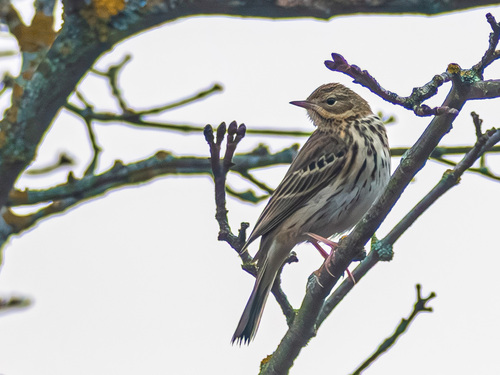
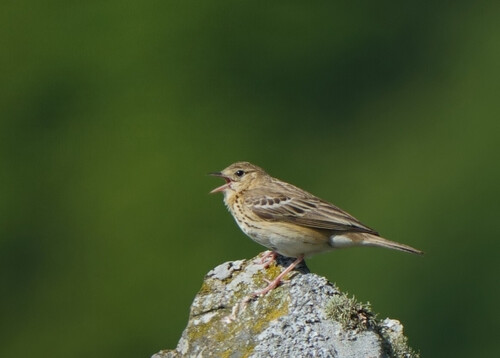
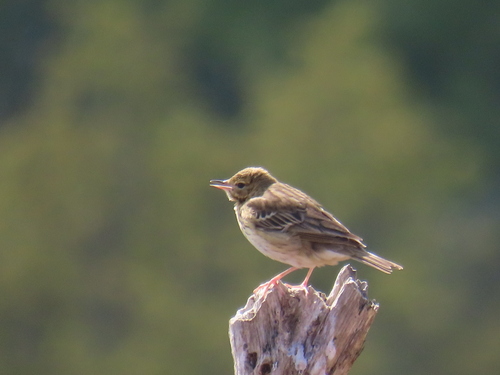
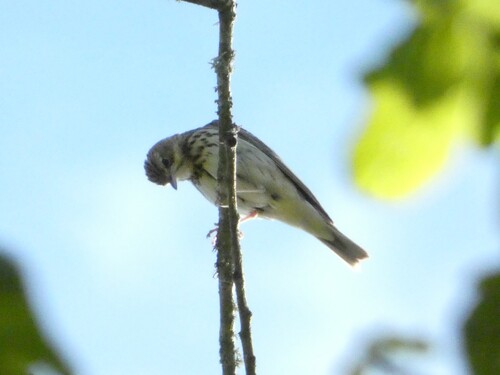
Anthus trivialis (Linnaeus, 1758)
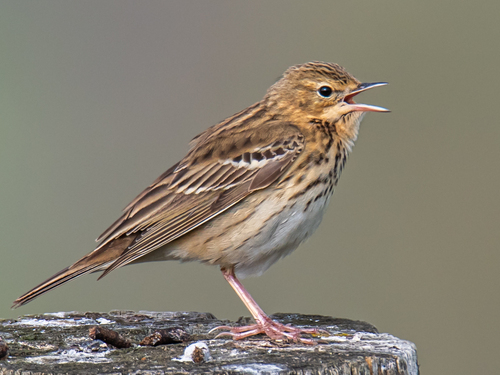
Source: Wikipedia
Synonyms 1
- 1,615,550 GBIF occurrences
- 34,791 iNaturalist observations
The European breeding population is estimated at 19,400,000–35,100,000 pairs, which equates to 38,900,000–70,100,000 mature individuals. The breeding population in the EU28 is estimated at 6,950,000–11,600,000 pairs, which equates to 13,900,000–23,100,000 mature individuals. For details of national estimates, see the Supplementary Information.
This species breeds in woodland edges, open woodland, cleared woodland and young conifer plantations, often with isolated remaining tall trees. It also uses heathland or grassland with developing scrub and trees.The breeding season occurs from April to August in north-west Europe. The species is mainly monogamous, however polygamy does occasionally occur. The nest is built in a depression in the ground and is a substantial cup of dry grass, often with moss foundation, lined with finer grasses. Normally four to six eggs are laid. The diet includes a variety of invertebrates but is mostly insects. Some plant material is also taken during the winter.The species is a long-distance migrant (Tyler 2004).Although the generation length for both EU and Europe regional assessments were calculated using the same methodology, new information arriving after the EU assessments were undertaken gave rise to an update in the generation lengths. This new information was then used for the Europe level assessments giving rise to a difference between the generation lengths used for the EU and Europe regions.
Local declines have been attributed to the changing nature of its habitats, such as in northern and central Europe where aging plantations become increasingly unsuitable for the species, but it will quickly recolonize when mature stands are felled (Hagemeijer and Blair 1997).
Conservation Actions UnderwayBern Convention Appendix II. There are currently no known conservation measures for this species.Conservation Actions ProposedNo conservation measures are currently needed for this species.
European regional assessment: Least Concern (LC)EU28 regional assessment: Least Concern (LC)In Europe, this species has an extremely large range (its extent of occurrence (EOO) is much larger than 20,000 km² and its area of occupancy (AOO) is much larger than 2,000 km²), and hence it does not approach the thresholds for Vulnerable under the range size criteria (criteria B and D2). The population size is extremely large, (much larger than 10,000 mature individuals), and hence it does not approach the thresholds for Vulnerable under the population size criteria (criteria C and D). Despite the fact that the population trend appears to be decreasing, the decline is not believed to be sufficiently rapid to approach the thresholds for Vulnerable under the population size reduction criterion (criterion A). The probability of extinction has not been calculated for this species, therefore criterion E cannot be applied. For these reasons the species is evaluated as Least Concern in Europe.In the EU28, this species has an extremely large range (its extent of occurrence (EOO) is much larger than 20,000 km² and its area of occupancy (AOO) is much larger than 2,000 km²), and hence it does not approach the thresholds for Vulnerable under the range size criteria (criteria B and D2). The population size is extremely large, (much larger than 10,000 mature individuals), and hence it does not approach the thresholds for Vulnerable under the population size criteria (criteria C and D). The population trend appears to be stable, and hence the species does not approach the thresholds for Vulnerable under the population size reduction criterion (criterion A). The probability of extinction has not been calculated for this species, therefore criterion E cannot be applied. For these reasons the species is evaluated as Least Concern within the EU28.
Gallery